.png)


Shipper’s Letter of Instruction (SLI): What to Include, Common Errors, and a Pre-Send Checklist

Optimize your business: use unlimited savings with Pazago fulfilled now!
Get Started ->SLI is still treated as a “no-guesswork” document in 2026 workflows: it’s the exporter’s written instructions that tell the freight forwarder exactly how to handle the shipment and the documentation, so execution doesn’t stall over basics like billing, document routing, or handling directions.
If you’re exporting from India, this matters because one unclear instruction can force a pause at the worst time (close to cut-off or sailing). This guide breaks down what to include in a shipper’s letter of instruction, where exporters typically slip up, and how to use it to keep the forwarder aligned when plans change.
Key Takeaways
- SLI = your written instructions to the forwarder for shipment handling and documentation.
- It reduces last-minute clarifications that trigger amendments near the cut-off.
- Templates vary, but core inputs don’t: parties, routing, cargo, handling notes, and document instructions.
- Pull details from the invoice/packing list/buyer master, and resend a dated version if anything changes.
- Choose partners who manage milestones and exceptions well—not just “tracking.”
What Is A Shipper’s Letter Of Instruction (SLI)?

A shipper’s letter of instruction (SLI) is the exporter’s written set of shipping and documentation instructions sent to the freight forwarder/logistics partner for a specific export shipment. It tells the forwarder what to follow while planning movement, coordinating handoffs, and preparing the shipment’s transport-document inputs.
Treat it as the instruction reference your forwarder can rely on when they set up the file and act on your directions across teams. Even if the format varies by provider, the role stays the same: it captures your shipment-specific directions in one place so execution and documentation stay aligned.
The SLI is exchanged between the exporter and the freight forwarder/logistics partner, and the layout may differ across providers, but the role stays consistent: it is the instruction base the forwarder uses to execute and document the shipment correctly.
When Do You Need An SLI, And Why Do Templates Differ Across Providers?
You will usually be asked for a shipper's letter of instruction (SLI) when you are shipping through a freight forwarder for air or ocean movement, and they need your instructions in one place, in writing.
It also becomes important when your buyer has specific expectations that can’t be “assumed” (who should receive documents, consignee/notify details, marking/label notes, or handling directions).
If your shipment is running on tight cut-offs, an SLI helps keep changes controlled instead of getting lost across calls and WhatsApp threads. And when multiple stakeholders are involved: transporter, CHA, CFS/ICD teams, having one written instruction set reduces the chance that different parties act on different versions of what you meant.
When It’s Optional But Still Smart
Even when the forwarder doesn’t insist on an SLI form, it is worth using one when your risk of rework is high.
That includes:
- It’s your first export or your first time shipping on a new lane.
- New buyer or consignee setups where you can’t afford mis-keyed details.
- Shipments where amendments are common because schedules move and cut-offs are tight.
It also helps when your team won’t be available to answer follow-ups in real time, because the forwarder can proceed using the instruction set you have already signed off.
Templates Vary, But The Non-Negotiables Don’t
In practice, the SLI template depends on the forwarder workflow; some use their own PDF, some use an online portal, and some use a structured email format. The layout can differ, but the information requirements don’t. Every SLI still needs the same core categories: parties, routing/mode basics, cargo summary, handling notes, documentation-linked instructions, and authorization/sign-off. If anything changes, the safest rule is simple: resend the updated SLI so everyone is working from the same version.
Now let’s get specific: which SLI details actually protect your shipment timeline, and which ones cause last-minute amendments when they’re wrong.
The SLI Details That Protect Your Shipment Timeline

A clean SLI is less about “filling a form” and more about locking the few details that most often trigger rework, document amendments, and last-minute delays.
Party Details That Trigger Rework
If party details are wrong or incomplete, the file usually stalls early, and the fix often turns into document rework later.
What needs to be cleaned:
- Exporter/shipper name + address (must match invoice/packing list)
- Consignee + notify party details (no spelling/format mismatches)
- Contact person + phone/email (so clarifications don’t sit idle)
Why it matters commercially:
Wrong party details often lead to SI/BL/AWB correction loops, which cost time and can spill into cut-off windows.
Routing + Freight Payment Instructions That Create Disputes
Routing confusion causes avoidable back-and-forth because the forwarder can’t plan movement confidently if the “from-to” is unclear.
What typically creates friction:
- Origin pickup location vs port of loading is not clearly tied together
- Destination port/airport not clearly stated
- Freight payment instructions unclear in plain language (who pays what)
Why it matters commercially:
Ambiguity here shows up as billing disputes, release friction, and handoff confusion, usually when timelines are already tight.
Cargo + Packing Details That Create Holds Or Clarifications
Cargo details don’t need to be long. They need to be consistent.
What must stay aligned:
- Commodity description (invoice-consistent wording)
- Packages/weight/volume (no mismatches across docs)
- Handling notes only when they change execution (fragile/non-stackable/temp control/DG)
Why it matters commercially:
Inconsistent cargo data triggers holds and clarifications, and poor handling notes can create damage disputes that delay closure.
Documentation-Linked Instructions That Affect SI/BL/AWB Accuracy
Some SLI inputs flow straight into shipping instructions and transport documents, so “small” errors become expensive amendments.
What exporters should double-check:
- Names + addresses exactly as they should appear on docs
- Cargo description consistency across SLI, invoice, and packing list
- Document copy routing instructions (who needs what, when)
Why it matters commercially:
Errors here often lead to amendments that cost money and time, and can trigger buyer escalation if documents don’t arrive when expected.
With the right inputs in hand, here’s the cleanest exporter workflow to fill and verify an SLI so it doesn’t bounce back with questions.
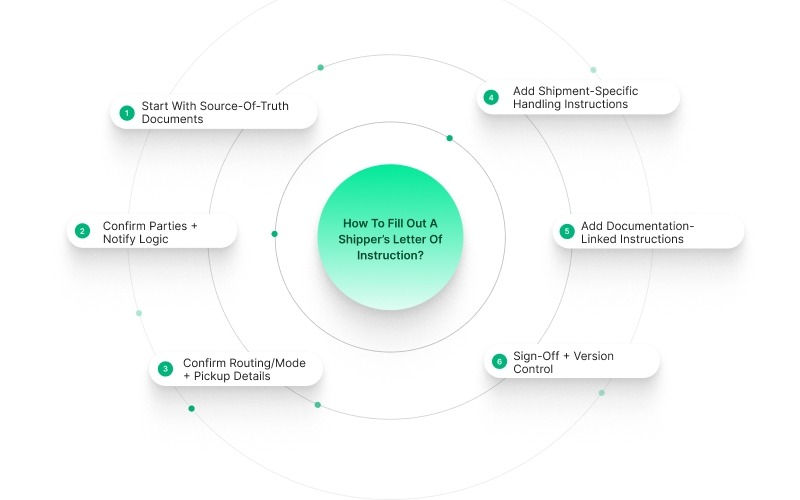
How To Fill Out A Shipper’s Letter Of Instruction: Exporter Workflow
Most exporters don’t lose time because they “don’t know the SLI.” Time gets lost because the SLI is filled from scattered inputs, shared too late, or sent without a clean reference set.
This workflow keeps it simple: start from approved documents, lock the routing and parties early, add only execution-critical notes, and send a versioned instruction set your forwarder can act on without chasing you.
1. Start With Source-Of-Truth Documents
Begin with what is already approved internally. Pull party names/addresses and cargo descriptions from the commercial invoice, packing list, and buyer/consignee master, not from memory, WhatsApp messages, or an old shipment file.
This keeps the SLI aligned with what will be declared and documented.
2. Confirm Parties + Notify Logic
Lock the consignee and notify party details exactly as required by the buyer. Add the right contact name, phone, and email so the forwarder can clarify quickly if anything looks off.
If there are multiple stakeholders on the buyer side, confirm who should be notified for document and arrival updates.
3. Confirm Routing/Mode + Pickup Details
Confirm the basics the forwarder will plan around: mode (air/ocean), origin pickup location, port/airport of loading, and destination port/airport.
If your cargo is moving via a CFS/ICD step, align that routing expectation early so the movement plan is built correctly from day one.
4. Add Shipment-Specific Handling Instructions
Only add handling notes that change execution. If a note does not affect how the cargo is moved, stacked, stored, or treated, it usually creates noise instead of control. Keep it tight and shipment-specific.
5. Add Documentation-Linked Instructions
State any document copy routing instructions clearly, who needs scans, who needs originals, and where they should go.
If the buyer has specific documentation preferences (or an LC-driven requirement), include only what the forwarder needs to execute without follow-ups.
6. Sign-Off + Version Control
Send the SLI only after internal sign-off, and treat it as versioned instructions. If any detail changes party info, routing, cargo numbers, or document routing, resend an updated SLI with a clear date/version so everyone is working from the same reference.
Verify before sending: take 60 seconds to cross-check the SLI against the invoice and packing list to confirm names, addresses, and cargo summary are consistent.
Common SLI Errors That Cause Delays Or Amendments
Most SLI problems are not “complex export issues.” They are simple input errors that snowball into document amendments, avoidable follow-ups, and timeline slips, usually when cut-offs are already close.
If you fix just these items, you reduce the reasons an SLI comes back with questions and lower the chance of amendments that cost time near sailing.
Once your SLI is clean, the next deciding factor is whether your logistics partner can actually run the shipment to that plan, keeping milestones on track and flagging exceptions early enough to protect your buyer commitments.
Run Export Shipments With Fewer Instruction Gaps And Better Milestone Control
A clean shipper's letter of instruction only works if someone runs the milestones to that plan.
Pazago supports exporters by coordinating the execution handoffs that usually create follow-up pickup readiness, stuffing windows, gate-in planning, and cut-off alignment so the instruction set stays actionable when timelines are tight.
Origin movement slips are often equipment-and-timing problems, not booking problems.
Pazago helps with booking discipline and loading coordination so container availability, factory reach, and gate-in timelines don’t drift into rollover risk during peak periods.
Buyer updates get harder when visibility is fragmented across vendors.
Pazago shares structured shipment visibility updates (milestone + exception-led), so you can respond to ETA questions with what changed, what it impacts, and what’s next before the buyer escalates.
Post-sailing follow-ups still matter for closure and buyer communication.
Pazago remains a point of contact for shipment status and document-linked follow-ups, reducing the “waiting on updates” loops that slow down closure.
If you want export logistics support built around milestone control and predictable visibility, talk to Pazago and align your next shipment plan to your cut-offs, exceptions, and buyer delivery commitments.
Conclusion
A shipper’s letter of instruction is your instruction backbone for export execution, because it puts shipment and documentation directions in one clear reference that your forwarder can act on.
Its biggest value shows up close to cut-offs: fewer last-minute clarifications, fewer corrections, and fewer avoidable amendments when timelines are already tight.
To get that benefit consistently, focus on the high-risk inputs that trigger rework (parties, routing, cargo, payment, and document routing), follow a clean fill workflow using source-of-truth documents, run the quick pre-send checklist every time, and maintain simple version discipline whenever anything changes.
FAQs
1) Is SLI mandatory for exports from India, or does it depend on the forwarder?
In most day-to-day export workflows, it depends on the forwarder’s process and the shipment risk, not on a single India-wide “mandatory” rule. Many forwarders request an SLI (or capture the same inputs through a portal/email template) because it gives them a written, auditable instruction set.
Even when they don’t insist on a formal SLI, sending one is still a practical control move when you are close to cut-off, working a new buyer/lane, or expecting changes.
2) What’s the difference between Shipping Instructions (SI) and an SLI?
An SLI is the instruction set you send to your freight forwarder to tell them how to handle the shipment and what details to follow for documentation.
Shipping Instructions (SI) are the document-issuance instructions used to create or validate transport documents such as the Bill of Lading (BL) or Air Waybill (AWB). In many workflows, your SLI becomes the forwarder’s base input for SI, but they are not interchangeable: SLI = exporter → forwarder instructions, SI = document-ready data set that must match what gets issued/filed.
3) Can your freight forwarder fill the SLI for you, and what must you verify anyway?
Yes. Many forwarders will draft the SLI (or capture the same inputs in their own template/portal) based on your invoice, packing list, and buyer details. Your job is still to sign off on the items that most often cause amendments later:
- Consignee + notify details (exact names, addresses, contacts)
- Cargo description + pack/weight/volume (must match invoice and packing list)
- Freight payment instruction (written clearly, no assumptions)
- Handling notes (only the ones that change execution)
Treat this as commercial risk control, not admin, because corrections usually surface when the cut-off pressure is already high.
4) What changes in an SLI for air freight vs ocean freight?
The purpose stays the same: your written instructions. What changes is where the risk concentrates.
- Air freight: AWB accuracy matters more, cut-offs are tighter, and handling sensitivity can become time-critical.
- Ocean freight: BL-linked details, gate-in and stuffing coordination, and sailing-related milestones tend to create bigger downstream rework if inputs are off.
In both cases, keep party and cargo details invoice-consistent, and treat routing, payment, and document routing as no-guesswork inputs.
5) If details change after sending the SLI, what’s the safest way to update it before cut-off?
Do not rely on informal updates. Resend an updated SLI in writing with a clear version/date and a short “what changed” note, then confirm receipt with the forwarder contact (and backup). If time is tight, ask them to acknowledge which version they will execute, so old and new instructions do not run in parallel.