.png)


Top 12 Advantages of FTAs (Free Trade Agreements): Major Implications for Shipping

Optimize your business: use unlimited savings with Pazago fulfilled now!
Get Started ->Free Trade Agreements play an important role in modern global trade. As supply chains become more connected, FTAs help reduce friction in cross-border commerce while improving cost efficiency and market access.
For exporters and importers, the advantages of FTA extend beyond tariff reductions. These agreements influence the speed of customs clearance, pricing competitiveness, and the ease of moving goods across international borders.
In India, FTAs directly impact export growth and sourcing decisions. Preferential duties, clearer trade rules, and smoother procedures can improve margins and support expansion into new markets. However, these benefits depend on correct implementation. Gaps in documentation, origin rules, or compliance planning can limit the real value of FTAs.
This guide explains the advantages of FTA and how businesses can apply them effectively across day-to-day trade operations.
Key Takeaways at a Glance
- Free Trade Agreements help exporters and importers reduce tariffs, simplify customs processes, and improve cost efficiency across international trade operations.
- The advantages of FTA go beyond duty savings, influencing market access, supply chain reliability, pricing competitiveness, and long-term business growth.
- Indian businesses can use FTAs to diversify export markets, attract foreign investment, and reduce dependence on single-country trade relationships.
- Real value from FTAs depends on accurate documentation, compliance with origin rules, and effective coordination across shipping and logistics workflows.
What is a Free Trade Agreement (FTA) and Its Objectives?

A Free Trade Agreement (FTA) is an official agreement between countries that aims to reduce barriers to trade, including tariffs, import limits, and export restrictions. FTAs make cross-border trade easier, faster, and more cost-effective, helping businesses expand into new markets and strengthen competitiveness.
Key objectives of FTAs include:
- Facilitate Trade: Streamline customs procedures and lower tariffs to enable goods to move smoothly across borders.
- Promote Economic Growth: Increase trade volumes, create employment opportunities, and stimulate domestic industries.
- Enhance Competitiveness: Encourage businesses to improve product quality, operational efficiency, and innovation to compete internationally.
- Diversify Trade Partners: Reduce dependence on a single market and spread business risk across multiple countries.
- Attract Investment: Provide a stable trade environment that encourages both domestic and foreign investment.
- Standardise Regulations: Align product standards, certifications, and documentation across partner countries for easier compliance.
- Support Sustainable Growth: Establish long-term trade relationships that foster economic stability.
- Strengthen International Relations: Build stronger diplomatic and economic ties through collaborative trade agreements.
Also read: Applying for Import and Export licence in India.
With the purpose of FTAs clear, the next step is to look at how these agreements benefit businesses and the wider economy in practical ways.

12 Major Advantages of Free Trade Agreements
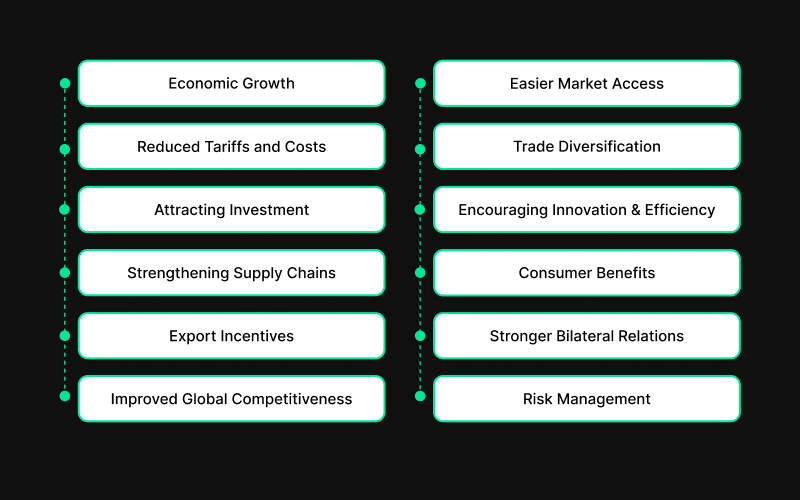
Free Trade Agreements provide significant benefits to businesses and the economy by reducing barriers, opening new markets, and improving operational efficiency. These advantages extend beyond cost savings and include long-term strategic gains that help companies compete globally. The following are twelve key benefits:
1. Economic Growth
Free Trade Agreements enable businesses to expand their exports to new markets. A pharmaceutical company supplying vaccines to multiple countries under preferential tariff rules can increase production and sales. This expansion leads to job creation, industrial growth, and contributes positively to the national economy.
2. Easier Market Access
By reducing tariffs and import restrictions, FTAs allow Indian exporters to enter foreign markets with fewer obstacles. An apparel brand, for example, can sell products across Europe without facing high import duties. This broader access increases the customer base and strengthens the company’s international presence.
This also increases shipment volumes across new routes, requiring better coordination with carriers and customs processes.
3. Reduced Tariffs and Costs
Lower import and export duties make goods more affordable and competitive in partner countries. Spices exported to Southeast Asia, for instance, can reach consumers at reduced costs. This improves profit margins and enables businesses to reinvest in growth initiatives.
This also reduces landed cost variability, helping exporters plan freight and pricing more accurately across trade lanes.
4. Trade Diversification
FTAs allow companies to diversify their trade partners and reduce dependency on a single market. Electronics manufacturers supplying both Middle Eastern and African markets can avoid revenue losses from regional fluctuations. This strategy helps mitigate risks and ensures more stable business performance.
5. Attracting Investment
Stable trade conditions created by FTAs encourage foreign companies to invest in India. Multinational corporations may establish production facilities locally to take advantage of reduced trade barriers. This attracts capital, advanced technology, and generates employment opportunities.
6. Encouraging Innovation and Efficiency
Exposure to international competition encourages businesses to improve their processes. Manufacturers may implement automated quality checks to meet global standards. This fosters innovation, enhances operational efficiency, and strengthens competitiveness in international markets.
7. Strengthening Supply Chains
Simplified trade rules make the movement of goods faster and more reliable. Automotive components, for example, can reach assembly plants without delays caused by customs procedures. This reduces logistics costs, minimises transit time, and lowers the risk of product damage.
Faster customs processes directly reduce port dwell time and improve shipment predictability.
8. Consumer Benefits
FTAs provide consumers with access to a wider range of products at competitive prices. Imported specialty foods, for instance, become available at more affordable rates. This increases customer choice and overall purchasing power.
9. Export Incentives
Many FTAs include trade incentives such as duty drawbacks, tax exemptions, or simplified documentation for certain products. Machinery exporters shipping to partner countries can benefit from these schemes. These incentives boost profitability and encourage higher export volumes.
10. Stronger Bilateral Relations
FTAs promote partnerships and collaborations between countries. Indian and foreign companies may jointly develop technology products, for example, enhancing knowledge sharing. This fosters long-term strategic alliances and strengthens international trade relations.
11. Improved Global Competitiveness
Companies operating under FTAs can compete more effectively in global markets. Textile exporters meeting EU quality standards while maintaining competitive pricing demonstrate the advantage. This increases market share and strengthens international brand recognition.
12. Risk Management
By diversifying trade and operating under predictable regulations, businesses can reduce exposure to economic or political shocks. A chemicals exporter supplying multiple regions, for instance, is less affected if one market faces sudden policy changes or natural disasters. This ensures business continuity and more stable revenue streams.
While FTAs create growth opportunities, they also introduce trade-offs that businesses and governments must manage carefully.
Core Disadvantages of Free Trade Agreements
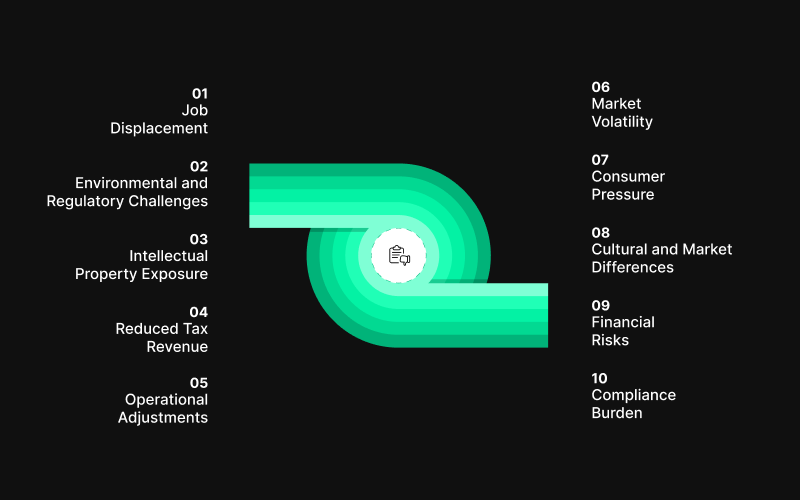
While FTAs offer significant opportunities, they also come with drawbacks that businesses need to consider. These disadvantages can affect operations, financial outcomes, market positioning, and regulatory compliance, making careful planning essential.
Here are the main disadvantages, along with real-world scenarios to illustrate each:
- Job Displacement: Industries exposed to international competition may need to reduce staff, such as a local textile factory scaling down when cheaper imports arrive.
- Environmental and Regulatory Challenges: Companies often adjust processes to meet different standards abroad, such as modifying the packing list to comply with overseas environmental regulations.
- Intellectual Property Exposure: Products can be copied in markets with weaker protections, requiring extra measures to safeguard designs or formulations.
- Reduced Tax Revenue: Eliminating import duties can reduce government revenue, potentially affecting funding for local infrastructure or business incentives.
- Operational Adjustments: Supply chains may need redesigning, such as rerouting shipments to comply with preferential trade requirements.
- Market Volatility: Sudden changes in partner countries’ policies can disrupt trade, like temporary restrictions on agricultural or electronic goods.
- Consumer Pressure: While lower prices attract buyers, domestic manufacturers may struggle to compete, reducing variety in local markets.
- Cultural and Market Differences: Products often require adaptation to meet local preferences, such as adjusting flavours or ingredients in food exports.
- Financial Risks: Fluctuating currency values can erode margins when trading with multiple partner countries.
- Compliance Burden: Managing certificates of origin and documentation for tariff benefits increases administrative workload.
Moving from theory to execution, businesses often face operational hurdles when applying FTA rules in real trade scenarios.
6 Major Challenges Businesses Face When Implementing FTAs
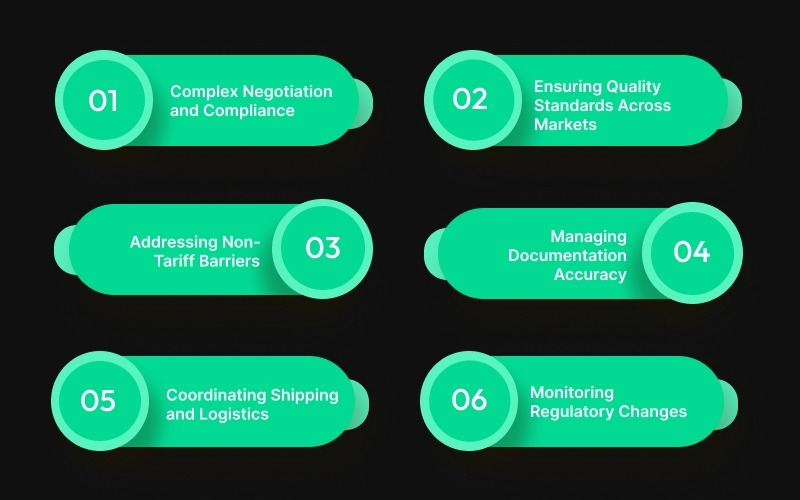
Free trade agreements offer Indian exporters opportunities for lower tariffs, faster market access, and greater competitiveness. Yet, realising these benefits requires careful management of several practical hurdles. From complex regulations to quality standards, every step demands diligence to avoid compliance issues, delays, or added costs.
Below are the key challenges businesses face under FTAs, along with solutions to overcome them:
1. Complex Negotiation and Compliance
Understanding FTAs requires a thorough understanding of each partner country’s rules, certifications, and documentation. Without clear guidance, businesses risk errors in filings and delayed approvals.
Solution: Use digital trade management platforms like Pazago to automate compliance checks, validate country-specific regulations, and maintain a digital audit trail. This ensures smoother cross-border transactions and reduces administrative errors.
2. Ensuring Quality Standards Across Markets
Products must meet local quality standards, which can differ significantly from Indian regulations. Failing to meet these requirements can lead to rejections, returns, or reputational damage.
Solution: Implement robust quality control systems and use integrated documentation tools to generate certificates of compliance and product testing records, keeping every shipment aligned with local standards.
3. Addressing Non-Tariff Barriers
Even with tariff reductions, exporters may encounter quotas, licensing requirements, or customs delays that slow market entry.
Solution: Centralised platforms provide alerts for non-tariff requirements and integrate licensing checks within shipment planning, allowing proactive resolution of potential barriers.
4. Managing Documentation Accuracy
FTA benefits often depend on correct documentation, including certificates of origin and invoices. Errors can result in lost tariff advantages or fines.
Solution: Automate document generation from order data, ensuring consistency and reducing manual mistakes while simplifying customs clearance.
5. Coordinating Shipping and Logistics
Multiple FTA markets mean managing diverse shipping routes, carriers, and timelines. Disconnected processes can cause delays or spoilage.
Solution: Use order-level logistics management tools to plan shipments, track containers, and monitor delivery timelines, ensuring timely, compliant execution.
6. Monitoring Regulatory Changes
FTA rules and partner country regulations evolve frequently. Without timely updates, businesses risk non-compliance and missed opportunities.
Solution: Employ real-time compliance monitoring tools that track regulatory updates and provide actionable alerts to keep operations aligned with current FTA requirements.
Given these challenges, having the right systems in place is critical to efficiently manage FTA-led trade.
Also Read: Advantages and Importance of International Trade
Running FTA Shipments Smoothly With Pazago Logistics
The real advantages of FTAs show up only when shipments move cleanly through customs, documents align with origin rules, and cargo reaches buyers without delays. In practice, many FTA benefits are lost because logistics, documentation, and compliance are handled in silos.
Pazago supports exporters by structuring FTA-driven shipments as a single logistics workflow, so preferential benefits translate into faster clearance and predictable delivery.
FTA-ready documentation linked to shipment movement
Tariff benefits depend on accurate certificates of origin, HS codes, and invoice values. Pazago keeps these documents tied to the shipment itself, reducing last-minute corrections that often cause customs queries or loss of preferential duty treatment.
Clear visibility across FTA trade lanes
FTA routes often involve new markets, unfamiliar ports, and tighter scrutiny. Pazago provides shipment and container visibility at the order level, helping exporters track movement, respond to delays early, and keep buyers informed.
Logistics planning aligned with FTA timelines
Preferential treatment is time-sensitive. Missed cut-offs, delayed gate-ins, or incomplete paperwork can erase FTA advantages. Pazago helps teams track critical dates such as inspection windows, document readiness, and sailing schedules so shipments stay eligible for benefits.
Coordination across teams and partners
FTA execution requires coordination between exporters, customs brokers, forwarders, and buyers. Pazago keeps logistics communication linked to each order, reducing dependency on scattered emails and follow-ups that often slow clearance.
By keeping documents, shipment milestones, and logistics updates connected, Pazago helps exporters apply FTA benefits where they matter most: at customs and during transit.

Conclusion
Free Trade Agreements bring exporters important advantages such as reduced tariffs, easier market access, and smoother cross-border trade. However, agreements alone do not simplify day-to-day operations. Exporters still need to manage regulatory compliance, accurate documentation, and efficient logistics across international markets.
To fully benefit from FTA, operational discipline is essential. Relying on separate tools or manual tracking can lead to delays, errors, and unnecessary costs.
Pazago helps exporters turn these agreements into actionable benefits by integrating orders, documents, shipments, and compliance into a single platform, making operations more efficient and reliable.
Book a demo today to see how Pazago can help you maximise the advantages of FTA.
FAQs
1. How do Free Trade Agreements benefit businesses in India?
Free Trade Agreements make it easier for Indian businesses to enter new international markets by reducing tariffs and simplifying trade rules, which supports growth and export expansion.
2. Do Free Trade Agreements reduce shipping and trade costs?
Yes. By lowering or eliminating import-export duties, Free Trade Agreements cut overall costs for exporters and importers, making Indian products more competitive globally.
3. Can Free Trade Agreements create more employment opportunities?
Absolutely. As Free Trade Agreements encourage higher trade volumes and production, businesses often expand operations, creating jobs across sectors.
4. How do Free Trade Agreements enhance competitiveness for Indian exporters?
By providing easier access to partner countries’ markets and reducing regulatory hurdles, Free Trade Agreements help Indian exporters compete on price, quality, and delivery efficiency internationally.
5. Do Free Trade Agreements benefit consumers as well?
Yes. Free Trade Agreements allow consumers to access a wider variety of products at lower prices, thanks to reduced tariffs and smoother cross-border trade.