

.png)


Export Incentives in India: How Businesses Can Benefit?
Optimize your business: use unlimited savings with Pazago fulfilled now!
Get Started ->Running an export business means juggling documentation, managing compliance, dealing with fluctuating costs, and competing against international players who often have lower embedded taxes than you do.
The numbers tell the story: India's exports reached USD 778.21 billion in 2023-24, a 67% jump from USD 466.22 billion a decade earlier. But here's what most exporters miss: the government offers substantial export benefits in India, specifically designed to neutralise the tax burden that makes your products expensive in global markets.
From duty refunds that put money back in your pocket to zero-cost capital goods imports that upgrade your manufacturing, these export incentive schemes can transform your bottom line. Yet many exporters either don't know about them or find the claiming process too complex to bother with.
This guide cuts through the complexity. We'll show you exactly which export incentives in India apply to your business, how they work, what documentation you need, and how to claim them without drowning in bureaucratic procedures.
Key Takeaways
- RoDTEP leads export benefits in India, disbursing over ₹57,976 crore as of March 2025 and refunding embedded taxes at 0.3-4.3% of the FOB value across 10,780+ product categories.
- EPCG allows zero-duty imports of capital goods, requiring an export obligation 6x within 6 years, saving exporters lakhs in customs duties and modernising manufacturing capabilities.
- Combining multiple schemes such as RoDTEP, EPCG, and Advance Authorisation can improve your margins, thereby transforming profitability in competitive global markets.
- Digital platforms like ICEGATE have simplified the claiming of export incentives, with most RoDTEP e-scrips credited within 2-4 weeks when the documentation is accurate.
- Policy stability through March 2026 ensures predictable support with ₹18,233 crore allocated for FY 2025-26, giving exporters confidence to plan long-term investments.
What Are Export Incentives and Why Do They Matter?

Export incentives are government-backed financial and non-financial benefits that help you offset the costs of international trade. The basic idea is simple: Indian exporters pay embedded taxes on fuel, electricity, transportation, and other inputs that don't get refunded through normal GST mechanisms. These hidden costs make your products more expensive compared to goods from countries where such costs are minimal or fully refunded.
The primary goals of export benefits in India include:
- Neutralising the impact of domestic taxes on exports
- Improving price competitiveness in global markets
- Encouraging value addition and quality upgrades
- Promoting employment in export-oriented sectors
- Supporting India's vision of becoming a USD 1 trillion export economy
As of March 31, 2025, the government had disbursed over ₹57,976 crore under various export incentive schemes. This massive scale demonstrates how seriously India takes supporting its exporters in competing globally.
Must Read: How Much Profit Is There In Export Business
Key Export Incentive Schemes You Should Know
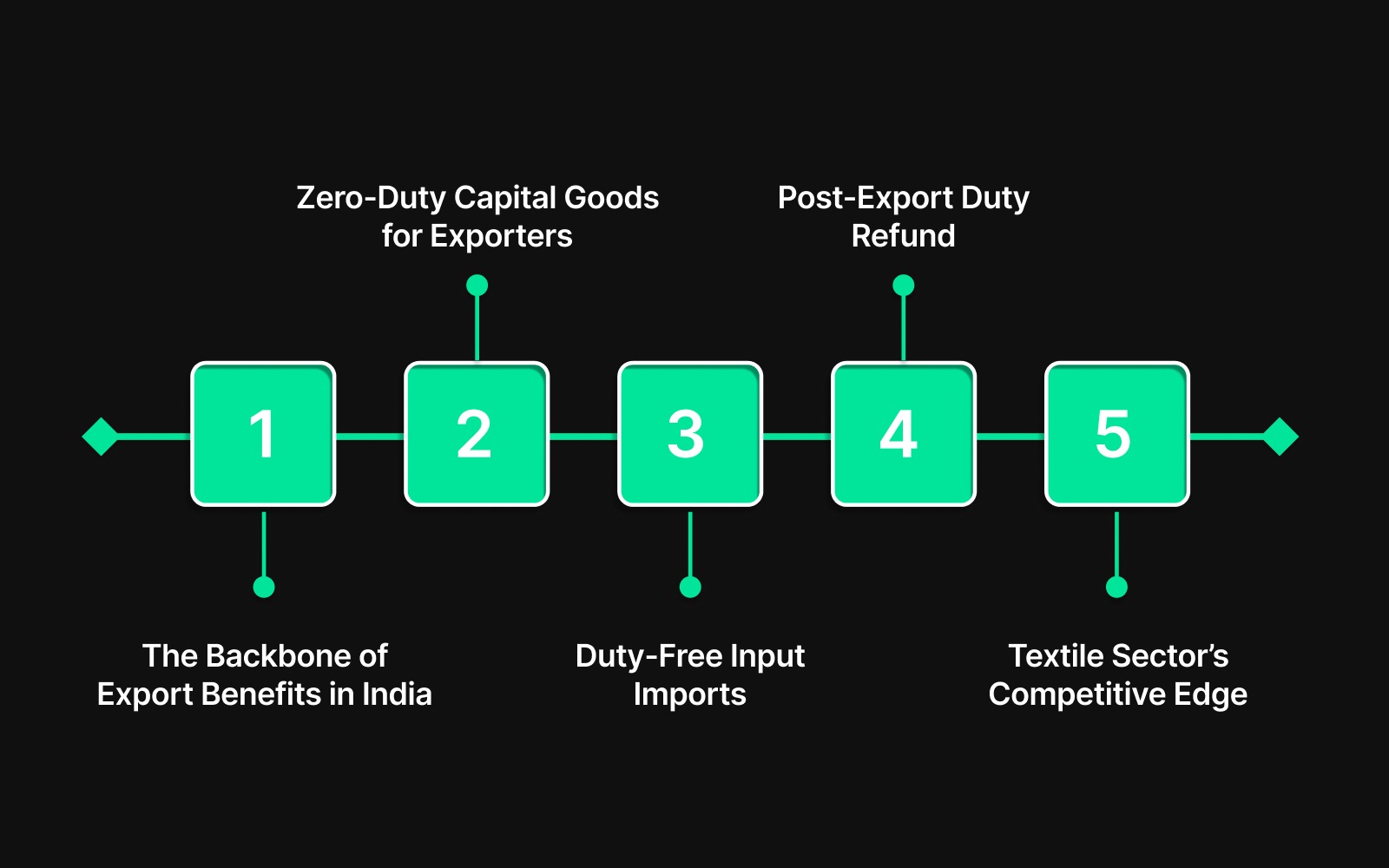
Understanding which export incentive schemes apply to your business is the first step towards claiming benefits. Below is a snapshot of the major programmes offering export benefits in India.
RoDTEP: The Backbone of Export Benefits in India
The Remission of Duties and Taxes on Exported Products (RoDTEP) is the most significant export incentive scheme today. Introduced on January 1, 2021, it replaced MEIS to ensure WTO compliance while providing broad tax relief.
What RoDTEP refunds:
- VAT and excise duty on fuel
- Mandi tax and stamp duty
- Uncreditable GST components
- Central, state, and local taxes not covered elsewhere
The scheme covers over 10,700 HS lines across DTA exports, AA, EOUs, and SEZs. For FY 2025–26, ₹18,233 crore has been allocated.
How to claim: Declare RoDTEP in the shipping bill. After customs verification, generate the e-scrip on ICEGATE. The process typically takes 2–4 weeks.
EPCG Scheme: Zero-Duty Capital Goods for Exporters
The Export Promotion Capital Goods (EPCG) scheme allows duty-free imports of machinery and equipment used in production.
Key features:
- Zero customs duty, IGST, and cess
- Export obligation of 6× duty saved in 6 years
- 24-month import validity
- Early redemption option
It’s especially useful for exporters of textiles, engineering, electronics, pharma, and food processing.
Advance Authorisation Scheme: Duty-Free Input Imports
The Advance Authorisation Scheme (AAS) allows duty-free import of inputs physically incorporated into export products.
What you need to know:
- Inputs based on SION norms
- Minimum 15% value addition
- 18-month export obligation
- Zero duty, IGST, and cess
Ideal for manufacturers needing high-quality imported inputs.
Duty Drawback: Post-Export Duty Refund
Duty Drawback refunds customs and excise duties paid on inputs used for exports.
Two rate types:
- All Industry Rate (AIR)
- Brand Rate (actual usage-based)
Claims are made through the shipping bill, with refunds typically credited within weeks. Duty Drawback can be combined with RoDTEP in certain cases, provided there is no overlap in the taxes being refunded under each scheme.
RoSCTL: Textile Sector’s Competitive Edge
The RoSCTL scheme supports apparel and textile exporters under ITC-HS Chapters 61–63.
Benefits:
- Refund of embedded state and central taxes
- Rates up to 6% of the FOB value
- Extended till March 31, 2026
This scheme is vital for textile hubs such as Tiruppur, Ludhiana, and Panipat, helping Indian exporters remain competitive globally.
Must Read: Import and Export Services: Basic Guidelines and Procedures
GST Benefits and Schemes for Exporters
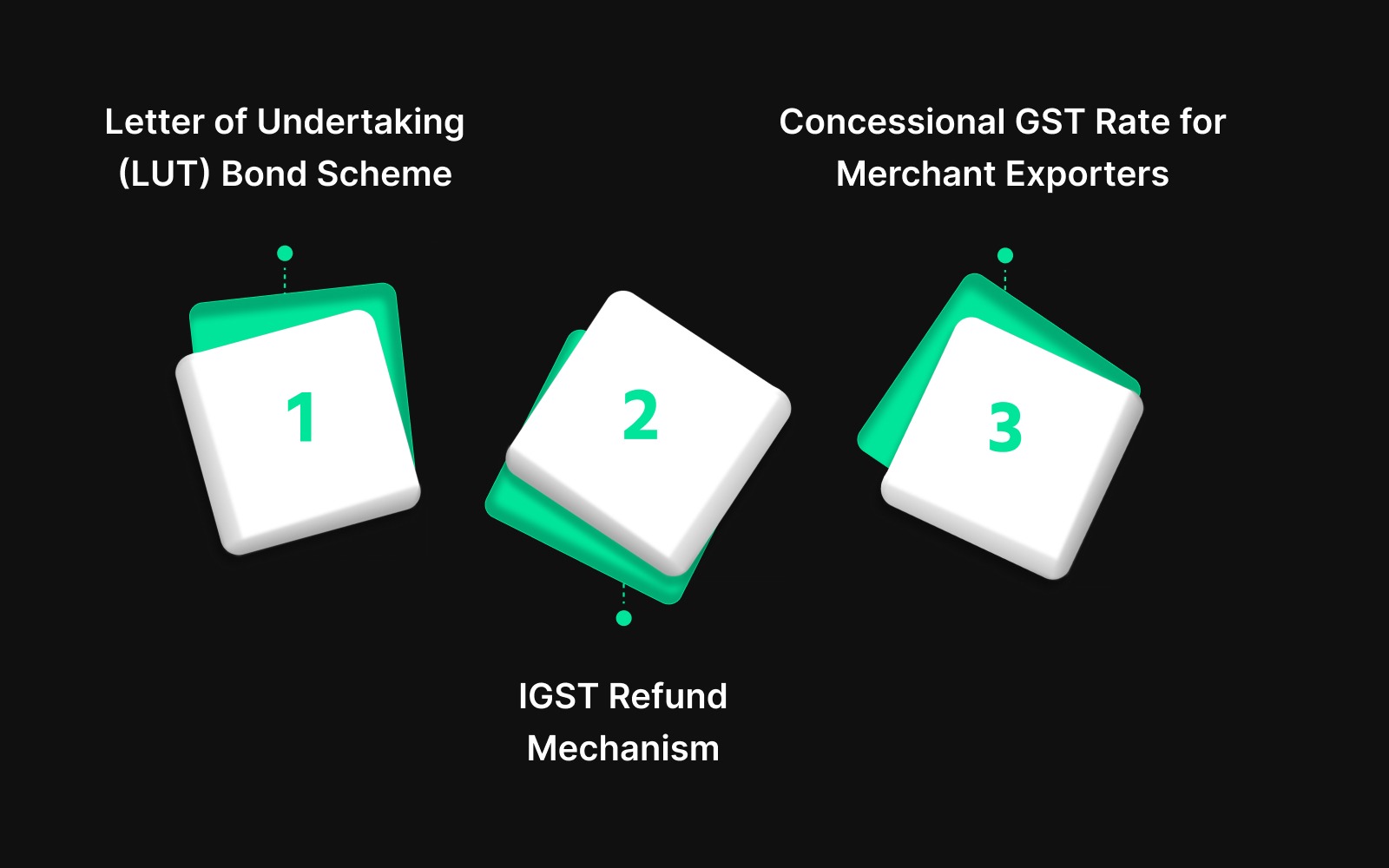
Beyond the major export incentive schemes, the GST framework offers several provisions that make exporting more financially viable.
Letter of Undertaking (LUT) Bond Scheme
Instead of paying IGST on your exports and then claiming a refund, you can furnish a Letter of Undertaking (LUT) and export without paying any GST upfront. This is a significant cash flow advantage, especially for small- and medium-sized exporters.
Requirements:
- GST registration
- Clean compliance record
- Submit LUT through the GST portal annually
This simple step can save you months of waiting for refund processing and keep your working capital free for business operations.
IGST Refund Mechanism
If you choose to export under bond, or the LUT isn't applicable, you can pay IGST at the time of export and claim a refund later. The refund process has been streamlined significantly, with most refunds processed within 7-14 days if your documentation is in order.
Make sure your shipping bills are properly linked to your GST returns and that all export proceeds are realised and reflected in your e-BRC to avoid delays.
Concessional GST Rate for Merchant Exporters
If you're a merchant exporter procuring goods from domestic suppliers for export, you're entitled to purchase these goods at a concessional GST rate of 0.1% instead of the standard rate. This significantly reduces your procurement costs and improves margins.
To avail of this benefit, provide your supplier with a valid LUT or bond, and ensure proper documentation showing that the goods are intended for export.
Also Read: Understanding the Procedures and Importance of Transportation Documents
Special Economic Zones and Export-Oriented Units

If you're planning large-scale export operations, setting up in a Special Economic Zone (SEZ) or as an Export Oriented Unit (EOU) can provide comprehensive benefits beyond individual schemes.
SEZ Benefits
SEZs offer a complete package of incentives:
- Exemption from customs duty on imports of capital goods, raw materials, and consumables
- Income tax benefits for SEZ developers and units
- Exemption from state and local taxes
- Single-window clearance for approvals
Units in SEZs can import without payment of duty and sell in the domestic tariff area (DTA) subject to payment of applicable duties. The reinstatement of RoDTEP benefits for SEZ units from June 1, 2025, has made this option even more attractive.
EOU Advantages
Export Oriented Units enjoy similar benefits to SEZs but with more flexibility in location:
- Set up anywhere in India
- Duty-free imports
- Income tax benefits
- RoDTEP refunds on exports
EOUs must export 100% of their production, though they can sell up to 50% in the DTA on payment of concessional duties, providing some revenue diversification.
Sector-Specific Schemes Worth Exploring

Beyond the major export incentives, several sector-specific schemes provide targeted support to particular industries.
Transport and Marketing Assistance (TMA) Scheme
If you export agricultural products, the TMA scheme helps offset high transportation costs and provides marketing support. This is particularly useful for perishable items where logistics costs significantly impact competitiveness.
Interest Equalisation Scheme (IES)
The IES provides interest subvention on pre- and post-shipment export credit in rupees:
- MSMEs get 3% interest equalisation on 410 tariff lines
- All exporters in labour-intensive sectors receive support
This directly reduces your financing costs for working capital.
Towns of Export Excellence and Product-Specific Schemes
Certain towns recognised for export excellence get additional infrastructure and support benefits. Similarly, specific products and sectors may have dedicated schemes offering enhanced benefits or relaxed conditions.
Must Read: Best Practices for Customs Documentation and Labeling
How to Actually Claim These Export Benefits in India?
Understanding schemes is one thing; successfully claiming export benefits is another. Here’s a practical roadmap to accessing incentives without drowning in paperwork.
Essential Documentation You Need
Before claiming any export incentive, make sure these basics are in place:
- Import Export Code (IEC)
- GST registration
- Registration-cum-Membership Certificate (RCMC)
- PAN card
- Export-linked bank account
For schemes like RoDTEP and EPCG, you’ll also need:
- Shipping bills with correct declarations
- Commercial invoices showing FOB value
- Bill of lading or airway bill
- Packing list
The most critical document is the e-BRC (electronic Bank Realisation Certificate). It proves foreign exchange receipt and is the most common reason exporters miss out on benefits when delayed or missing.
Step-by-Step Process for RoDTEP Claims
Step 1: Obtain IEC and RCMC.
Step 2: Declare RoDTEP intent in the shipping bill—this cannot be done later.
Step 3: After customs verification, log in to ICEGATE using your digital signature.
Step 4: Select eligible shipping bills to generate e-scrips based on the notified rates.
Step 5: The duty credit scrip is credited to your electronic ledger and can be used for customs duty or transferred.
With correct documentation, the process usually takes 2–4 weeks.
Applying for EPCG Authorisation
EPCG requires pre-approval for the import of capital goods.
Application process:
- Apply online via the DGFT portal
- Provide details of capital goods and export products
- Submit an export obligation plan and SION details if applicable
- Pay the application fee
- Furnish a bank guarantee or insurance bond
Once approved, the EPCG authorisation is valid for 24 months for imports. You have six years to meet export obligations, file annual returns, and apply for redemption after completion to release your bank guarantee.
Also Read: Essential Technical Write Up Documents Required for Smooth Customs Clearance
Combining Multiple Schemes: Maximising Your Benefits

Smart exporters don't just use one export incentive scheme—they strategically combine multiple programmes to maximise export benefits in India without violating any rules.
Permissible Combinations
You can typically combine:
- RoDTEP with EPCG: RoDTEP refunds embedded taxes on your export product, whilst EPCG provides duty exemption on capital goods
- Advance Authorisation with RoDTEP: Use Advance Authorisation for duty-free raw materials whilst claiming RoDTEP on the final export
- Duty Drawback with RoDTEP: Provided you're not claiming a refund for the same duties or taxes twice
Schemes You Cannot Stack
You cannot claim both MEIS (where still applicable) and RoDTEP on the same export. Since RoDTEP replaced MEIS, the two are mutually exclusive. Similarly, if you've imported inputs under Advance Authorisation (duty-free), you cannot claim duty drawback on those same inputs since you didn't pay any duty in the first place.
For EOUs and SEZ units, certain combinations are subject to specific restrictions. Always verify the current DGFT notifications and handbook of procedures before assuming a combination is allowed.
Creating Your Benefit Optimisation Strategy
Start by mapping out your entire cost structure:
- Production costs
- Input duties
- Embedded taxes
- Capital goods requirements
- Financing needs
Then identify which export incentive scheme addresses each cost element. Review your strategy annually as schemes get modified, new benefits are announced, and your business needs evolve. What worked last year might not be optimal now.
Must Read: Common Documents Required for Import and Export Procedures
How Pazago Simplifies Export Incentive Management
A missed cut-off, the wrong shipping bill declaration, a document mismatch, or a late e-BRC can stall RoDTEP credits and disrupt EPCG compliance tracking.
Pazago supports exporters by keeping shipment execution and incentive-critical documentation tied to each order, so claims stay clean and timely.
Incentive-ready logistics documentation at the shipment level
Pazago keeps shipping bills, invoices, packing lists, BL/AWB, and supporting docs linked to the exact shipment. This reduces version mix-ups and helps ensure RoDTEP declarations and values match what customs validates.
Milestone tracking that protects claim timelines
Many incentives depend on “when” things happen, not just “what” you filed. Pazago tracks critical logistics dates like booking confirmation, gate-in, sailing/ETD, and document finalisation. This helps teams follow up early when a delay could push timelines and slow credits.
Shipment visibility that helps teams follow up faster on e-BRC collection
Export proceeds and e-BRC availability often lag when teams lose track of where a shipment stands. With shipment visibility tied to orders, exporters can coordinate faster with banks and buyers after dispatch, which helps keep e-BRC collection on track.
Coordination without scattered follow-ups
Incentive claims often require quick clarifications from the CHA, forwarder, or bank. Pazago keeps order-level communication and document sharing in one thread, so teams resolve mismatches faster and avoid repeated rework.
Conclusion
Export benefits in India can improve margins and reduce cost pressure, but they only work when shipment execution stays disciplined. RoDTEP credits depend on correct shipping bill declarations and clean customs validation. EPCG depends on consistent export performance and traceable shipment records. In both cases, logistics issues, not scheme rules, cause most headaches.
If you treat incentives as part of your shipping workflow, you reduce delays, avoid rework, and keep claims moving. That means getting documents right the first time, tracking shipment milestones closely, and staying ready with proof when customs, banks, or auditors ask.
Pazago supports exporters by keeping logistics milestones, shipment documents, and follow-ups tied to each order, so you don’t lose incentives because of preventable execution gaps.
Want to keep exports moving and claims on track? Book a Demo with Pazago to see how a structured logistics workflow can help you capture export benefits without constant chasing.
Frequently Asked Questions (FAQs)
1. What is the RoDTEP scheme, and how much can I claim?
RoDTEP (Remission of Duties and Taxes on Exported Products) refunds embedded central, state, and local taxes that aren't covered under other schemes. Rates vary between 0.3% to 4.3% of FOB value, depending on your product category. As of March 2025, over ₹57,976 crore has been disbursed under this scheme.
2. Can I combine multiple export incentive schemes?
Yes, you can combine schemes such as RoDTEP, EPCG, and Advance Authorisation, as long as you're not claiming the same cost twice. For example, you can use EPCG for capital goods whilst claiming RoDTEP on your final exports. Always verify current DGFT guidelines for permissible combinations.
3. What documents do I need to claim export benefits in India?
Essential documents include Import Export Code (IEC), GST registration, RCMC from your Export Promotion Council, shipping bills with proper declarations, commercial invoices, and most importantly, e-BRC (electronic Bank Realisation Certificate) proving you've received foreign exchange for your exports.
4. How long does it take to receive RoDTEP benefits?
If your documentation is correct and complete, RoDTEP e-scrips are typically credited to your ICEGATE account within 2-4 weeks after customs verifies your export. Delays usually occur due to documentation errors or missing e-BRCs.
5. Are export incentive schemes available for all products?
Most export incentive schemes cover a wide range of products, but some sectors may be excluded. RoDTEP currently covers 10,780 HS lines for DTA exports and 10,795 for AA/EOU/SEZ exports. Check Appendix 4R on the DGFT website for your specific product's eligibility and applicable rates.


