.png)


Complete Guide to Export Value Declaration: FOB, CIF, Customs Compliance & Penalties Explained

Optimize your business: use unlimited savings with Pazago fulfilled now!
Get Started ->Customs flags your container at the port. The delay? Your export value doesn't match comparable shipments. Your buyer is furious, your duty drawback claim is stuck, and penalties loom.
For Indian exporters, the export value declaration isn't bureaucratic paperwork; it's the foundation of your entire export transaction. This single document controls your customs clearance speed, determines your duty drawback and RoDTEP credits, validates your GST refunds, and affects your compliance with the Reserve Bank of India's foreign exchange regulations. Misdeclaration, whether accidental or intentional, triggers consequences that extend far beyond the current shipment.
This guide explains what an export value declaration is, why accurate declarations matter, how to calculate FOB values correctly, and how to avoid common mistakes that trigger scrutiny and penalties.
Key Takeaways
- Export value declaration is mandatory under the Customs Valuation Rules, 2007, and directly impacts your duty drawback, GST refunds, RoDTEP credits, and foreign exchange realisation tracking
- FOB valuation is critical; you must correctly separate freight and insurance from CIF values to avoid over-claiming export benefits and subsequent penalties
- Customs accepts four valuation methods (transaction value, comparative value, computed value, and residual method), with transaction value being the default for most commercial exports
- Misdeclaration carries severe consequences, including confiscation of goods, penalties up to four times the duty involved, loss of export privileges, and potential criminal prosecution
- Modern export management platforms automate value calculations, enforce compliance checks, and maintain complete documentation trails
What Is An Export Value Declaration In India?

Your export value declaration is a formal document that states the transaction value of the goods you're exporting. It's mandated under Rule 7 of the Customs Valuation (Determination of Value of Export Goods) Rules, 2007.
The declaration is submitted along with the shipping bill and includes details such as:
- Shipping bill number and date
- Invoice number and value
- Nature of transaction (sale, consignment, gift, sample)
- Valuation method used (Rule 3, 4, 5, or 6)
- Buyer-seller relationship status
- Payment and delivery terms (Incoterms)
- Previous exports of similar goods
The export value declaration ensures your commercial invoice matches what you're declaring to customs. It creates a transparent record that customs uses to verify transaction legitimacy and serves as the baseline for calculating export benefits.
Must Read: 10 Required Pre-Shipment Documents for Export Procedure and Shipping Process
Why Export Value Declaration Matters for Indian Exporters
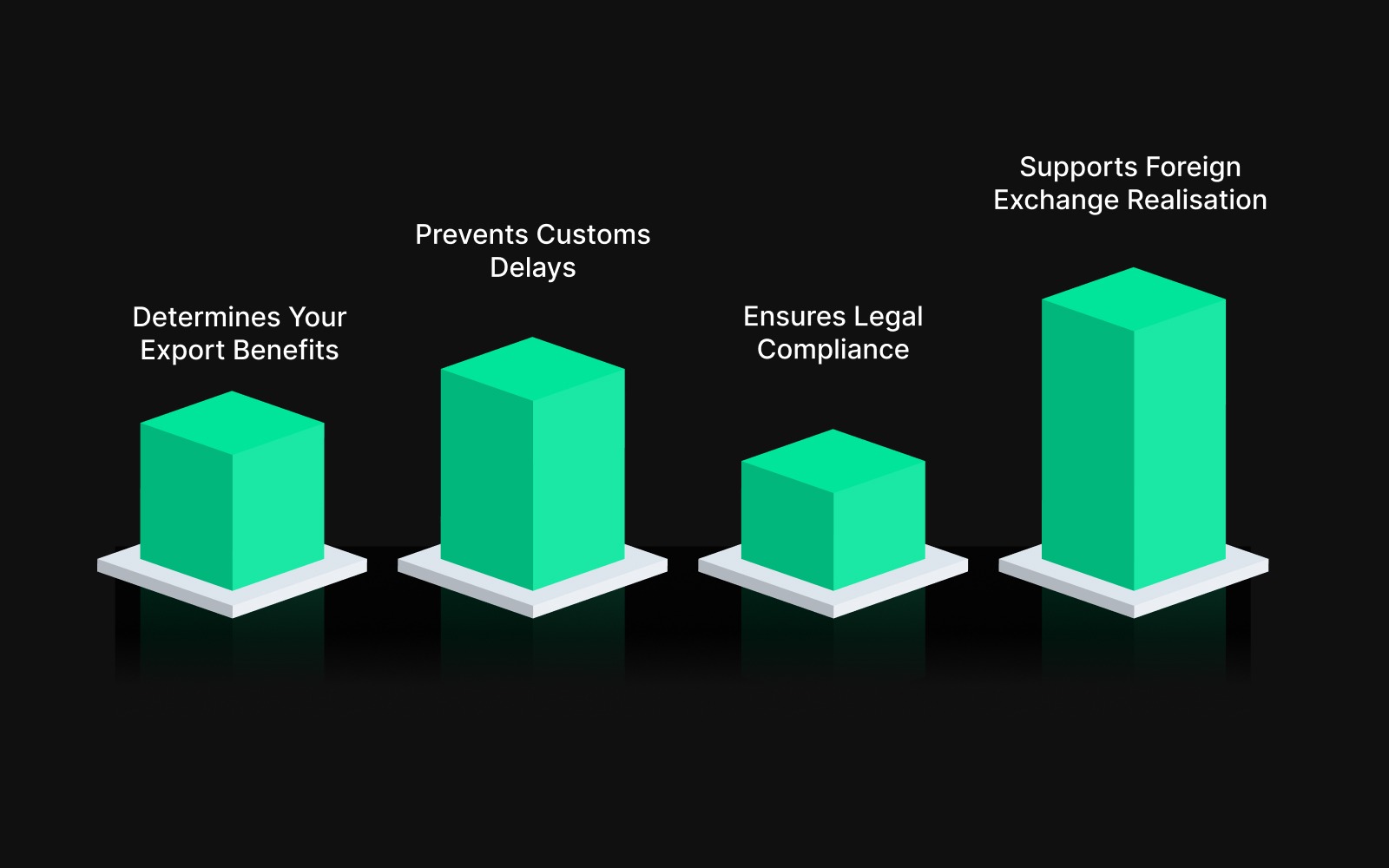
Understanding why customs scrutinises export values helps you appreciate the importance of accurate declaration. Your declared value touches multiple stakeholders, customs, the RBI, the DGFT, your bank, and international buyers, each relying on this figure for different compliance purposes.
Determines Your Export Benefits: Most export incentive schemes are value-based. Your duty drawback, RoDTEP credits, and GST refunds are calculated on the FOB value in your shipping bill. If your export value declaration is incorrect, you risk losing benefits or facing audit scrutiny.
Prevents Customs Delays: Customs cross-verifies your declared value against market benchmarks and historical data. If something looks off, like significantly lower values than similar goods, they'll issue query memos requesting explanations. Your shipment gets held until you provide satisfactory evidence.
Ensures Legal Compliance: Misdeclaration is a serious offence under Sections 111, 113, and 114 of the Customs Act, 1962. It can lead to confiscation of goods, penalties up to four times the duty involved, loss of export privileges, and legal prosecution in severe cases.
Supports Foreign Exchange Realisation: The RBI requires you to realise foreign exchange equivalent to the export value within the stipulated timeframe. Your export value declaration serves as the baseline for this tracking, is required for your Bank Realisation Certificate (BRC), and is used to claim export benefits.
Must Read: Export Procedures and Documents under GST
Customs Valuation Methods Used for Export Declaration

The Customs Valuation Rules specify multiple methods for determining export value. Most exporters use the transaction value method, but knowing all methods helps when customs questions your declaration.
Transaction Value Method - This applies in over 90% of export cases. The transaction value is the price actually paid or payable for goods when sold for export. Key requirements include a genuine sale transaction, price as sole consideration, no restrictions on the buyer's use, and no undisclosed payments.
Comparative Value Method - When customs doubts your declared value, they'll compare your goods with similar exports. They look at identical or similar goods exported around the same time in comparable quantities. If most exporters ship similar cotton bedsheets at ₹800 per piece FOB, but you've declared ₹400, customs will ask why.
Computed Value Method - This method calculates the value based on production costs, including materials, fabrication, profit, general expenses, and other necessary costs. You might need a cost accountant's certificate to substantiate this valuation.
Residual or Fallback Method - When none of the above methods work, customs can use reasonable means consistent with these rules' principles. This gives officers flexibility but means they won't accept arbitrary valuations.
Must Read: Essential Documents Required for Smooth Import-Export Customs Clearance
How to Fill Your Export Value Declaration Correctly?

Getting your export value declaration right requires attention to detail and consistency across all export documentation. A systematic approach prevents errors that trigger delays or penalties.
Step 1: Gather Your Documents
Ensure you have a commercial invoice with complete product details, a packing list matching the invoice quantities, a purchase order or export contract, previous export records for similar goods, and cost sheets for high-value products.
Step 2: Declare the Correct Transaction Type
Clearly state whether your export is a direct sale, a consignment sale, a gift, a sample, or another category. Each has different valuation implications.
Step 3: Choose the Right Valuation Method
For most commercial exports, select Rule 3 (Transaction Value). Only choose other rules if Rule 3 doesn't apply or customs have rejected your transaction value.
Step 4: Disclose Buyer-Seller Relationship
You must declare if you and the buyer are related parties. Relationships exist when one party owns 5% or more stake in the other's business, you're officers or directors of each other's companies, you're business partners, or you're family members. If related, declare whether this influenced the price.
Step 5: Specify Payment and Delivery Terms
Clearly mention payment terms (advance payment, credit terms, LC) and delivery terms using standard Incoterms (FOB, CIF, CFR, EXW). This determines what's included in your FOB value calculation.
Step 6: Provide Additional Information
Include special discounts or rebates, royalty or licence fees, post-sale adjustments, currency conversion rates used, and any non-cash considerations.
Step 7: Review and Sign
Double-check that all information matches your commercial invoice and shipping bill. Any mismatch triggers red flags. Sign the declaration confirming all information is true and correct.
FOB vs CIF: Getting Your Export Value Right

One of the biggest sources of confusion in export value declaration is understanding FOB and CIF values. Customs requires FOB value for export incentives and GST refunds, but your contract might be CIF or CFR.
What's FOB Value? - FOB (Free on Board) includes only costs up to loading goods onto the vessel at the Indian port:
- Cost of goods
- Inland transport to the port
- Loading charges at the port
- Export clearance fees
- Pre-shipment inspection charges
FOB value excludes international freight, insurance, and destination charges.
What's CIF Value? - CIF (Cost, Insurance, and Freight) includes everything in FOB plus:
- Ocean/air freight to the destination port
- Marine insurance (typically 110% of FOB value)
Formula: CIF = FOB + Freight + Insurance
Why This Matters: If your contract is CIF or CFR, correctly break down the value on your shipping bill. For example, if your CIF invoice is $50,000 with freight $4,000 and insurance $600:
- Invoice value: $50,000
- Freight: $4,000
- Insurance: $600
- FOB value: $45,400
Your GST refund and export incentives are calculated on the $45,400 FOB value, not the full CIF amount. Declaring the entire CIF value as FOB is a common mistake that leads to overclaiming refunds and subsequent penalties.
Must Read: How to Calculate Duty Drawback on Export: Pazago Guide
Common Mistakes in Export Value Declaration

Even experienced exporters make critical errors. Knowing what to watch for saves you from compliance issues and penalties.
1. Over-Invoicing or Under-Invoicing: Some exporters inflate values to claim higher duty drawback or deflate them to help buyers evade import duties. Both are illegal and easily detected through customs intelligence and data analytics.
Solution: Always declare the actual transaction value.
2. Mismatching Invoice and Shipping Bill Values: Your commercial invoice must match your shipping bill exactly. Even small discrepancies cause delays.
Solution: Prepare both documents simultaneously using the same exchange rate.
3. Not Adjusting for Incoterms: Declaring CIF value as FOB, or not separating freight and insurance, affects your export benefit calculations.
Solution: Understand your Incoterm clearly and break down the components in your shipping bill.
4. Ignoring Related Party Disclosures: Failing to declare relationships with buyers invites scrutiny.
Solution: Be transparent about any relationships and provide comparative data demonstrating arm's-length pricing.
5. Inconsistent Pricing Across Shipments: Exporting similar goods at wildly different prices without valid reasons raises red flags.
Solution: Maintain pricing consistency and document any legitimate changes.
6. Missing Supporting Documentation: Submitting declarations without supporting documentation, such as cost certificates or market research, leaves you vulnerable.
Solution: Maintain comprehensive records, including cost sheets, purchase invoices, and buyer communications.
What Happens When Customs Doubts Your Declared Value?

Under Rule 8 of the Customs Valuation Rules, if customs has a reasonable doubt about your declared value, they can question it. Understanding this process helps you respond effectively.
The customs officer issues a written query memo specifying why they doubt your value. Common reasons include significant variation from comparable exports, unusual pricing, or suspicious relationships. Whilst the investigation continues, your goods are typically not detained, you sign an undertaking and your shipment proceeds.
You must provide whatever evidence customs requests: detailed cost breakdowns, market price comparisons, buyer communications, previous transaction records, or third-party valuations. After reviewing your response, customs will either accept your declared value, reject it and determine value using alternative methods, or initiate proceedings for confiscation and penalties if fraud is suspected.
Must Read: Understanding Customs Clearance Fees and Procedures in India
Penalties for Misdeclaration of Export Value

The Customs Act takes value misdeclaration extremely seriously. Understanding potential consequences emphasises why an accurate declaration must be your top priority.
- Administrative Penalties: Under Sections 114 and 117, penalties range from ₹10,000 to several lakhs, often proportional to the duty involved or benefit claimed.
- Confiscation of Goods: Under Section 113, goods can be confiscated for misdeclaration. You may be able to redeem goods by paying a fine, but repeated violations result in permanent confiscation.
- Loss of Export Benefits: Benefits already claimed will be recovered with interest, future claims may be blocked, and you could be blacklisted from export promotion schemes.
- Criminal Prosecution: In cases of deliberate fraud, you face prosecution under Section 135, with a maximum imprisonment of up to 7 years and/or fines, as well as permanent reputational damage.
Best Practises for Accurate Export Value Declaration

Following established best practises ensures your export operations remain compliant and reduces the risk of scrutiny.
- Maintain Detailed Records: Keep comprehensive documentation for every export, including cost sheets, purchase invoices, freight quotations, insurance certificates, and buyer communications. Retain these for at least five years.
- Use Consistent Valuation Methods: Unless circumstances genuinely change, use the same valuation approach for similar products. Document any methodology shifts with clear business reasons.
- Conduct Internal Audits: Periodically review your export documentation to identify inconsistencies before customs does.
- Train Your Export Team: Ensure everyone understands valuation methods, Incoterms, related-party definitions, and how to correctly complete declarations.
- Work with Experienced Customs Brokers: A knowledgeable broker can review declarations before submission and flag potential issues.
- Stay Updated on Regulations: Subscribe to CBIC updates, attend trade seminars, and consult trade consultants when new regulations are introduced.
Must Read: Understanding Export General Manifest (EGM) Procedures And Differences
How Pazago Supports Export Value Declaration Through Logistics Execution
Export value declaration breaks down when shipment terms, charges, and documents are managed separately. Freight gets finalised after booking. Insurance changes close to sailing. Values get copied manually into shipping bills. These gaps surface during customs scrutiny, not during filing.
Pazago supports exporters by keeping export value inputs connected to how the shipment actually moves.
Order-level value clarity from the start
Each export order is structured early with buyer details, Incoterms, currency, product value, and destination. This ensures the declared export value is tied to confirmed commercial terms, not adjusted late during shipping bill filing.
Single source for value consistency across documents
Customs queries often arise from small mismatches between the commercial invoice, shipping bill, and supporting records. Pazago keeps values, quantities, HS codes, and terms aligned across the document set, reducing avoidable discrepancies that trigger scrutiny.
Audit-ready records for customs queries
When customs questions declared value, exporters need cost sheets, freight quotes, insurance proofs, and past shipment references quickly. Pazago helps keep these records organised at the order level, making it easier to respond without delays or reconstruction.
Shipment visibility that supports post-shipment compliance
Export value declaration does not end at sailing. It links to EGM filing, BRC timelines, and export benefit claims. Pazago supports shipment visibility across key logistics milestones, helping exporters keep valuation-related filings and follow-ups aligned with actual shipment movemen
Conclusion
Export value declaration forms the foundation of customs compliance, export benefit claims, and foreign exchange management for every Indian exporter. Getting it right requires understanding valuation methods, accurately calculating FOB values, maintaining comprehensive documentation, and staying transparent with customs.
The consequences of misdeclaration extend far beyond immediate penalties. You risk confiscation, blocked benefits, damaged reputation, and even criminal prosecution. But with proper systems, trained teams, and modern platforms, accurate declaration becomes streamlined rather than a compliance burden.
If export value declaration still feels reactive or error-prone, it may be time to align valuation more closely with shipment execution. Pazago helps exporters keep shipment terms, charges, and declared values in sync so exports remain clearance-ready and benefit claims stay protected.
Connect with Pazago to understand how logistics-led execution can reduce export value disputes. Book a free consultation today.

Frequently Asked Questions
Q1: Is export value declaration mandatory for all exports from India?
Yes, under the Customs Valuation Rules, 2007, all exports require a proper value declaration. The format might vary, sometimes integrated into your shipping bill, other times as a separate form, but the requirement is universal.
Q2: Can I modify my export value declaration after submission to customs?
Once submitted and processed, modifications are extremely difficult to make. If you discover errors before customs processes your shipping bill, you can request amendments. After clearance, corrections require formal procedures and may trigger investigations.
Q3: How long should I retain export value declarations and supporting documents?
Maintain all export documentation, including value declarations for at least five years from the date of export. Customs can audit transactions within this period.
Q4: What's the penalty for honest mistakes in export value declaration?
Even genuine errors can attract penalties under Section 114 of the Customs Act, though severity depends on circumstances. If you demonstrate it was unintentional with no fraudulent intent and cooperate fully, penalties may be minimal. However, repeated "mistakes" will be treated more seriously.
Q5: What if my buyer refuses to share certain pricing information I need for the declaration?
You're solely responsible for your export value declaration regardless of what your buyer provides. Use your sales contract, commercial invoice, and transaction records. If elements like commissions or royalties exist, you must declare them even if your buyer is reluctant.