.png)


A Complete Guide To Freight Rate: Meaning, Importance And Types
Optimize your business: use unlimited savings with Pazago fulfilled now!
Get Started ->Are unpredictable shipping costs quietly eating into your export profits? You finalise a deal with an international buyer. Then a complex freight rate quote arrives. Hidden charges and confusing surcharges make your final cost unpredictable. This lack of clarity can turn a profitable deal into a loss.
Managing international freight rates is a major challenge for Indian SMEs, especially as export volumes grow rapidly. India’s total exports reached $824.9 billion in FY 2024–25, setting a new record for goods and services trade.
Understanding these costs is crucial for accurate pricing and maintaining healthy margins within this competitive landscape. Without this knowledge, you risk budget overruns and strained client relationships.
This guide will demystify the complete freight rate meaning for you. We will break down its components, types, and calculation methods. You will also learn practical strategies to manage and reduce these shipping expenses effectively.
Key Takeaways
- Freight rate refers to the price charged by a carrier for transporting cargo between two locations, typically excluding duties, insurance, and local handling costs.
- Freight rates are determined primarily by the shipment's weight (chargeable weight), the mode of transport, the distance/route, and the nature of the goods being shipped.
- Effective rate management is crucial for Indian SMEs, directly leading to improved profit margins and predictable cost control, supporting India's LPI improvement drive.
- Freight charges are complex, categorised into Standard, Ocean (e.g., BAF, Demurrage), Air (Chargeable Weight), and Truck rates, requiring detailed financial understanding.
- Strategic cost reduction tips include consolidating smaller shipments into FCL loads and negotiating long-term volume contracts with carriers for better pricing.
What is Freight Rate
A freight rate represents the complete cost charged by a carrier to transport goods from one specified place to another. This structured price is essential for businesses engaged in importing and exporting products worldwide.
Calculating the accurate rate involves evaluating the specific cargo, the chosen transportation method, and the overall travel distance required. Understanding the final commercial price ensures proper budgetary control and maintains competitive pricing for your commodities.
The true freight rate meaning is the final commercial charge paid for essential logistics services.
Also read: Cargo Logistics Meaning: Definition, Key Processes & Modern Challenges
Knowing the definition is just the start; the next step is identifying the core factors that contribute to freight rate volatility and cost.
Factors that Contribute to Freight Rate
Managing international shipping costs requires clarity regarding the many factors influencing the final commercial price. These highly variable elements collectively determine the true expense of moving cargo across borders and oceans reliably.

Exporters and importers must monitor these six critical areas to predict and budget their global logistics spending accurately.
Determining the exact freight rate involves considering several primary variables:
1. Type of Goods Being Shipped
The nature of the cargo significantly impacts the required specialised handling and associated liability insurance needed. Hazardous materials or fragile items need specialised containers and strict safety precautions during transit.
This necessary level of specialised care consequently results in higher final shipping charges.
2. Distance and Route
The physical distance between the origin and the final delivery destination is the primary rate determinant. Furthermore, routes that include busy shipping lanes or complex geographical challenges may incur additional costs.
Moving cargo through congested ports or remote areas increases the total required shipping expense.
3. Weight and Volume of Goods
Carriers use both the actual gross weight and the dimensional weight to calculate the final chargeable rate. Freight is always charged based on the higher of the two calculations, known as the chargeable weight.
Heavier or bulkier shipments require more container space and fuel, thus increasing the total final rate.
4. Customs Processing and Documentation Fees
Customs brokerage fees and documentation processing costs may appear alongside freight quotes depending on the logistics arrangement.
5. Mode of Transportation
The chosen method of shipping, such as air, ocean, rail, or road, has a massive influence on the total cost. Air freight is typically the fastest but the most expensive transportation option available to global shippers.
Ocean shipping provides a much more cost-effective alternative for moving high volumes of non-urgent cargo.
6. Fuel Surcharges
Fluctuations in global oil and diesel prices directly affect the total operational expenses of all carriers and vessels. These costs are commonly passed onto the customer through an adjustment known as the Bunker Adjustment Factor (BAF).
This surcharge helps the carrier absorb the volatile and rapidly changing fuel prices effectively.
Also read: Understanding the Process of Reverse Logistics: Steps and Strategies
Understanding the components is powerful, but knowing how to manage them strategically unlocks the importance of effective freight rate management for businesses.
Importance of Effective Freight Rate Management For Businesses
Effective management of freight costs is crucial for the overall financial health of Indian SMEs in global trade. Proper cost management translates directly into improved profitability and predictable business operations globally. A strategic approach to freight costs helps companies maintain a significant competitive edge in the international marketplace.
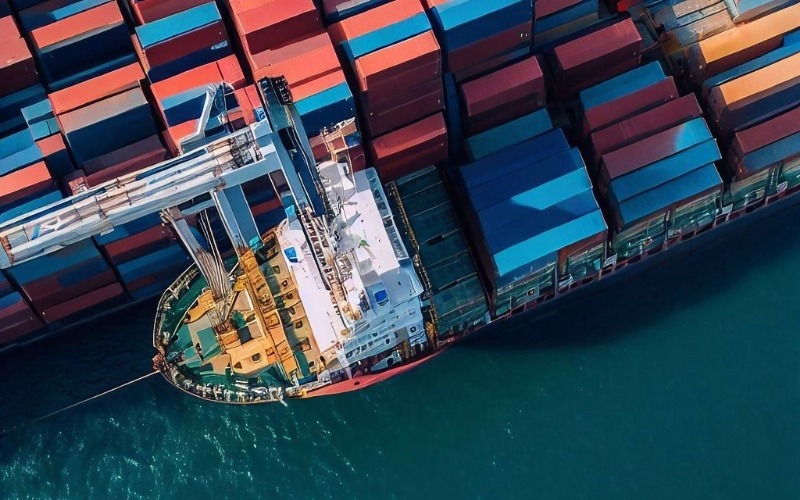
Understanding and managing freight rates provides several significant business benefits. This drive for efficiency is reflected nationally, as India’s rank improved by 16 places from 54th to 38th in 2023 on the World Bank's Logistics Performance Index (LPI). This positive trend underscores the growing importance of operational excellence.
Understanding and managing freight rates provides several significant business benefits:
1. Cost Control and Budgeting
Accurate knowledge of transportation costs allows companies to set realistic and achievable financial budgets successfully. This clear cost visibility prevents unexpected expenses from significantly disrupting annual financial forecasts.
Effective rate control ensures stable long-term planning for businesses operating internationally.
2. Improved Profit Margins
Reducing excessive freight spending directly decreases the overall cost of goods sold for Indian exporters. Lower shipping costs mean that the company retains a larger percentage of the revenue generated.
Even small reductions in the final rate can substantially increase overall net profit margins.
3. Supply Chain Efficiency
Managing rates effectively often involves optimising routes and consolidating smaller shipments into much larger cargo loads. This critical practice reduces the number of separate transactions and minimises potential logistical bottlenecks efficiently.
A streamlined shipping process results in faster delivery times and better inventory control.
4. Better Carrier Relationships
Negotiating fair, long-term contracts with reliable carriers is a critical part of necessary rate management. Strong partnerships can sometimes provide access to priority booking and more favorable negotiated pricing terms.
Trustworthy carrier relationships result in consistent and reliable service quality for your valuable cargo.
5. Enhanced Customer Satisfaction
Predictable and affordable shipping costs allow businesses to offer reliable and stable pricing to their international buyers. Consistent delivery schedules and competitive pricing strengthen the buyer's confidence in the Indian supplier.
High customer satisfaction encourages repeat orders and supports sustainable long-term business growth.
6. Compliance with Regulations
Freight management requires careful attention to the complex documentation and mandatory governmental compliance requirements. Understanding all freight-related charges helps businesses ensure accurate customs declarations and payment of necessary duties.
Proper adherence to global regulations minimises the risk of costly delays and financial penalties.

Effective management requires recognising the full structure, which leads us to explore the different types of freight rates used across various transport modes.
Different Types of Freight Rates
The world of global trade involves many different charges that together form the total final freight rate. These costs vary based on the specific mode of transport and the Incoterms used for the specific transaction.
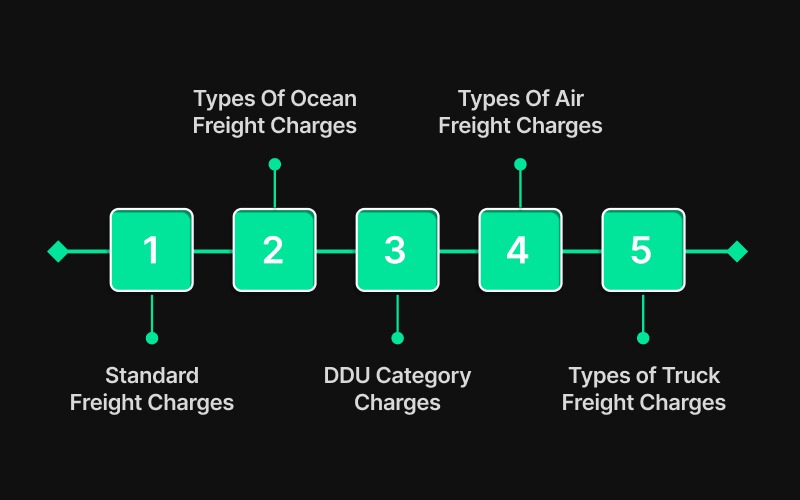
A detailed understanding of these specific charges is vital for cost transparency and proper financial reconciliation. Freight charges are typically organised into several distinct categories:
1. Standard Freight Charges
These essential charges constitute the base fees and standard administrative costs applied to most freight movements. They define the basic financial responsibility between the shipper and the consignee for the core transportation services. Standard freight charges include:
1. Consignee Collect Charges
These specific charges indicate that the buyer or consignee is financially responsible for the shipping costs incurred. Payment for the freight is formally due when the cargo physically arrives at the destination port or location. This arrangement ensures the seller does not bear the cost of transportation in the transaction.
Example: An Indian importer buys textiles under an Ex Works (EXW) agreement. The bill of lading specifies that the freight charges are "Collect," meaning the importer must pay the ocean carrier upon the cargo's arrival in Mumbai.
2. Prepay and Add Charges
The seller or shipper pays the charges upfront and subsequently includes them in the total commercial invoice sent to the buyer. This method means the seller arranges and finances the transport, then seeks reimbursement from the customer later. The total cost is often presented to the buyer as a single line item.
Example: An Indian exporter ships handicrafts to Europe, paying the ₹40,000 air freight cost upfront. The exporter then adds the ₹40,000 charge to the buyer’s commercial invoice, which includes the cost of the goods.
3. Freight on Board (FOB) Charges
This Incoterm determines the specific point where the financial risk and liability for the goods shift from the seller to the buyer. The party responsible for paying the freight rate is determined by the chosen FOB variant, which defines the handover location. It is a critical clause for international insurance and cost allocation.
Example: Under FOB Mumbai Port, the seller covers all costs to get the goods onto the ship at Mumbai. The buyer becomes financially responsible for the main freight costs (the ocean leg) and assumes liability once the cargo is loaded onto the vessel.
4. Freight Forwarder Fees
This is the service fee charged by the third-party logistics company for managing the entire complex shipping operation efficiently. This fee covers their coordination of carriers, documentation processing, and customs brokerage services provided. It is a separate charge from the actual carrier rate for movement.
Example: A freight forwarder arranges a shipment from Delhi to New York and charges a separate ₹15,000 fee for handling the booking, insurance, and paperwork. This fee is in addition to the actual rate charged by the shipping line or airline.
5. Fuel Surcharge
This is an added variable fee designed to cover the fluctuating and unpredictable operating costs of diesel and bunker fuel globally. Carriers apply this charge to ensure profitability when the market price of fuel rises unexpectedly during the contract period. It is usually indexed and changes monthly or quarterly.
Example: Due to a sudden spike in crude oil prices, a trucking company adds a 15% fuel surcharge to the base rate of ₹20,000 for a domestic haul. The final charge for that leg becomes ₹23,000 (₹20,000 + ₹3,000 surcharge).
6. Accessorial Charges
These cover extra services beyond the basic transportation service provided by the carrier, such as specialised sorting, use of a lifting gate, or inside delivery fees. They are often unexpected fees incurred when special handling or services are required at the origin or destination. Transparency regarding these charges is crucial for accurate budgeting.
Example: A consignment requires a heavy-duty lift gate for unloading at the buyer's warehouse, which results in a ₹5,000 Accessorial Charge added to the final invoice. The carrier charges this fee because it is not included in the basic line-haul rate.
Also read: Benefits of Supply Chain Automation Tools: Pazago Insights
2. Types Of Ocean Freight Charges
Ocean shipping involves numerous specific surcharges and fees beyond the basic vessel charge. These costs account for terminal operations, fuel price volatility, and administrative processing unique to maritime transport. Different types of ocean freight charges are listed below:
- Basic Ocean Freight: This is the fundamental cost of moving the container or cargo from the origin port to the destination port via a vessel.
- Terminal Handling Charge (THC): This fee covers the cost associated with moving the container within the port terminal, including lifting and stacking activities.
- Bill of Lading Fee: A required administrative charge for processing and issuing the official document that confirms the shipment's specific details.
- Bunker Adjustment Factor (BAF): A specific surcharge levied to account for the instability and high volatility of global fuel prices for the vessel.
- Peak Season Surcharge (PSS): An additional fee implemented by carriers during high-demand shipping periods, like the busy time before major holidays.
- Container Imbalance Charge (CIC): A fee applied when the global trade flow creates a surplus of empty containers in one specific region.
- Customs Clearance Fee: The cost incurred for preparing and formally submitting all necessary import and export documentation to customs authorities.
- Demurrage and Detention Charges: Penalties incurred for holding carrier equipment, containers, or terminal space longer than the allocated free time.
3. Destination Charges (DAP / Delivery Stage Charges)
Destination Charges apply specifically at the destination country and location. These costs are often managed by the buyer, but must be understood by the exporter for complete cost transparency.
These charges ensure the cargo is released smoothly upon arrival and delivered to the final location accurately:
- Destination Fuel Surcharge (DFUE): An adjustment added at the final destination to cover the local costs of fuel for the final delivery portion.
- High Cube Additional (HQA): An extra fee is applied when shipping a container that is taller than the standard size container available.
- Container Cleaning/Fumigation Fees: Costs necessary to ensure the container is safe and free of contaminants before preparation for the next use.
- Chassis Fee (CHF): The charge for using the specialised wheeled trailer required to move containers on local roads from the port.
- Wharfage (WHA): A fee charged by the port or terminal operator for the use of the dock or pier area by the shipping line.
- On Carriage (ONC): The cost of transporting the cargo from the destination port to the buyer's specified final delivery location.
- Telex Electronic Cargo Release Fee: A fee for electronically issuing the necessary document that allows the consignee to collect the shipment.
- Destination Charges (DES): Various overall fees collected by the receiving terminal to process and handle the incoming international cargo.
Also read: What is Supply Chain Management and Its Importance?
4. Types Of Air Freight Charges
Air freight rates are based on speed and security, generally resulting in a higher cost structure compared to sea transport. The chargeable weight calculation is particularly important in detailed air cargo logistics planning.
Understanding these specific costs is crucial for timely and budget-conscious international air shipments:
- Chargeable Weight: The greater of either the actual gross weight or the calculated dimensional weight of the cargo being shipped.
- Fuel Surcharge: A variable cost added to account for the continuously fluctuating jet fuel prices and associated fuel consumption.
- Security Surcharge: A mandatory fee covering the increased security measures, including screening and careful handling of the high-value cargo.
- Terminal Handling Charges (THC): The costs related to the ground movement and storage of cargo within the busy airport warehouse facility.
- Airline Handling Fees: Administrative fees charged by the specific airline for managing the paperwork and processing of the air shipment.
- War Risk Surcharge: An additional insurance premium applied when the flight path traverses politically unstable or conflict-prone regions.
5. Types of Truck Freight Charges
Road transport is essential for the crucial first and last miles of any international shipment within India. These local charges are usually calculated based on distance and the type of specific vehicle required for the job.
Truck rates connect the port or airport with the company's warehouse or final destination. Here’s what you need to know about types of truck freight charges:
- Truck Freight Rates: The base fee for moving the cargo over a specified road distance using the designated transport vehicle.
- Pickup Charges: The fee incurred for collecting the shipment directly from the exporter's facility or specified local warehouse location.
- Handling Charges: Costs associated with physically loading and unloading the specific cargo onto and off the commercial truck efficiently.
- Main Leg Charges: The primary transportation cost for the longest section of the road journey between major logistical hubs.
- Delivery Charges: The final mile fee for moving the shipment from the last hub to the buyer's specified address or warehouse.
Now that you recognise the various costs, let us combine this knowledge to detail exactly how to calculate freight rate accurately for any shipment.
Also read: Top Supply Chain Management Tools for Modern Logistics
How to Calculate Freight Rate: Step-by-Step Process
Calculating a precise freight rate requires a systematic, multi-step approach that considers all relevant variables. Here’s how you do it:

- Determine Cargo Details: Start by accurately determining the gross weight and precise dimensions of the total cargo volume.
- Find Chargeable Weight: Use the gross weight and dimensions to calculate the dimensional weight. The chargeable weight is the higher of the actual gross weight or the calculated dimensional weight. This is the weight used for pricing by the carrier.
- Identify Route and Mode: Identify the required mode of transport (e.g., air, ocean, road) and the distance between the origin and the final destination.
- Determine Base Rate: Identify the carrier's base rate for that specific route and transportation mode, considering the specific freight classification of the goods being shipped.
- Apply Surcharges: The carrier will then add all applicable surcharges to the base rate. These may include charges like the Bunker Adjustment Factor (BAF), Terminal Handling Charges (THC), currency adjustment factors, and any specific accessorial service fees.
- Final Quotation: The sum of the base rate and all applicable surcharges provides the final comprehensive freight rate quotation. Indian SMEs should always request a detailed breakdown to fully understand every component of the final cost.
Calculating the rate provides transparency, but the ultimate goal is cost savings, so here are four key tips to reduce freight rates effectively.
Also read: Supply Chain Transparency Solutions and Platforms
4 Key Tips to Reduce Freight Rate
Reducing freight expenses is a constant priority for competitive Indian exporters seeking much higher profit margins. Small and medium-sized businesses can immediately take several actionable steps to lower their logistics spending. Strategic planning and informed decision-making are necessary to achieve better transportation costs consistently and predictably.
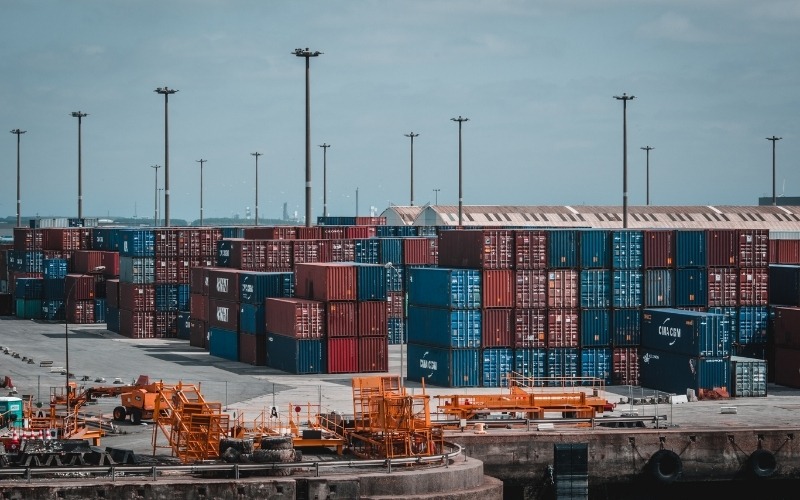
Indian SMEs can adopt key strategies to significantly reduce their overall shipping expenses:
1. Consolidate Shipments
Combining multiple small shipments into one larger Full Container Load (FCL) reduces the cost per unit. This practice helps maximise the efficiency of container space usage and minimises administrative processing fees. Consolidating shipments reduces the frequency of individual pickups and associated charges dramatically.
2. Negotiate Long-Term Contracts
Establishing committed volume contracts with preferred carriers can help secure much more favorable long-term pricing agreements. Carriers are often willing to offer substantial discounts in return for guaranteed, consistent shipping volume annually. This essential strategy helps stabilise costs even during periods of high market fluctuation.
3. Be Flexible with Shipping Times
Choosing non-peak shipping seasons or slightly slower transit times often results in much lower base transportation rates. Avoiding premium expedited services reduces the total cost of transportation significantly for non-urgent goods. Planning shipments further in advance offers carriers more scheduling flexibility and options.
4. Optimise Packaging and Weight
Lightweight but sturdy packaging reduces the total chargeable weight, particularly for expensive air freight shipments. Properly sized packaging prevents paying for unused or wasted dimensional space inside the commercial container. Reducing overall weight is a direct and immediate way to decrease a significant portion of the total final rate.
How Pazago Improves Freight Rate Stability and Execution Control
Freight rate volatility rarely comes from the base rate alone. It often escalates through fuel adjustments, container shortages, rollover risks, and unclear shipment visibility. Even when exporters understand freight rate meaning, execution gaps during booking and transit create cost unpredictability. Delays at cut-off, last-minute equipment changes, or limited status updates can quickly convert a well-calculated rate into a higher landed cost.
Pazago strengthens this execution layer by improving coordination, rate stability, and shipment-level visibility across international freight movements. Here is how execution reliability is reinforced:
- Competitive Freight Rates Through Long-Term Carrier Relationships: Stable rate structures across key trade lanes reduce exposure to sudden freight spikes that disrupt export pricing and margin planning.
- Assured Container Booking and Coordinated Loading: Confirmed equipment availability and structured loading coordination at factory, CFS, or port minimize rollover risks and protect planned dispatch schedules.
- Daily Status Reports (DSRs) for Shipment Visibility: Structured updates covering container movement, ETD and ETA shifts, transshipment events, and BL status help exporters manage buyer communication confidently during transit.
- Comprehensive Pre-Shipment and Post-Shipment Sales Support: Hands-on coordination across booking confirmations, documentation alignment, and shipment-level clarifications reduces operational friction throughout the freight cycle.
- Equal Operational Support Across Shipment Volumes: Consistent coordination regardless of shipment size ensures predictable execution, whether managing occasional exports or regular container volumes.
Stable freight execution reduces the likelihood of unplanned surcharges, demurrage exposure, and communication-driven delays, helping exporters maintain control over total freight cost outcomes.
Conclusion
Understanding freight rate meaning gives exporters clarity on cost structure, but sustained margin control depends on disciplined execution across booking, loading, and shipment monitoring. Applying consolidation strategies, long-term carrier engagement, and packaging optimization improves cost efficiency when paired with stable logistics coordination.
Pazago supports exporters by reinforcing freight execution reliability through competitive rate access, confirmed container availability, structured shipment updates, and consistent operational coordination. This approach helps maintain predictable shipping costs and protect delivery commitments in competitive global markets.

FAQs
Q. What is the difference between freight rate and shipping cost?
The freight rate is specifically the price charged by the carrier for the physical transportation service of the goods. The broader term shipping cost includes the freight rate plus insurance, customs duties, packaging, and local handling fees.
Q. Can freight rates be negotiated by Indian SMEs?
Yes, freight rates are very much negotiable, particularly for businesses that ship moderate or high volumes consistently and reliably. Negotiating long-term agreements with carriers or freight forwarders can often secure favorable discounts.
Q. How is chargeable weight determined for air freight?
Chargeable weight is calculated by comparing the shipment’s actual gross weight with its calculated dimensional weight. The dimensional weight is calculated using a specific formula based on the shipment's overall volume. The air carrier will charge based on whichever of these two calculated weights is higher.
Q. What does the Bunker Adjustment Factor (BAF) cover?
The BAF is a variable surcharge applied to ocean freight rates to compensate the carrier for volatile fuel price fluctuations globally. It helps shipping lines maintain profitability when the cost of bunker fuel rises unexpectedly.
Q. Why do freight rates fluctuate so frequently?
Freight rates are highly volatile because they are influenced by real-time factors like global demand, fuel costs, seasonal shipping periods, and geopolitical events. The rates reflect the constantly changing supply and demand dynamics for available shipping capacity.