.png)


Order Management in Logistics: How It Streamlines Supply Chain?

Optimize your business: use unlimited savings with Pazago fulfilled now!
Get Started ->International orders rarely move in straight lines. One buyer may split a single shipment across multiple locations, each with its own documents, timelines, and compliance checks. At the same time, new orders keep coming in from different markets, each moving at a different pace.
Without a clear system in place, coordination starts to break down. Freight forwarders wait for instructions. Customs agents flag missing paperwork. Production teams ask for delivery commitments. Finance looks for payment status. Information lives across emails, spreadsheets, and chat threads, and nothing connects.
This isn’t a volume problem. It’s a visibility problem. And it’s exactly what poor logistics order management looks like.
The good news is this can be fixed. With the right logistics order management approach, exporters can restore structure, visibility, and control to every shipment. Let’s break down what effective logistics order management actually looks like, and why it matters as your export volumes grow.
Key Takeaways
- Order management description encompasses receiving, processing, tracking, and fulfilling export orders whilst coordinating multiple international stakeholders across your supply chain.
- Effective order management reduces processing time, improves documentation accuracy, and enhances buyer communication through centralised information systems.
- Manual processes create costly errors in export documentation, payment delays, and coordination failures that damage buyer relationships.
- Technology-driven order management enables real-time shipment visibility, automated documentation workflows, and seamless multi-currency payment tracking.
- Integrated platforms like Pazago consolidate order tracking, stakeholder communication, document generation, and payment management into a single dashboard.
What Is Order Management Description in Export Operations?

An order management description defines the systematic approach to handling every stage of your export order lifecycle. It covers everything from quotation acceptance through final payment receipt, coordinating multiple stakeholders whilst maintaining complete visibility.
For Indian exporters, this process involves navigating international shipping regulations, customs clearance procedures, multi-currency transactions, and coordination across time zones.
Key differences from domestic fulfilment:
- Multi-stakeholder coordination: Shipping lines, customs brokers, freight forwarders, inspection agencies, banks, and buyers across time zones
- Documentation intensity: Commercial invoices, packing lists, bills of lading, certificates of origin, and country-specific compliance documents
- Regulatory compliance: Different requirements for each destination, UAE's legalised certificates, EU's packaging standards, and US customs declarations
- Currency management: Handling quotations, payments, and reconciliations across multiple currencies with fluctuating exchange rates
Your order management system must handle inventory validation, production scheduling, quality inspection coordination, container booking, documentation preparation, customs clearance, shipment tracking, and payment reconciliation seamlessly.
Must Read: Guide to Export Documentation Procedure
Why Order Management Matters for Indian Exporters?
Global trade competition intensifies every year. Buyers evaluate you not just on product quality and pricing, but on operational reliability and communication excellence. The exporters who win are those who make buyers' lives easier through consistent delivery and proactive updates. Modern order management has evolved from a back-office function to a strategic differentiator.
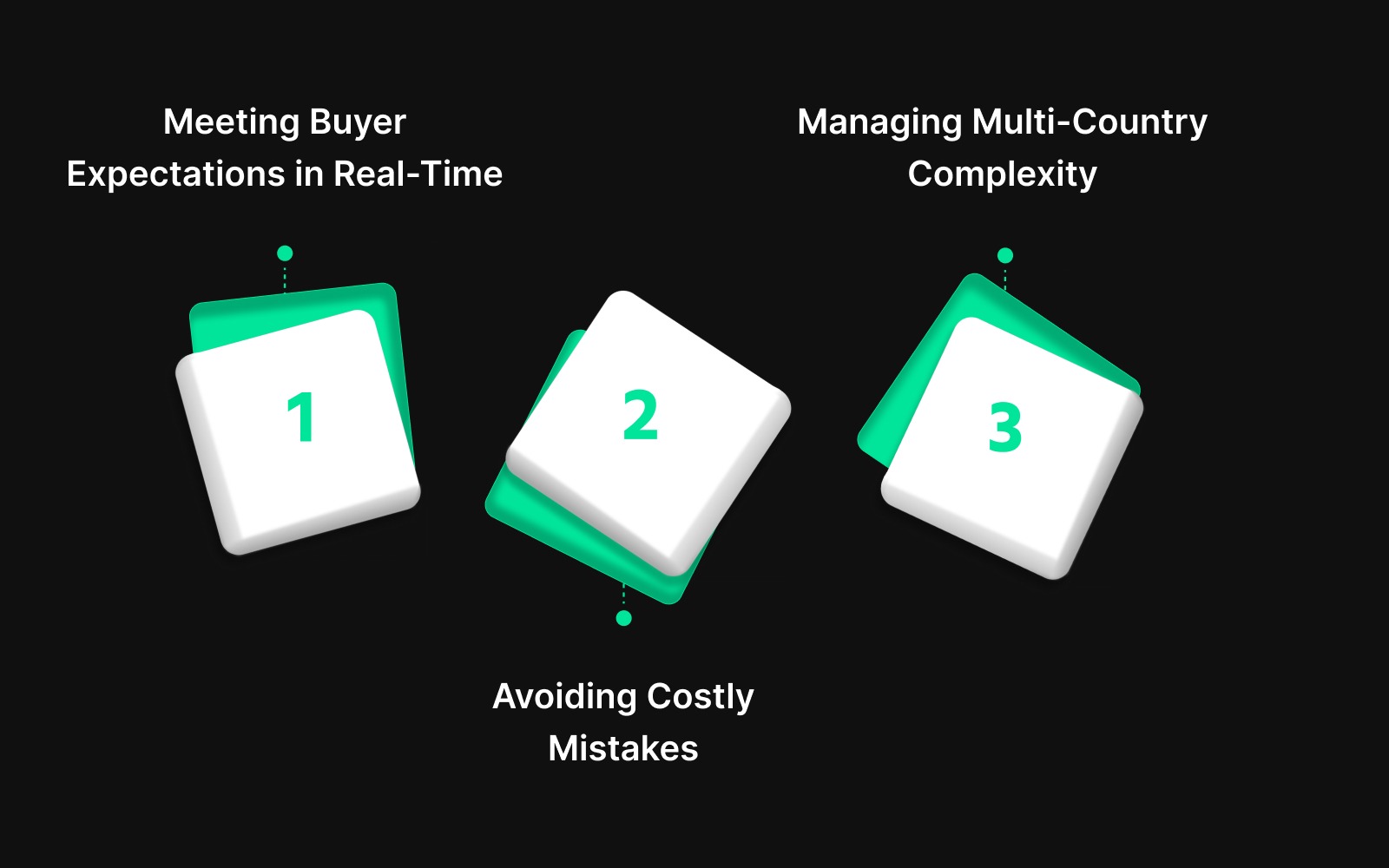
Meeting Buyer Expectations in Real-Time
International buyers operate with tight inventory schedules. They need precise information about shipment status, estimated arrival times, and potential delays. Your German buyer wants confirmation that their container will reach Hamburg on schedule. Your American client expects quality inspection updates before shipment. Your Australian customer can track whether the customs documentation is complete.
Modern order management gives you this visibility without requiring constant manual updates or late-night status calls across time zones. You automatically provide buyers with real-time information, which builds trust and demonstrates operational maturity.
Avoiding Costly Mistakes
Export errors carry expensive consequences:
- Documentation delays: Single errors can delay containers for weeks at ports
- Compliance failures: Incorrect HS codes trigger customs holds and penalties
- Payment delays: Mismatched invoices and letters of credit delay payment by months
- Demurrage charges: Container storage fees accumulate daily
- Expedited shipping costs: Airfreight expenses can erase order profitability
Effective order management catches errors early, validates information systematically, and prevents small mistakes from becoming expensive disasters.
Also Read: Understanding Essential Import & Export Delivery Documents
Managing Multi-Country Complexity
Each export destination brings unique requirements:
- UAE: Legalised certificates of origin through embassy attestation
- European Union: Packaging compliance, REACH regulations for chemicals
- United States: Detailed product declarations, importer security filings, and FDA compliance
- Australia: Biosecurity declarations and treatment certificates
Organised order management lets you template country-specific processes whilst maintaining flexibility for unique buyer needs.
Core Components of Effective Order Management

Building robust order management requires understanding its fundamental components. Each element plays a specific role in creating seamless export operations. Think of these components as interconnected gears, when one fails, the entire system suffers.
Order Capture and Validation
Order management begins when your buyer confirms their purchase. Strong order capture includes:
- Complete information collection: Product specifications, quantities, delivery schedules, payment terms, Incoterms, shipping addresses
- Single-entry principle: Information entered once flows through your entire process
- Immediate validation checks: Inventory availability, production capacity, delivery timeline feasibility
- Buyer confirmation: Automated acknowledgement with complete order details
Early validation prevents confirming orders you cannot fulfil and manages buyer expectations realistically from the beginning.
Inventory Synchronisation
Real-time inventory visibility prevents overselling and enables accurate order confirmation. Track:
- Current availability across all warehouses
- Quantities allocated to confirmed orders
- Work-in-progress and planned production
- Automated alerts when stock levels fall below thresholds
Effective inventory management ensures you never confirm orders you cannot fulfil.
Must Read: Creating a Packing List for International Exports
Production and Quality Coordination
For manufactured exports, aligning production timelines with shipping schedules prevents costly delays. Coordinate:
- Production milestones with early alerts for delays
- Quality inspection scheduling with buffer time before shipping
- Packaging completion meeting buyer specifications
- Certificate generation and compliance documentation
Booking containers too early creates storage costs. Booking too late causes missed shipping schedules.
Logistics and Shipping Coordination
This is where logistics order management delivers the greatest value. Every stakeholder needs different information at different times:
Structured order management ensures nothing falls through operational cracks.
Documentation Management
Export documentation must be accurate, consistent, and completed within strict deadlines. Workflow stages include:
- Creation: Generate documents from master order data
- Verification: Cross-check all documents for consistency
- Approval: Route through internal approval workflows
- Legalisation: Obtain necessary stamps and attestations
- Submission: Deliver to banks, customs, buyers
- Archival: Maintain organised digital records
Late or incorrect documentation delays shipments and holds up payments.
Also Read: Procurement Steps and Role in Supply Chain Management
Payment Tracking and Reconciliation
Orders aren't complete until payment is received. Track:
- Invoice generation aligned with shipment documentation
- Payment milestone tracking (advance, on-shipment, post-delivery)
- Currency conversion and exchange rate impacts
- Bank reconciliation: matching payments against invoices
- Aging analysis identifying overdue payments
Integration between order management and financial systems ensures automatic updates to payment status.
How Order Management Streamlines Your Export Supply Chain?

Understanding these benefits helps justify investment in proper systems. These advantages compound as order volumes grow and operational complexity increases.
Reduced Order Processing Time
Time savings breakdown:
- Order entry: From 30-45 minutes to 5-10 minutes with automated data capture
- Document creation: From 2-3 hours to 15-30 minutes with templates
- Stakeholder coordination: From dozens of emails to automated notifications
- Status updates: From manual checking to instant dashboard visibility
Orders that previously took days now complete in hours. Information flows automatically to relevant stakeholders. This speed advantage creates capacity for growth without proportional team expansion.
Improved Order Accuracy
Common errors eliminated:
- Quantity mismatches between orders and invoices
- Incorrect product codes or descriptions
- Wrong shipping addresses or buyer contacts
- Inconsistent pricing across documents
- Missing compliance certificates
Integrated order management significantly reduces manual handoffs. Data entered once flows automatically through your entire process, dramatically improving accuracy.
Enhanced Visibility Across Stakeholders
Visibility benefits by role:
- Sales team: Real-time order status for buyer updates, pipeline visibility
- Operations team: Production schedules aligned with shipping deadlines
- Finance team: Payment tracking, cash flow projections
- Management: Dashboard views of overall performance
- Buyers: Self-service access to shipment tracking
This transparency improves coordination and reduces hours spent in status update meetings.
Must Read: How Logistics Operations and Supply Chain Works
Proactive Problem Identification
Early warning indicators:
- Shipments are not tracking as expected based on historical timelines
- Documentation pending beyond normal processing windows
- Quality inspection failures requiring corrective action
- Payment delays exceeding the agreed terms
- Inventory levels approaching stockout thresholds
Good order management helps you spot problems early through systematic monitoring and automated alerts. Early identification means early resolution.
Better Customer Communication
Communication improvements:
- Automated updates: Triggered at key milestones without manual intervention
- Consistent messaging: Standardised formats ensuring professional communication
- Timely notifications: Sent immediately when status changes
- Self-service access: Buyers check status anytime without contacting you
Instead of manually checking shipping websites and sending emails, information flows to buyers automatically.
Common Order Management Challenges
Understanding specific challenges helps you address them systematically. These challenges are common but not inevitable with proper solutions.
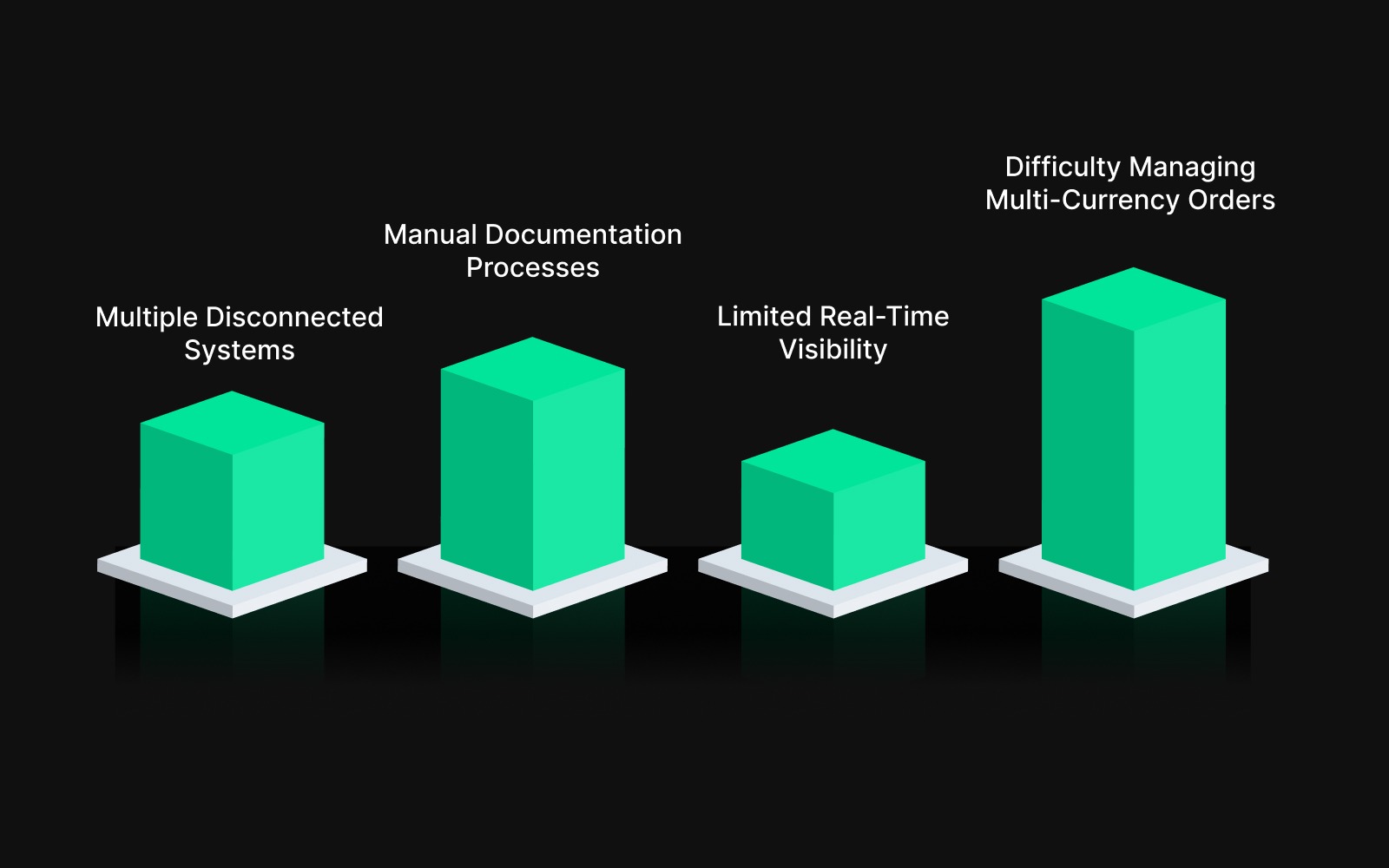
Multiple Disconnected Systems
Most exporters use different tools for different functions: emails for communication, Excel for tracking, WhatsApp for coordination, and separate accounting software. Information lives everywhere and nowhere simultaneously.
Fragmentation problems:
- Information silos in individual email inboxes or personal spreadsheets
- Version control issues are creating confusion
- Manual data transfer introduces errors
- Access limitations prevent team members from getting the needed information
- No single source of truth with conflicting information across systems
When buyers ask for order status, you check with multiple people across different systems before responding.
Manual Documentation Processes
Creating export documents manually is tedious and error-prone. You're pulling information from multiple sources, formatting documents, checking consistency, and routing for approvals.
Documentation bottlenecks:
- Hours spent on document creation instead of business development
- Manual data entry introduces typos and inconsistencies
- Documents sitting in email inboxes waiting for signatures
- Lost documents in email chains or filing systems
- Compliance risks from missing required documents
A single mistake means redoing everything, often under tight deadlines.
Also Read: Features and Functions of SCM Modules in Supply Chain Management
Limited Real-Time Visibility
When buyers enquire about order status, you begin a scavenger hunt. Operations confirms production status. Logistics checks shipping status. Documentation verifies paperwork completion.
Without real-time visibility, you're constantly reacting to questions instead of proactively providing information. This creates stress and makes buyers feel you don't have control over operations.
Difficulty Managing Multi-Currency Orders
Export operations involve constant currency juggling. You quote in USD, pay suppliers in INR, and receive payment in EUR.
Currency management challenges:
- Understanding true margins when costs and revenues are in different currencies
- Exchange rate fluctuations between quotation and payment affect profitability
- Reconciliation complexity: matching payments against invoices
- Bank charges from forex conversions and wire transfers
Poor currency management affects your bottom line and makes it difficult to understand true order profitability.
How Pazago Helps Exporters Master Order Management in Logistics
Order management breaks down in exports not because orders are missing, but because execution falls out of sync. Bookings move ahead of documents. Payments lag behind shipments. Buyers ask for updates that teams cannot answer with certainty.
Pazago supports exporters at this execution layer, helping orders move smoothly from confirmation to delivery by keeping logistics, documentation, and coordination aligned.
Bringing Structure to Orders Before Logistics Starts
Pazago helps exporters structure orders early, capturing buyer information, destination, product details, and commercial terms at the start. This clarity allows logistics planning, documentation, and payment milestones to move forward without last-minute corrections that disrupt shipment schedules.
Coordinating Logistics Across Long, Multi-Stage Export Cycles
Pazago supports exporters by keeping logistics coordination tied to each order. Shipment bookings, container movements, and handovers stay connected to the same order context, reducing confusion when timelines shift or multiple stakeholders are involved.
Keeping Documentation Aligned With Shipment Movement
Pazago helps exporters keep documentation aligned with shipment execution. Documents are prepared from the same order details used for logistics planning, reducing mismatches and rework. Certified and final documents remain linked to the shipment, ensuring they are ready when required for clearance or payment.
Maintaining Visibility After Dispatch
Pazago supports continuous visibility by keeping shipment status, milestones, and exceptions visible at the order level. This allows exporters to respond confidently to buyer queries, anticipate delays, and take corrective action before issues escalate.
Ready to transform how you manage export orders? Schedule a demo to see how Pazago streamlines logistics operations, reduces processing time, and helps you scale your export business efficiently.
Conclusion
Operational excellence separates successful exporters from those who struggle. Buyers work with exporters who communicate well, deliver consistently, and make their lives easier through reliable, transparent operations.
Effective order management in logistics directly impacts your ability to deliver this excellence. When you give buyers real-time visibility, respond instantly, and deliver without errors or delays, you build relationships that generate repeat business and referrals.
If managing export orders still feels reactive, fragmented, or dependent on follow-ups, it may be time to rethink how logistics execution is handled.
Pazago works with exporters to bring structure, visibility, and coordination to order management so shipments move as planned and buyers stay informed. Explore Pazago now
Frequently Asked Questions
1. What does an order management description mean in export logistics?
Order management description refers to the systematic process of handling export orders from quotation acceptance through payment receipt. It includes coordinating inventory, production, documentation, shipping, and stakeholder communication whilst maintaining visibility into order status at every stage.
2. How does order management improve export supply chain efficiency?
Order management streamlines operations by centralising information, automating repetitive tasks, reducing documentation errors, and providing real-time visibility. This significantly reduces processing time, improves coordination among stakeholders, and eliminates costly delays caused by miscommunication or missing information.
3. What are the biggest challenges in export order management?
Major challenges include disconnected systems that fragment information, manual documentation processes that are time-consuming and error-prone, limited real-time visibility requiring constant status checks, multi-currency complexity affecting profitability tracking, and coordination difficulties across different time zones.
4. Can small exporters benefit from order management systems?
Absolutely. Small exporters actually benefit more because order management systems let them compete with larger players through operational efficiency. They can handle more orders without proportionally expanding their teams, provide professional buyer communication, and maintain accuracy that builds trust with international clients.
5. How long does it take to implement an order management system?
Implementation timelines vary based on business complexity and existing processes. Cloud-based platforms like Pazago can be operational within weeks rather than months. The key is proper planning, comprehensive team training, and gradual migration from existing processes to avoid disrupting ongoing operations.