.png)


Restricted Items for Import in India: Full List & Documentation Rules
Optimize your business: use unlimited savings with Pazago fulfilled now!
Get Started ->One missing authorisation can turn a routine import into a cash-bleeding problem, shipments held at port, storage charges stacking up, and worst-case, goods seized.
While many products can be imported freely, certain regulated items receive extra scrutiny at customs. Understanding which products are restricted and the documents they require helps importers prevent delays and keep shipments moving smoothly.
This guide explains what “restricted” really means, how to identify potential red flags before your shipment moves, and the approvals you’ll need to avoid penalties or confiscation.
Key Highlights
- Restricted imports in India require DGFT authorisation and regulator approvals such as BIS, FSSAI, CDSCO, WPC, or MoEFCC, along with stricter customs checks.
- Categories like electronics, chemicals, food items, medical devices, wildlife goods, defence items, precious metals, scrap, and printed materials often fall under restricted status.
- Importing these items demands accurate documents, including the DGFT licence, Bill of Entry, invoice, packing list, and sector-specific certificates.
- Non-compliance can lead to detention, confiscation, penalties, prosecution, and increased scrutiny for future consignments.
What Are Restricted Items Under India’s Import Policy?

Under India’s Import Policy, restricted items are goods that cannot be imported freely and require prior approval, licensing, or compliance with specific conditions before they are allowed into the country. These controls are governed by India’s Foreign Trade Policy (FTP) and administered mainly by the Directorate General of Foreign Trade (DGFT), along with other regulatory authorities.
Restricted items are not completely banned, but their import is allowed only after meeting prescribed regulatory requirements. This distinguishes them from prohibited items, which are entirely forbidden from being imported under any circumstances.
Importing restricted items typically involves:
- Obtaining an import license or authorization from DGFT
- Submitting additional regulatory documents, such as certificates, test reports, or end-use declarations
- Complying with sector-specific regulations issued by authorities like BIS, FSSAI, CDSCO, WPC, or the Ministry of Environment, Forest and Climate Change (MoEFCC)
- Facing enhanced customs checks, including documentation verification and physical inspections
Restricted imports often cover goods that may impact public health, national security, environmental safety, or domestic industries.
Governing Authorities Regulating Restricted Imports in India

Restricted imports in India are regulated by different authorities based on the product type and risk involved. Knowing which agency applies to your goods helps you plan approvals, compliance documents, and clearance timelines correctly.
1. Directorate General of Foreign Trade (DGFT)
DGFT defines the import policy status of goods (free/restricted/prohibited), and issues import authorisations where required under the Foreign Trade Policy.
- Classifies items as Free/Restricted/Prohibited through policy notifications
- Issues import licences/authorisations for restricted items (when permitted)
- Publish conditions linked to specific HS codes and product categories
2. Central Board of Indirect Taxes and Customs (CBIC)
CBIC (through Customs formations) enforces import policy and allied laws at the border, ensuring restricted goods are cleared only when conditions are met.
- Verifies licences/authorisations and mandatory certificates at the time of clearance
- Conducts examination, sampling, and document scrutiny when required
- Applies actions for non-compliance (detention, seizure, penalties, re-export directions)
3. Bureau of Indian Standards (BIS)
BIS regulates product quality and safety for notified goods, especially under Quality Control Orders (QCOs) and mandatory certification requirements.
- Requires BIS certification/registration for certain product categories before sale/use in India
- Checks compliance with applicable Indian Standards for notified goods
- Non-compliance can block clearance or prevent lawful sale in the domestic market
4. Food Safety and Standards Authority of India (FSSAI)
FSSAI regulates the import of food items to ensure that safety, labelling, and hygiene standards are met before products enter the Indian market.
- Enforces food import clearance procedures, including documentation and inspection/testing
- Checks labelling and packaging compliance for imported food products
- Can order hold, rejection, or re-export for non-compliant consignments
5. Ministry of Environment, Forest and Climate Change (MoEFCC)
MoEFCC governs environmentally sensitive imports, including hazardous waste, certain chemicals, and materials with environmental impact.
- Controls imports that may pose environmental hazards (waste, scrap, hazardous substances)
- Implements permissions/procedures aligned with environmental rules and international commitments
- Non-compliance can lead to the refusal of clearance and enforcement action
6. Atomic Energy Regulatory Board (AERB)
AERB regulates items related to radiation and nuclear safety to prevent exposure risks and ensure secure handling.
- Oversees imports of radiation-emitting equipment and radioactive sources (as applicable)
- Requires approvals and safety compliance documentation for regulated items
- Ensures secure transport, storage, and usage conditions are met.
Also read: Emerging Logistics Tech Trends and Their Meaning
Complete List of Restricted Items for Import in India

Restricted status is decided HS-code-wise. Before you treat any product as “restricted,” first confirm the 8-digit ITC(HS) import policy on DGFT’s ITCHS (Import & Export Policy) portal, which is the source Customs and DGFT policy that aligns to.
1) Electronics & IT Products
Electronics restrictions usually come from mandatory BIS compliance and wireless (RF) approvals for devices that transmit.
- BIS CRS applies to many electronics/IT items (e.g., laptops/notebooks/tablets are listed under CRS)
- Wireless devices operating in de-licensed bands commonly require WPC Equipment Type Approval (ETA) for import/sale/use
- What to check before shipping: BIS CRS applicability + WPC ETA (if Wi-Fi/Bluetooth/RF) + exact ITC(HS) policy conditions on DGFT
2) Chemicals, Hazardous Substances & Industrial Inputs
These are restricted to manage worker safety and environmental risk, and many imports trigger documentation and regulator conditions.
- Chemical imports often need strong document readiness (classification, MSDS/SDS, end-use clarity) because restrictions can be linked to policy notes and environmental rules
- If the item falls under hazardous waste / controlled waste streams, MoEFCC procedures and checklists apply for import permissions and documentation
- What to check before shipping: whether the product is treated as “waste” under waste rules; whether DGFT policy notes impose a licence/conditions for your HS code
3) Food Products & Agricultural Commodities
Food and agri restrictions exist for public health and biosecurity, and clearance is process-driven.
- Food consignments typically require clearance through FSSAI’s Food Import Clearance System (FICS)
- Seeds/planting materials can require import permits and may be released under post-entry quarantine conditions, depending on the item
- What to check before shipping: FSSAI import process applicability + labelling compliance + Plant Quarantine permit/quarantine conditions for seeds/propagation material
4) Pharmaceuticals & Medical Devices
These are restricted to ensure safety and regulatory control, and licensing pathways are defined.
- Import of medical devices (where notified) requires an import licence in Form MD-15 via application Form MD-14 under the Medical Devices Rules
- What to check before shipping: whether your product is regulated as a drug/cosmetic/device + whether the MD-14/MD-15 import licensing route applies
5) Animals, Animal Products & Wildlife Items
This category is restricted to prevent disease entry and protect wildlife/biodiversity.
- Live animals/birds and animal-origin goods can trigger strict documentation and compliance checks at import due to disease-risk controls
- Wildlife-linked items can trigger additional scrutiny/permissions depending on species/material and applicable laws
- What to check before shipping: whether your product is animal-origin or wildlife-linked + documentary requirements (health/veterinary certificates, product identity and origin clarity)
6) Defence, Security & Dual-Use Items
These goods are restricted due to national security and often require multiple approvals.
- Restrictions are commonly expressed through DGFT’s HS-based policy conditions and controlled item frameworks (including strategic/dual-use controls)
- What to check before shipping: HS policy conditions + whether any strategic/dual-use controls apply to the product/end-use
7) Precious Metals, Jewellery & Currency Items
Controls here are sensitive and often depend on form, purity, route, and purpose.
- Many precious metal and currency-linked imports are tightly conditioned (policy + procedural controls vary by HS code and product form)
- What to check before shipping: exact HS classification and the specific “policy condition” text on DGFT ITCHS for that code
8) Waste, Scrap & Second-Hand Goods
This category is restriction-heavy because the wrong classification can convert a shipment into a non-clearable environmental compliance issue.
- Imports of hazardous/other wastes are governed by MoEFCC procedures and documentation checklists under the waste rules framework
- What to check before shipping: whether it is treated as waste/scrap under rules + whether the MoEFCC permission/document route applies + HS policy conditions
9) Books, Maps & Printed Material
Restrictions typically trigger when content affects sovereignty, security, or legal compliance.
- Maps and printed content can face seizure/hold if boundaries/content violate applicable rules (often determined during examination)
- What to check before shipping: content review for maps/boundaries + publisher/version control + avoid “mixed cartons” that hide restricted content
10) Alcohol, Tobacco & Related Products
This category is tightly controlled for public health and taxation, and rules vary across India.
- Alcohol and tobacco imports may require category-specific labelling and licensing controls (including state-level requirements for alcohol)
- E-cigarettes are not “restricted”; they are prohibited: the 2019 Act prohibits production, manufacture, import, export, sale, distribution, storage, and advertising
- What to check before shipping: category legality + labelling requirements + destination-state rules (for alcohol).
Also read: Popular Types of Logistic Management Software Tools
Documentation Required for Importing Restricted Items

Restricted imports require policy permission and regulator compliance proof in addition to standard Customs paperwork.
1. DGFT Import Authorisation / Licence
This is the core permission that allows the import of goods marked “Restricted” under the import policy.
- Needed when the ITC(HS) policy condition asks for DGFT authorisation/licence
- Must match HS code, description, quantity/value limits, IEC, validity dates, and any licence conditions
- Mismatch, expired validity, or exceeding limits commonly result in detention or non-clearance
2. Bill of Entry
This is the official Customs filing used for assessment of duty and clearance processing.
- Must align with invoice/packing list, HS classification, valuation, and attached approvals
- Incorrect HS code, incomplete product description, or inconsistent values trigger queries and examination
- Supporting documents are evaluated against declared details during assessment
3. Commercial Invoice and Packing List
These documents establish the commercial value and the shipment’s physical details for verification.
- The invoice should clearly show item description, unit price, total value, currency, Incoterms, and supplier/buyer details
- The packing list should show the package count, weights, dimensions, and item-wise quantities
- Discrepancies across the invoice, packing list, and Bill of Entry frequently cause clearance holds
4. Product-Specific Approvals (BIS / FSSAI / CDSCO / WPC, etc.)
These prove the product meets category-specific regulatory requirements before release into India.
- BIS compliance documents for notified electronics/industrial products are mandatory
- FSSAI clearance documentation for food imports, where applicable
- CDSCO import permissions/licences for drugs, medical devices, and cosmetics, where applicable
- WPC ETA/permissions for RF-enabled products (Wi-Fi/Bluetooth/IoT) where applicable
5. Pre-Shipment Inspection Certificate (Where Applicable)
Some restricted categories require inspection before shipment to confirm compliance and condition.
- Often relevant for certain scrap/waste streams and select second-hand machinery/capital goods cases
- Must match shipment identity, quantities, and declared condition/specifications
- Missing or unacceptable PSI documentation can block clearance even if other papers are complete.
Penalties for Importing Restricted Items Without Authorization
If restricted goods are imported without the required licence/approval or in breach of policy conditions, Customs can treat the shipment as an improper import and initiate adjudication.

1. Confiscation and Seizure of Goods
Customs can seize and confiscate goods imported in violation of import restrictions/prohibitions.
- Goods can be held at the port/ICD and seized during examination or post-clearance checks
- Confiscation is commonly invoked for breach of import restrictions (e.g., Section 111, including 111(d) scenarios)
- Clearance may be denied until the case is adjudicated or compliance is proven
2. Redemption Fine to Get Goods Released
Even when goods are confiscated, Customs may allow release on payment of a “redemption fine” (case-specific discretion).
- The importer may be given an option to redeem the confiscated goods by paying a fine under Section 125
- Release may still depend on completing missing approvals/licences (where a licence route exists)
3. Monetary Penalties on Importer and Others Involved
Penalties can be imposed on the importer and also on anyone who abets or handles goods liable to confiscation.
- Penalty exposure typically arises under Section 112 when the act/omission makes goods liable to confiscation
- Additional penalties can apply for false/incorrect documents or declarations (case-dependent)
4. Legal Proceedings and Prosecution Risk
Serious violations can escalate beyond fines into criminal proceedings under the Customs Act.
- Customs Act includes prosecution provisions for certain offences (used in higher-gravity cases)
- Investigations can extend to suppliers, CHA/customs brokers, and related parties if misdeclaration/abetment is alleged
5. Compliance Flagging and Future Shipment Disruption
Even when a shipment is released, the compliance history can increase scrutiny on future imports.
- Higher probability of examination, document queries, and longer clearance cycles after an adverse case history
- Greater internal compliance burden (stricter pre-checks, more frequent sampling, enhanced due diligence by logistics partners).
Also read: How Logistics Operations and Supply Chain Works
How to Check If an Item Is Restricted Before Importing
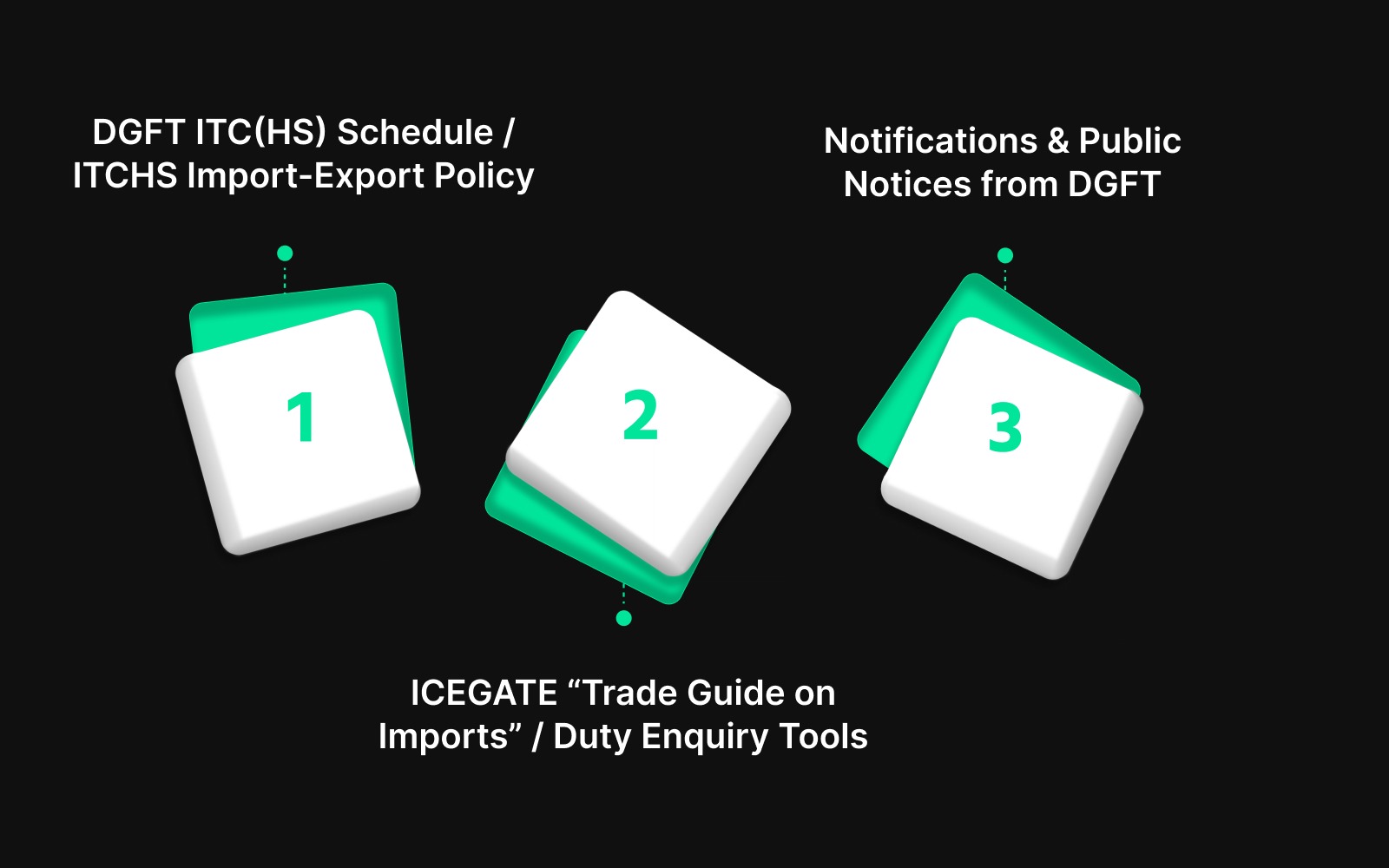
You can confirm restriction status reliably only by checking HS-code based policy and the latest government notifications. Do this before you book cargo, because “restricted” is enforced at clearance.
a. DGFT ITC(HS) Schedule / ITCHS Import-Export Policy
This is the primary source that shows whether an 8-digit HS code is Free / Restricted / Prohibited and lists the exact policy conditions.
- Search your 8-digit ITC(HS) on DGFT’s ITCHS-Based Import & Export Policy tool
- Read the “Policy” status and the Policy Condition text (this is where licence/permit/port/end-use conditions are written)
- Save a PDF/screenshot of the policy result for your shipment file and internal approvals
b. ICEGATE “Trade Guide on Imports” / Duty Enquiry Tools
ICEGATE helps validate tariff classification and support import guidance that’s useful for clearance planning.
- Use ICEGATE’s import guide tools to cross-check the tariff heading/description you’re using
- Use it as a secondary check alongside DGFT to reduce HS-code mismatch risk
c. Notifications and Public Notices from DGFT and Relevant Ministries
Restrictions change through notifications; checking the latest updates prevents using outdated policy assumptions.
- Review DGFT Notifications for amendments to import policy conditions (these can change “free vs restricted,” add port limits, add conditions, etc.)
- Check DGFT Public Notices for procedural changes and compliance requirements
- For regulated sectors, also track the concerned regulator’s updates (example: food/agri entry restrictions are referenced in DGFT’s import policy notes where applicable).
Common Challenges Importers Face with Restricted Items

Restricted imports usually get stuck due to coordination gaps, not because the goods are “illegal.” Here are the most common issues in a cleaner, easy-to-scan format.
How Pazago Supports Execution for Shipments Involving Restricted Imports
Once the required licences, certificates, and regulatory approvals are secured, the next challenge is executing the shipment without delays at the port or during transit. Even compliant shipments can face disruptions when container bookings, port cut-offs, and shipment coordination are not managed carefully.
Pazago supports exporters by strengthening logistics execution after regulatory requirements are in place, helping shipments move smoothly through the freight and port stages.
Here’s how Pazago helps:
- Competitive Freight Rates Through Strong Shipping Line Relationships: Pazago’s long-term relationships with major shipping lines help exporters secure stable and competitive freight rates across key routes, making cost planning easier even for regulated shipments.
- Assured Container Booking & Coordinated Loading: azago ensures confirmed container bookings and coordinates loading with factories, CFS facilities, and port terminals. This helps exporters align cargo readiness with vessel cut-offs and avoid missed sailings.
- Daily Status Reports (DSRs) For Shipment Visibility: Exporters receive structured daily updates covering container movement, ETD and ETA changes, transshipment updates, and delay alerts. This visibility helps exporters respond quickly when shipment timelines change.
- Operational Support Across The Shipment Lifecycle: Whether managing occasional shipments or continuous export cycles, Pazago provides consistent operational coordination to help exporters move cargo reliably through the logistics process.
Conclusion
Importing restricted items into India requires careful attention to licensing conditions, regulatory approvals, and documentation accuracy. Missing approvals or incorrect paperwork can quickly lead to detention, penalties, or shipment disruption at the port.
However, regulatory compliance is only one part of the process. Once approvals are secured, the shipment still depends on reliable logistics execution, confirmed container bookings, and clear visibility into vessel schedules and cargo movement.
Pazago supports exporters by strengthening the logistics layer around international shipments. Through stable freight planning, coordinated container booking, and structured shipment visibility, exporters can reduce delays, respond quickly to operational changes, and move cargo with greater predictability.
Contact Pazago to explore how structured logistics coordination can help you manage export shipments more reliably.
FAQs
1) What does “Restricted” mean in India’s import policy?
“Restricted” means the item is allowed to be imported, but only if you meet specific conditions, usually a DGFT authorisation/licence and/or regulator approvals. Without those, Customs can hold or stop clearance.
2) Is a restricted item the same as a prohibited item?
No. Restricted items can be imported with permission/conditions. Prohibited items cannot be imported at all under any circumstances, so there’s no licence route to legalise the import.
3) How do I confirm if my product is restricted?
Check the 8-digit ITC(HS) on DGFT’s ITCHS portal and read the policy condition text for that HS code. Don’t rely on product names; classification drives the restriction.
4) Why do restricted shipments get delayed at the port?
Most delays happen due to missing approvals (DGFT/BIS/FSSAI/CDSCO/WPC, etc.), inconsistent descriptions/HS codes across documents, or additional checks like examination/sampling triggered by restricted status.
5) Can I apply for the licence after the goods arrive?
In many cases, arriving without the required authorisation is treated as non-compliance and can lead to detention, penalties, or even confiscation. Best practice is to secure permissions before booking a shipment or before arrival.