.png)


When Should a Shipment Be Inspected for Quality? 8 Key Checks for Exporters

Optimize your business: use unlimited savings with Pazago fulfilled now!
Get Started ->Quality issues in exports rarely appear overnight. Most problems start much earlier in the supply chain and surface only when shipments are rejected, delayed, or returned. This is why exporters often ask a critical question: when should a shipment be inspected for quality to avoid costly surprises?
For Indian exporters dealing with international buyers, inspections are not optional. They are a safeguard against compliance failures, financial losses, and damaged buyer relationships. Knowing the right inspection stages helps you maintain consistent quality and protect your export operations.
This guide explains when quality inspections should be conducted, the best practises at each stage, and how exporters can reduce risk while meeting global trade standards.
Key Takeaways
- Inspect shipments at multiple stages, including pre-production, in-process, pre-shipment, container loading, and upon arrival, to maintain quality and compliance.
- Early inspections prevent defective materials from entering production, reducing rework, scrap, and shipment delays.
- Focused, risk-based inspections save time and resources while ensuring high-value, fragile, or regulated goods are protected.
- Accurate documentation and compliance checks help avoid customs delays, fines, and disputes.
- Structured inspection routines with integrated tools improve customer trust, protect profit margins, and ensure supply chain reliability.
Why Are Quality Inspections Important for Exporters?

Ensuring product quality is critical for exporters. Defective materials, poor handling, or non-compliance with buyer and regulatory requirements can lead to delays, penalties, and lost trust.
Strategic inspection at key stages of production and shipment ensures problems are identified and addressed when corrective action is still possible.
Examples:
- Inspecting raw materials for tensile strength in steel sheets prevents faulty production.
- Checking pharmaceutical labels ensures compliance with buyer and regulatory requirements.
Also read: Essential Shipping Documents Every Importer and Exporter Should Know.
Knowing the key inspection stages is essential, but to prevent delays and ensure compliance, exporters must follow specific checkpoints.
How Do You Know When a Shipment Should Be Inspected? 8 Essential Checks
Even minor defects, mislabelling, or documentation errors can cause delays, financial loss, or damage to brand reputation. By inspecting shipments at the right stages, exporters can mitigate risks, ensure compliance, and maintain customer trust.
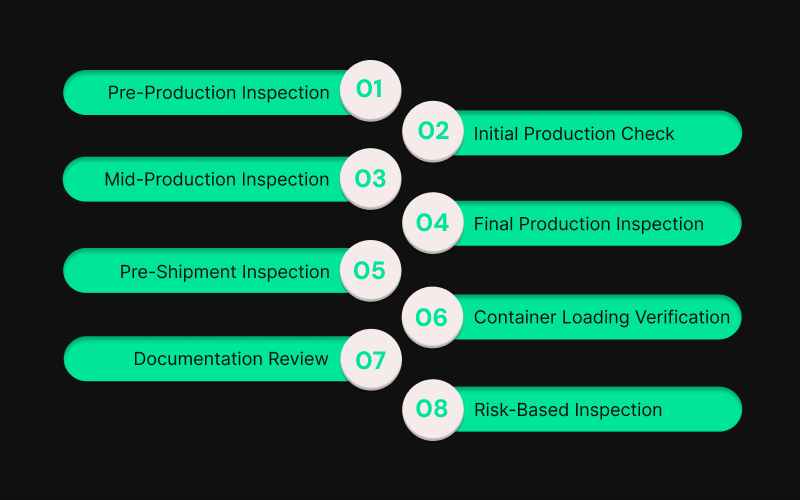
Here are 8 essential inspection points with practical examples and their impact.
1. Pre-Production Inspection
Before production begins, verify the availability of raw materials, components, and suppliers. Check for material defects, proper certification, and conformity to buyer specifications.
Example: For an electronics shipment, inspect incoming copper wires for correct gauge and insulation quality.
Impact: Prevents defective materials from entering production, reducing rework or scrap. Early intervention ensures production starts on a strong quality foundation.
2. Initial Production Check
Inspect early batches during production to confirm that the manufacturing process meets quality standards. Evaluate dimensions, assembly accuracy, and adherence to design specifications.
Example: In a furniture order, check the first few chairs for correct screw placement, frame alignment, and surface finish.
Impact: Detects process deviations early, preventing defects from propagating through the batch. Corrective actions can be implemented without halting the entire production process.
3. Mid-Production Inspection
Monitor production at intermediate stages to track consistency in quality, functional performance, and material usage. Focus on critical parameters like tolerance adherence, proper assembly, and component alignment.
Example: For a textile shipment, examine fabric rolls for colour consistency, stitching quality, and proper finishing before the final batch.
Impact: Maintains uniform quality, prevents cumulative defects, and provides exporters with real-time insights into manufacturing quality trends.
4. Final Production Inspection
Conduct a thorough review of finished goods before packaging. Check dimensional accuracy, surface quality, operational performance, and adherence to specifications.
Example: For a batch of machinery parts, confirm that all gears and shafts meet specified tolerances and operate smoothly.
Impact: Ensures only products meeting quality standards move forward, reducing returns, customer complaints, and potential brand damage.
5. Pre-Shipment Inspection
Inspect goods post-packaging to confirm correct labelling, quantities, packaging integrity, and adherence to buyer-specific or destination-country requirements.
Example: For a pharmaceutical shipment, verify that bottles are sealed, labels match the batch numbers, and the packaging includes the necessary regulatory inserts.
Impact: Confirms shipment readiness, reduces transit damage, and ensures compliance with regulations, preventing rejection at customs or by buyers.
6. Container Loading Verification
Verify that products are loaded correctly, secured, and optimised to prevent shifting during transit. Check stacking, weight distribution, and protective materials.
Example: For a shipment of glassware, inspect padding and spacing in containers to avoid breakage during transit.
Impact: Prevents in-transit damage, preserves product integrity, and reduces insurance claims. Proper loading ensures goods arrive as intended.
7. Documentation Review
Ensure all export documents, including commercial invoices, packing lists, certificates, permits, and compliance documentation, are accurate and complete.
Example: For an electronics shipment to Europe, confirm CE certificates are attached and invoice values match the packing list.
Impact: Prevents customs delays, fines, and shipment holds. Accurate documentation strengthens audit readiness and ensures smooth verification at destination ports.
8. Risk-Based Inspection
Not all shipments carry the same risk. High-value, fragile, or regulated goods require more frequent or detailed inspections. Consider supplier history, past quality trends, and product complexity.
Example: For a shipment of lithium-ion batteries, implement additional safety and performance checks due to high-risk handling requirements.
Impact: Focused inspections prevent critical failures while reducing unnecessary checks on low-risk goods, saving time and costs.
Once shipments are inspected at the right stages, exporters start seeing tangible results.
5 Benefits of Implementing Regular Shipment Inspections

Regular shipment inspections are essential for maintaining product quality and safeguarding your supply chain. By proactively monitoring shipments, exporters can prevent costly errors, ensure compliance, and build stronger relationships with buyers.
Key advantages include:
- Early Defect Detection: Consistent inspections catch issues such as damaged goods, incorrect labelling, or packaging errors before they escalate, reducing returns, recalls, and rework costs.
- Improved Customer Satisfaction: Reliable quality builds trust. When shipments consistently meet buyer expectations, it strengthens long-term partnerships and repeat business.
- Supply Chain Risk Mitigation: Inspections reveal recurring problems with suppliers or processes, enabling exporters to address root causes and prevent future disruptions.
- Regulatory Compliance: Regular inspections ensure shipments meet international standards, certifications, and destination country regulations, reducing the risk of customs delays or penalties.
- Cost Efficiency: Detecting issues early prevents large-scale losses, reduces emergency logistics costs, and enables better resource planning across the supply chain.
Also read: 7 Steps to Streamline and Improve Your Supply Chain Process
By implementing a structured inspection routine, exporters not only protect profit margins but also enhance operational efficiency and reliability across the supply chain.
Top 4 Shipment Inspection Challenges and Best Practises for Exporters
Maintaining consistent product quality across shipments is a critical concern for exporters. However, the inspection process often faces challenges, including delayed feedback, inconsistent reporting, and limited visibility across suppliers and destinations.

By understanding these challenges and applying best practises at each stage, exporters can prevent costly errors, reduce delays, and ensure customer satisfaction.
1. Inconsistent or Conflicting Inspection Reports
One common challenge is receiving inconsistent or conflicting inspection reports, especially when multiple inspectors or agencies are involved. Such discrepancies can create confusion and delay corrective actions.
Best practises:
- Clearly define inspection criteria, including product specifications, tolerances, packaging standards, and labelling requirements.
- Standardising report formats ensures consistency across all inspections.
- Additionally, working with experienced and reliable inspection partners helps maintain professional oversight and accurate evaluations.
2. Delayed Communication of Findings
Late communication of inspection results is another significant challenge. When defects are identified too late, there is little time to implement corrective measures, which can disrupt shipment schedules and impact delivery commitments.
Best practises:
- Schedule inspections at strategic points, such as during production or before shipment, to allow sufficient time for corrective action.
- Use digital platforms to share inspection results in real time with all relevant stakeholders.
- Maintaining a centralised communication system ensures that everyone involved in the export process stays informed and aligned.
3. Limited Visibility Across Shipments and Suppliers
Exporters often struggle with tracking inspection status across multiple suppliers, warehouses, or international destinations. Limited visibility can lead to overlooked issues or inconsistent quality standards.
Best practises:
- Implement a centralised digital inspection system that provides a complete overview of inspection progress and results.
- Maintain detailed logs of each inspection, including dates, findings, and follow-up actions.
- Integrating inspection data with overall export order management helps address potential issues promptly.
4. Inspections Conducted Too Late
Inspections performed at the last minute are less effective because identifying issues right before the shipment leaves minimal time for remediation. This can increase costs and the risk of shipment delays.
Best practises:
- Plan inspection schedules strategically to allow sufficient time for corrective measures.
- Random sampling can efficiently assess product quality without checking every unit, saving time while maintaining accuracy.
- Aligning inspection timelines with logistics schedules ensures that shipments proceed smoothly without unexpected delays.
Addressing common challenges and implementing best practises, exporters can transform shipment inspections from a reactive task into a proactive quality-control measure.
Critical Compliance Checks and Their Impact on Shipment Success
Compliance with international quality standards and destination regulations is critical for exporters. Inspections not only verify product quality but also ensure that shipments meet legal, industry, and buyer-specific requirements.
Properly conducted inspections reduce the risk of customs delays, rejections, and costly disputes, while supporting audit readiness and long-term supplier reliability.
The table below highlights key compliance aspects and their impact on shipments:
With proper inspection planning and compliance checks in place, exporters can streamline quality control across shipments.
Manage Shipment Inspections Without Disrupting Logistics with Pazago
Quality checks often fail when they happen outside the logistics plan. The inspection gets scheduled late, the stuffing date moves, documents stay pending, and the container still rolls to meet ETD.
Pazago helps exporters align inspection checkpoints with shipment execution timelines, so quality checks happen at the right time without breaking your booking and cut-off timelines.
Inspection planning tied to booking and port cut-offs
Set inspection checkpoints (in-process, pre-shipment, container loading) against key logistics dates such as stuffing, gate-in, document cut-off, and ETD. This reduces “inspection found late” surprises that trigger rollovers.
Container-level coordination for loading and sealing
When inspections must happen during packing, stuffing, or before seal closure, Pazago helps exporters keep shipment and container updates aligned. Teams can track loading verification updates and seal confirmations alongside shipment progress.
Document readiness linked to inspection status
Store inspection reports, test results, and certificates alongside shipping documents. This helps you avoid last-minute holds when a forwarder, CHA, or buyer asks for proof before clearance or BL release.
Visibility and accountability across logistics partners
Keep inspection actions, notes, and handoffs tied to the shipment. This helps operations, quality, and logistics teams stay aligned on what’s cleared, what’s pending, and what can move to dispatch.
Conclusion
Quality inspection timing works smoothly when it fits the logistics plan. If checks happen too late, exporters face rework, missed cut-offs, rollovers, and buyer disputes. If checks happen too early without shipment context, results go stale and teams repeat work.
The reliable approach is simple: align inspections to production readiness, packing, stuffing, and final dispatch milestones, and keep inspection proofs ready before documentation cut-offs and clearance steps.
Pazago supports this by tying inspection checkpoints to shipment timelines, container steps, and export documents in one workflow, so shipments move on schedule with fewer quality surprises.
Want inspections to support on-time dispatch instead of slowing it down? Book a Demo and see how Pazago keeps quality checks aligned with logistics milestones.
FAQs
1. When should a shipment be inspected for quality?
A shipment should be inspected for quality before production begins, during manufacturing, and most importantly, before shipment dispatch to confirm it meets buyer and regulatory requirements.
2. Who is responsible for quality inspection in exports?
The exporter is responsible, but inspections are often conducted by internal QC teams, third-party inspection agencies, or buyer-appointed inspectors, depending on the contract terms.
3. Is quality inspection required for every export shipment?
Not always. Mandatory inspection depends on the destination country, product category, buyer requirements, and regulatory norms. However, inspections are strongly recommended to reduce the risk of rejections.
4. Can quality inspection be done after the shipment is dispatched?
Post-shipment inspection is rarely effective. If defects are found after dispatch, resolving claims becomes costly and time-consuming, especially for international shipments.
5. Does quality inspection replace other export documentation checks?
No. Quality inspection complements documentation checks. Both product quality and accurate export documents are essential for smooth customs clearance and buyer acceptance.