.png)


Dead Freight: Meaning, Causes, and How to Prevent It
Optimize your business: use unlimited savings with Pazago fulfilled now!
Get Started ->Every exporter books cargo space to deliver orders on time, but what happens when part of that space goes unused? Shipping lines still charge for it. This charge is called dead freight.
It’s one of the least discussed yet most common cost leaks in export logistics. Dead freight may look small per shipment, but it adds up quickly across multiple export orders.
Understanding how it works and how to avoid it helps you protect margins, plan logistics better, and strengthen your control over freight costs.
Key Takeaways
- Dead freight = paying for unused booked space. You’re charged when your shipment uses less cargo space than reserved, a common hidden export cost.
- It directly raises per-unit freight costs. Even one partially filled container can reduce margins across multiple orders.
- The main causes are poor forecasting and miscommunication. Late production updates and inaccurate booking data trigger penalties that could be avoided.
- Structured visibility prevents losses. Platforms like Pazago connect orders, logistics, and payments, helping exporters reduce operational gaps and improve shipment coordination.
Dead Freight Meaning Explained for Exporters
Dead freight is the penalty charged by a carrier when booked cargo space is not fully used. In simple terms, you pay for the space you reserved, even if you didn’t ship the full volume.
It compensates the carrier for lost revenue since the empty space could have been sold to another shipper.
Example: If you booked space for 10 containers but shipped only 8, you may still pay for the remaining 2.
Why do shipping lines charge dead freight?
Carriers plan vessel loads in advance. When booked cargo doesn’t show up:
- They lose potential revenue from other exporters who could have used that space.
- Ship schedules and stowage plans get disrupted.
- Ports face inefficiencies and loading delays.
Dead freight ensures the carrier recovers part of that loss, a standard clause in most freight agreements and charter party contracts.
Where does dead freight apply most often?
Dead freight usually applies to:
- Full Container Load (FCL) bookings where you fail to meet the committed container volume.
- Bulk shipments (chartered vessels) where contracted tonnage isn’t fully loaded.
- Air freight or LCL bookings with reserved pallet or cubic space not used.
It is not limited to exporters, but exporters experience it more often because of production delays, documentation errors, and last-minute order changes.
What dead freight is not
Dead freight is often mistaken for other shipping penalties, but it’s different:
Dead freight is unique because it deals with unused cargo space, not time, not delay.
Also Read: Guide to Various Types of Freight and Shipping Charges
How Dead Freight Arises in Export Operations?
Dead freight rarely happens by accident; it’s the result of timing, coordination, or communication gaps across export operations. For many exporters, the cause is not poor intent but poor visibility.
Common scenarios that lead to dead freight
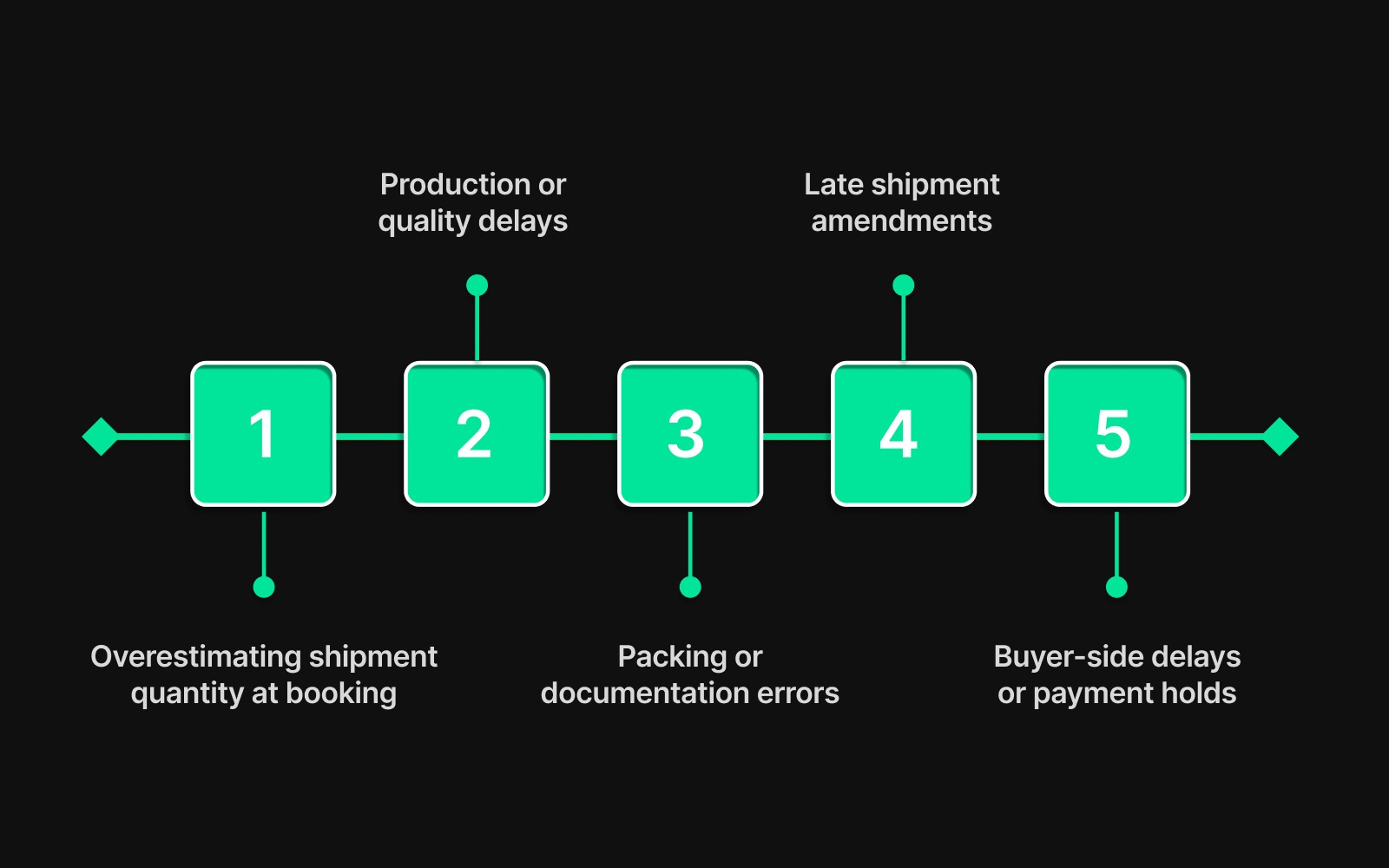
- Overestimating shipment quantity at booking: Exporters often reserve space based on expected production output. If production falls short or the order quantity changes, unused space triggers dead freight.
- Production or quality delays: When goods are not ready by the loading date, the container sails partly empty, or the booking is cancelled too late to reassign the space.
- Packing or documentation errors: Incorrect dimensions, weights, or incomplete export documents can stop part of the cargo from being loaded on time.
- Late shipment amendments: Changing shipment details close to departure, container type, product mix, or buyer, can leave unused space that still incurs cost.
- Buyer-side delays or payment holds: Sometimes, buyers delay shipment clearance or payment confirmation, leaving exporters with booked but unused freight slots.
Contract terms that influence dead freight
Dead freight is covered under charter party or freight contracts, and exporters often overlook these clauses.
Understanding these terms at the time of booking helps exporters plan space more accurately and reduce unnecessary costs.
Why exporters are more exposed to dead freight
Export shipments are longer and more complex than domestic deliveries. Factors like multiple hand-offs, overseas documentation, and uncertain production timelines make forecasting harder.
Exporters who coordinate better between production, logistics, and finance can significantly reduce the chance of paying for empty space.
Also Read: Common Types of Shipping Methods for Businesses
Simple Dead Freight Calculation for Export Shipments
Dead freight is easy to understand mathematically; the challenge lies in tracking accurate data.
Step-by-step calculation logic
Here’s a simple way to calculate potential dead freight:
- Agreed cargo quantity: What you committed to ship (e.g., 10 containers).
- Actual cargo quantity: What you actually shipped (e.g., 8 containers).
- Difference = Booked – Shipped = 2 containers.
- Freight rate = ₹40,000 per container.
- Dead freight = 2 × ₹40,000 = ₹80,000 (penalty payable).
This can also be applied by weight or cubic meter (CBM) for bulk or LCL shipments.
Example table: FCL vs LCL
The total cost might look small for one order, but it compounds fast across multiple shipments, especially when export volumes rise.
What to remember
- Calculation is simple; prevention is not. The key lies in synchronising data between booking, production, and shipment.
- Partial shipment accuracy helps; book only what you’re sure to load.
- Early communication with carriers can sometimes reduce or waive partial dead freight if alternate cargo is found in time.
How Dead Freight Affects Your Export Costs and Profitability?
Dead freight doesn’t just add a line item to your shipping bill; it changes your overall cost structure. For exporters managing thin margins, even one unplanned charge can make a difference.
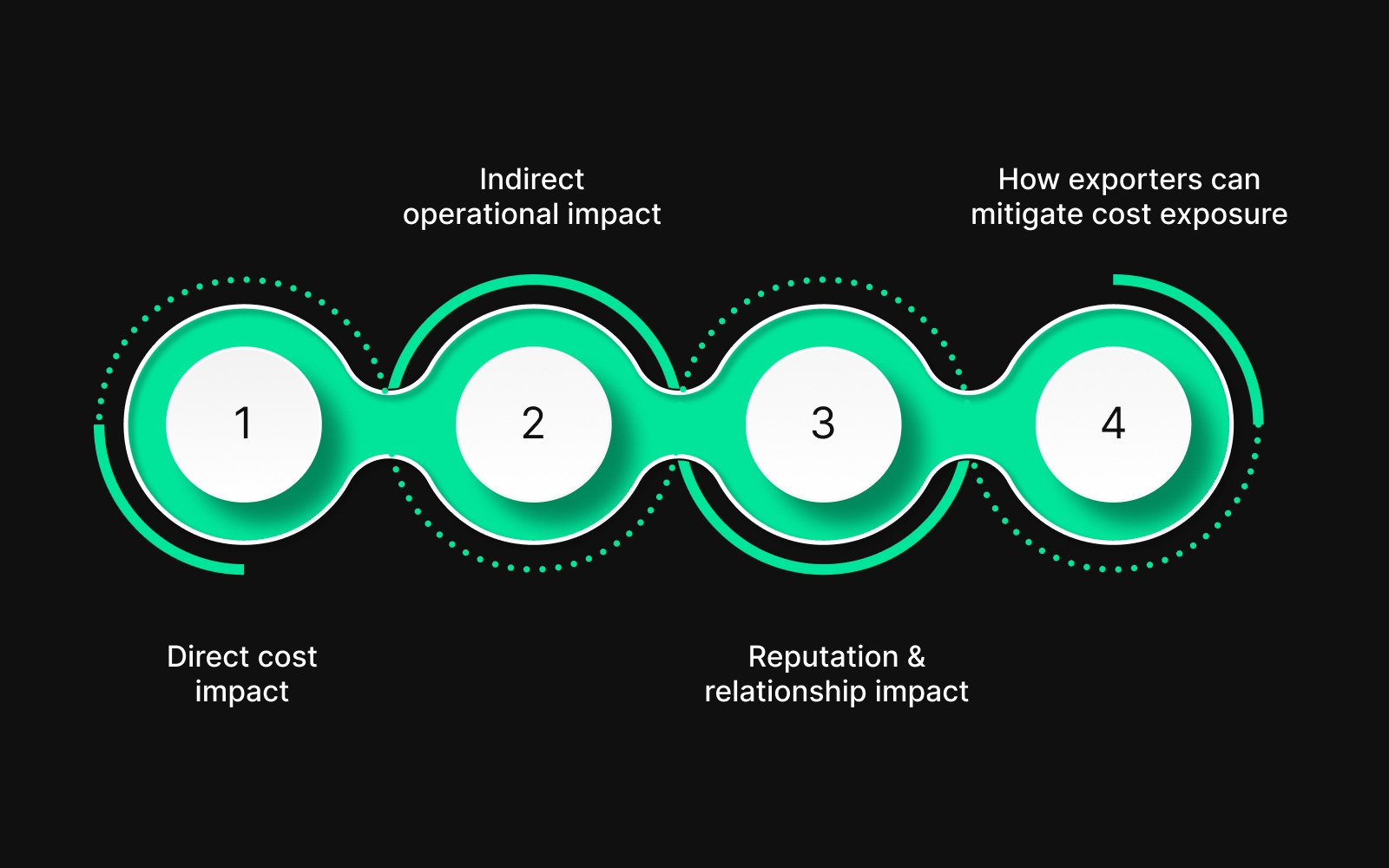
Direct cost impact
Dead freight is a non-recoverable expense. When you pay for unused cargo space, you absorb that cost entirely. This can:
- Raise the cost per unit shipped, especially when shipment volume drops.
- Reduce your gross margin for the order.
- Distort cost calculations for future pricing or buyer quotations.
Example: If you planned for ₹5 lakh freight cost on 10 containers but shipped only 8, you still pay ₹5 lakh. Your freight cost per container jumps from ₹50,000 to ₹62,500, a 25% increase.
Indirect operational impact
The financial cost is only one side of the problem. Dead freight often reflects deeper operational issues.
- Disrupted cash flow: More money goes out than planned, straining short-term liquidity.
- Reduced working capital efficiency: Funds blocked in logistics costs cannot be used for production or raw materials.
- Loss of predictability: Freight cost variations make it harder to estimate margins accurately across shipments.
Reputation and relationship impact
Carriers track how consistently exporters honour bookings. Frequent space wastage can lead to:
- Lower carrier priority during high-demand periods.
- Reduced flexibility in negotiations or rate contracts.
- Limited access to premium sailing schedules.
Strong operational discipline builds credibility, making future bookings smoother and sometimes cheaper.
How exporters can mitigate cost exposure
You can reduce cost volatility by:
- Matching booking quantities with confirmed production schedules.
- Using rolling forecasts instead of fixed bookings.
- Tracking shipment status and changes through structured systems.
Platforms like Pazago help exporters track production readiness, container allocation, and shipment timelines, reducing the risk of paying for empty cargo space and improving cost predictability.
Dead Freight vs Related Shipping Cost Penalties
Dead freight is often confused with other shipping penalties that appear in logistics invoices. Understanding the differences helps you negotiate better and manage risks more precisely.
Dead freight vs demurrage
Tip: Dead freight is about space, while demurrage is about time.
Dead freight vs detention
Detention charges occur after shipment, while dead freight arises before or at loading.
Dead freight vs cancellation or amendment fees
Cancellation fees apply when a booking is withdrawn close to departure, even before containers are allocated. Amendment fees apply when shipment details are changed late (for example, port or vessel change).
Dead freight, however, is charged after space is blocked but not fully used. It’s the outcome of under-utilisation, not outright cancellation.
Why exporters must track all three
For accurate freight cost control:
- Review invoices carefully for which fee applies.
- Keep shipment change logs internally.
- Track recurring patterns — repeated dead freight or demurrage issues often signal planning or communication gaps.
Also Read: Understanding the Difference Between Demurrage and Detention in Shipping
How to Reduce or Avoid Dead Freight Charges?
Dead freight is preventable. The key is improving visibility and communication across production, logistics, and documentation teams. Exporters who act early often manage to reduce or completely avoid these charges.
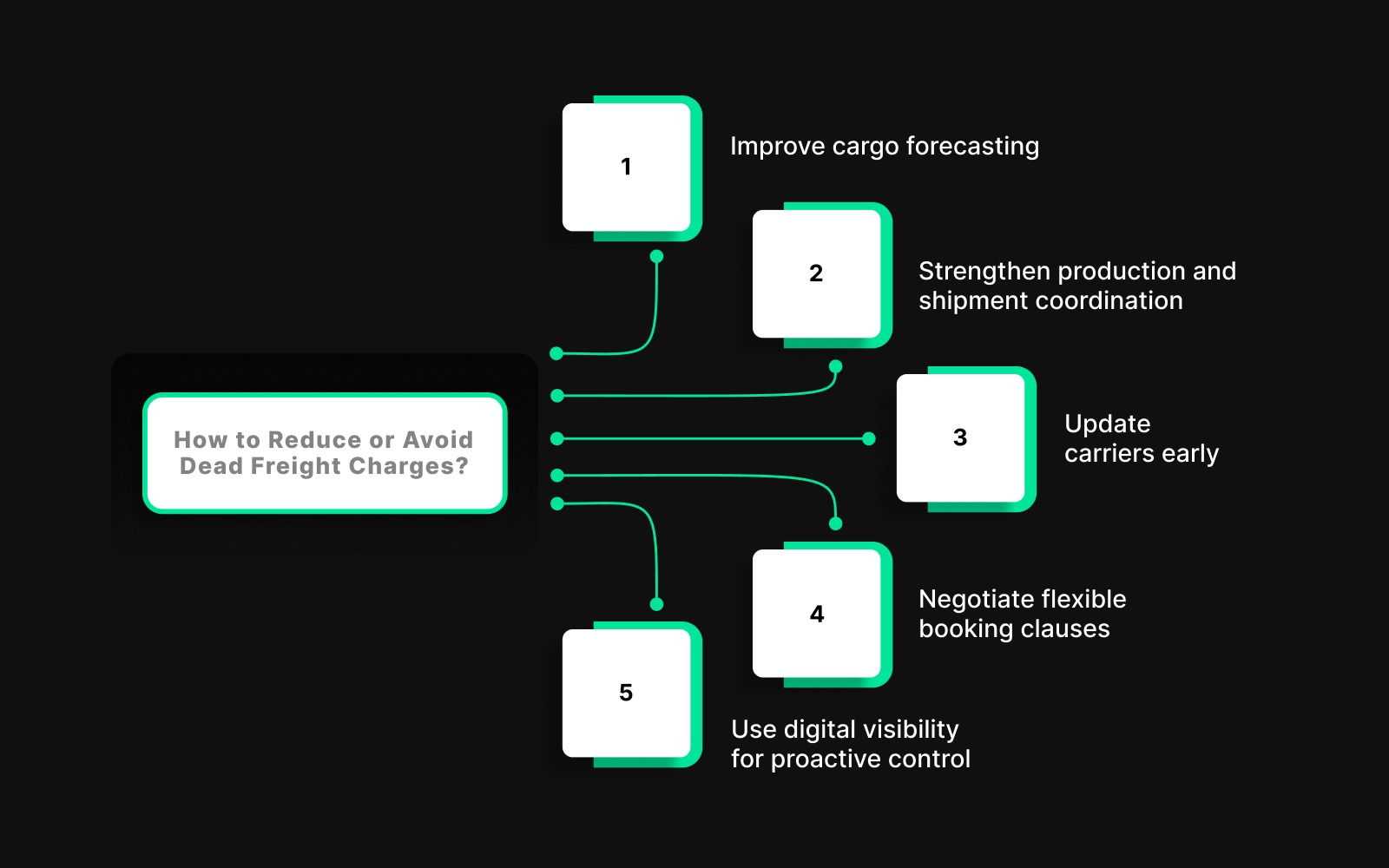
1. Improve cargo forecasting
The first step to avoiding dead freight is accurate planning.
- Match booking volumes with realistic production capacity.
- Use rolling forecasts instead of static monthly estimates.
- Track buyer confirmations before finalising space with the carrier.
Exporters who forecast demand with real data, not assumptions, rarely pay for unused space.
2. Strengthen production and shipment coordination
Dead freight often happens because teams operate in silos.
- Make sure logistics teams are informed of any production delays immediately.
- Build a system where shipment readiness is visible across departments.
- Share loading plans and final packing lists before booking confirmation.
The earlier carriers are informed of changes, the easier it is to reallocate space and avoid penalties.
3. Update carriers early
If you realise you won’t be able to fill all the booked space:
- Notify the carrier as soon as possible.
- Request to reduce booking quantity or reschedule space.
- Document the change via official channels or digital confirmations.
Carriers often waive or reduce dead freight charges if informed in advance and if alternate cargo can be arranged.
4. Negotiate flexible booking clauses
Exporters can negotiate contracts with flexible or rolling load clauses:
- Adjustable space commitments within a defined percentage.
- Cancellation windows that allow booking changes without full penalty.
- Partial load terms for regular shippers with predictable frequency.
Having these clauses helps manage uncertainty in production-heavy industries such as textiles, engineering goods, and food exports.
5. Use digital visibility for proactive control
Manual updates and WhatsApp coordination don’t provide real-time insight. Platforms that track order status, container allocation, and production progress give exporters better control over booking utilisation.
Also Read: Analyzing Freight Charges and Rates in India
Operational Checklist to Prevent Dead Freight Costs
Dead freight prevention depends on preparation. Exporters can follow a structured workflow to stay ahead of it.
Pre-booking readiness
Before you book freight space, confirm:
- Production completion percentage and shipment readiness
- Accurate carton and container measurements
- Buyer confirmation and payment clearance status
- Documentation availability (invoice, packing list, shipping bill draft)
Booking before these are aligned often leads to last-minute volume changes.
At the booking stage
During booking:
- Share final cargo dimensions and weights with your freight forwarder.
- Verify container type and size match your cargo.
- Cross-check vessel schedules with production timelines.
- Maintain written records of booking confirmations and amendments.
A five-minute double check at this stage can prevent thousands in penalties.
Post-booking coordination
Once booking is confirmed:
- Track gate-in and cut-off times.
- Communicate any change in quantity to the carrier 2–3 days before loading.
- Keep a record of communication for accountability.
Automation can help here; structured reminders reduce last-minute surprises.
Periodic internal review
Every exporter should track:
- % of bookings that sailed as planned
- % of containers underutilised
- Total dead freight cost as a share of total freight
This data shows where inefficiencies occur and what needs to be fixed.

Best Practises Exporters Use to Manage Shipment Planning
Efficient shipment planning is the strongest defence against dead freight. Exporters who handle logistics consistently use structured processes to keep bookings accurate and costs predictable.
1. Plan bookings around production reality
Avoid booking based only on purchase orders.
- Confirm production timelines and packaging status before reserving space.
- Use weekly production tracking to decide booking quantity.
- Avoid overbooking “just in case.” This prevents space wastage and builds credibility with carriers.
2. Align logistics, documentation, and finance teams
Dead freight often happens when one department is unaware of another’s delays.
Create a rhythm of coordination:
- Short weekly check-ins between operations, logistics, and documentation.
- Shared visibility of key dates: gate-in, cut-off, ETD, and invoice completion.
- Single reporting dashboard for all teams.
Better alignment helps identify shipment risks several days before vessel closing.
3. Use performance data to refine planning
Track and analyse metrics such as:
Regular reviews allow exporters to identify recurring issues, like a specific buyer, product, or factory causing underutilisation, and take corrective action.
4. Build strong relationships with carriers and forwarders
Reliable communication can save costs.
- Share forecasts with carriers early.
- Update them quickly when order quantities change.
- Request flexible booking programmes for long-term trade lanes.
Exporters known for transparency often get priority bookings and better flexibility during tight shipping seasons.
How Pazago Helps Exporters Prevent Dead Freight
Dead freight is rarely a carrier problem. It is almost always a visibility problem inside the exporter’s own operations. Missed production updates, late packing confirmation, or disconnected booking decisions are what leave paid space unused.
Pazago addresses this at the logistics level by connecting order readiness, container planning, and shipment execution in one workflow.
Cargo-Readiness Based Container Planning
Pazago helps exporters align container bookings with confirmed cargo readiness. By coordinating production updates, packing completion, and shipment schedules, exporters avoid reserving space that ultimately goes unused.
Container And Booking Visibility Before Cut-Off
Pazago gives exporters a live view of booked containers, gate-in timelines, and vessel cut-offs. If production falls short or quantities change, teams see the mismatch early enough to reduce space, amend bookings, or inform carriers before penalties apply.
Documentation Readiness Before Loading
Dead freight can also occur when cargo is ready but shipment documentation is incomplete. Pazago helps exporters stay aligned on documentation timelines so cargo is not held during loading due to missing paperwork.
Shipment Visibility Through Daily Status Reports
Once cargo is dispatched, Pazago provides shipment visibility through Daily Status Reports covering container movement, ETD and ETA updates, and delay alerts. This helps exporters stay informed and respond quickly if shipment plans change.
Conclusion
Dead freight is one of the most avoidable costs in export logistics. It does not come from bad luck or carrier behaviour; it comes from booking space without full visibility into production readiness, documentation status, and shipment timing.
Exporters who prevent dead freight follow a simple discipline: they book based on confirmed data, communicate changes early, and track utilisation continuously. When logistics decisions are connected to real order status, unused space disappears.
If dead freight shows up regularly in your freight bills, it is a signal to fix coordination, not negotiate harder.
Connect with us to see how Pazago helps exporters plan containers accurately, adjust bookings before cut-offs, and run shipments with full visibility. Request a demo to understand how better logistics control eliminates hidden freight losses.
FAQs
Q. What exactly triggers dead freight charges?
Dead freight is charged when booked cargo space is not fully utilised, for example, if you book 10 containers but load only 8.
Q. Is dead freight negotiable?
Sometimes. If you notify the carrier early or have flexible booking clauses, charges can be reduced or waived.
Q. Does dead freight apply to LCL shipments too?
Yes. It can apply to Less-than-Container Load shipments if the reserved cubic space (CBM) is not used.
Q. Who pays dead freight in exports?
Usually, the shipper (exporter) who booked the space pays for it. However, contracts may shift this responsibility depending on INCOTERMS.
Q. How can exporters reduce dead freight risk?
By booking accurately, updating carriers early, and using export management systems that track production and logistics status in real time.
Q. Does Pazago help in managing dead freight risk?
Yes. Pazago helps exporters align order readiness, container bookings, and shipment execution to prevent unused freight space.