.png)


Mandatory Export Documents: Purpose, Format, and Regulatory Guidelines

Optimize your business: use unlimited savings with Pazago fulfilled now!
Get Started ->Global trade doesn’t move on products alone; it moves on paperwork. Mandatory export documents are the legal backbone of every international shipment, determining whether goods clear customs smoothly or get stuck in costly delays. Even minor errors can trigger inspections, penalties, or shipment rejections.
According to the reports, trade documentation and compliance requirements can account for up to 20% of total trade costs, making documentation errors one of the most expensive risks in cross-border commerce. When done right, mandatory export documents ensure regulatory compliance, accurate customs clearance, and uninterrupted movement of goods across international borders.
Key Highlights
- Export documentation errors contribute to nearly 20% of total trade costs, making accuracy essential for smooth global shipping.
- Mandatory export documents, such as the commercial invoice, packing list, bill of lading/air waybill, export declaration, and certificate of origin, are the legal foundation of every shipment.
- These documents protect exporters by ensuring customs compliance, correct valuation, fraud prevention, and eligibility for trade agreement benefits.
- Incorrect HS codes, mismatched data, or missing licenses are the most common causes of customs delays, penalties, and shipment rejections.
What Are Mandatory Export Documents?

Mandatory export documents are legally required records that validate every critical aspect of an international shipment. Governments, customs authorities, banks, and logistics partners rely on these documents to confirm that exported goods are lawful, correctly valued, and eligible to cross borders.
At a minimum, these documents establish four core facts about a shipment:
- What is being shipped – product description, quantity, and classification
- What is it worth – transaction value used for duties, taxes, and foreign exchange controls
- Where it comes from – country of origin for trade agreements and tariff benefits
- Whether it is compliant – adherence to export controls, licensing rules, and trade regulations
Common mandatory export documents typically include the commercial invoice, packing list, bill of lading or airway bill, export declaration, and, in many cases, a certificate of origin or export license.
These documents are not just procedural formalities. Errors or omissions can lead to customs holds, financial penalties, payment delays from banks, or even seizure of goods. Accurate documentation ensures faster clearance, protects exporters legally, and keeps international supply chains moving without disruption.

Role of Export Documents in Regulatory Compliance
Export documents are a critical enforcement tool for governments and regulatory bodies worldwide. They provide the visibility and verification needed to monitor cross-border trade, ensuring that goods move in line with national laws and international obligations.
Through mandatory export documentation, authorities are able to:
- Monitor trade activity by tracking what goods leave a country, in what quantities, and to which destinations
- Enforce export controls and sanctions by identifying restricted, dual-use, or prohibited items and their end users
- Prevent fraud and misdeclaration by cross-checking product value, classification, and origin against declared data
- Ensure compliance with trade agreements by validating eligibility for preferential tariffs, quotas, and duty exemptions
For exporters, accurate documentation is not just about clearance; it is about legal accountability. Incorrect or misleading information can trigger audits, fines, shipment seizures, or long-term trade restrictions.
6 Mandatory Export Documents
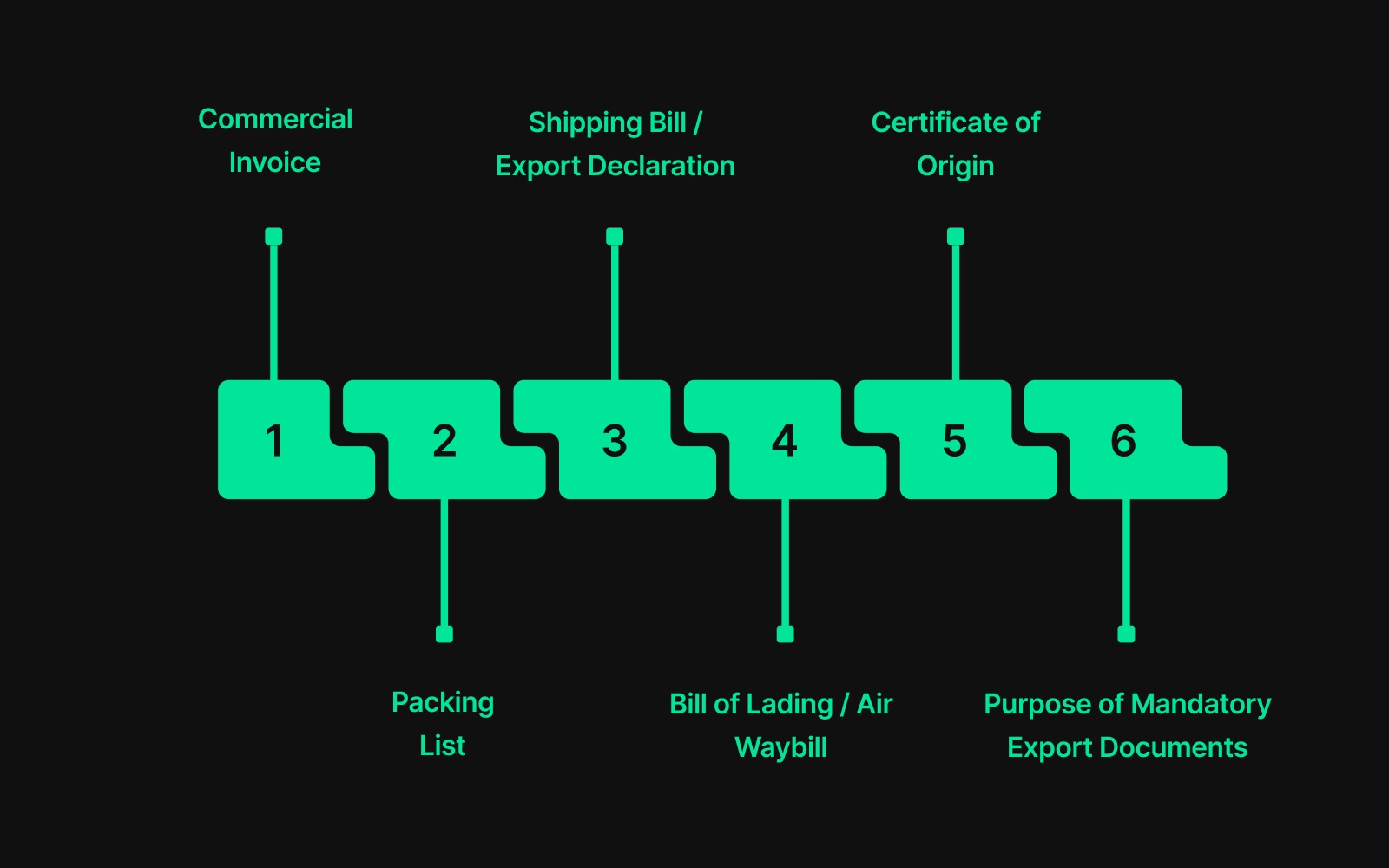
While export requirements can vary by country and product, certain documents are universally required for most export shipments. These documents collectively establish the legality, value, ownership, movement, and origin of goods, making them essential for customs clearance, transportation, and payment processing.
Below are the core mandatory export documents every exporter must understand.
1. Commercial Invoice
The commercial invoice is the primary legal document of an export transaction. It details the sale between the exporter and importer and serves as the foundation for customs valuation.
Key information typically includes:
- Exporter and importer details
- Description of goods and HS codes
- Invoice value, currency, and payment terms
- Country of origin and destination
Customs authorities use this document to assess duties and taxes, while banks rely on it for trade finance and payment settlement.
2. Packing List
The packing list provides a precise breakdown of how goods are packed within a shipment. Unlike the commercial invoice, it focuses on physical details rather than value.
It usually specifies:
- Number of packages
- Weight (gross and net)
- Dimensions and packing method
- Itemized contents per package
This document supports customs inspections, enables efficient cargo handling, and helps logistics providers plan storage and transportation
3. Shipping Bill / Export Declaration
The shipping bill (or export declaration) is the official document filed with customs to declare export details. It authorizes goods to leave the country legally.
It includes:
- Exporter and consignee details
- Description and value of goods
- Applicable export incentives or duties
- Mode of transport and destination
Without an approved export declaration, goods cannot be cleared for shipment
4. Bill of Lading / Air Waybill
The bill of lading (for sea freight) or air waybill (for air freight) is issued by the carrier and plays multiple legal roles.
It functions as:
- Proof that goods have been shipped
- A receipt issued by the carrier
- A contract of carriage between shipper and transporter
This document is also critical for cargo release and ownership transfer at the destination.
5. Certificate of Origin
The certificate of origin confirms the country where the goods were manufactured or produced. Customs authorities use it to determine applicable tariff rates and eligibility for preferential trade agreements.
It is especially important when:
- Claiming reduced or zero-duty benefits under trade agreements
- Complying with the import regulations of the destination country
Incorrect origin declarations can lead to penalties, duty reassessments, or loss of trade privileges.
6. Purpose of Mandatory Export Documents
Mandatory export documents are not redundant paperwork; they each serve a distinct legal, financial, and operational function within the export process. Together, they create a transparent and verifiable record that enables governments, financial institutions, and logistics providers to manage international trade effectively.
Key purposes include:
- Customs clearance and duty calculation: Export documents provide customs authorities with the data needed to classify goods, determine their value, apply duties or incentives, and authorize shipments to leave the country without delays.
- Legal proof of the export transaction: Documents such as the commercial invoice and bill of lading establish formal evidence of the sale, shipment, and transfer of goods, protecting both exporters and importers in the event of disputes or audits.
- Trade statistics and government reporting: Governments use export documentation to track trade volumes, monitor economic activity, and develop trade policies. Accurate data ensures compliance with national reporting requirements and international obligations.
- Payment settlement and foreign exchange compliance: Banks rely on export documents to process payments under letters of credit, manage foreign exchange regulations, and verify that funds are linked to legitimate trade transactions.
When prepared accurately and consistently, export documents reduce compliance risks, speed up operations, and safeguard exporters from financial and legal exposure.
Standard Formats and Key Data Requirements

Export documents must adhere to prescribed formats and data standards to be accepted by customs authorities, banks, and trade regulators. Even when the right documents are submitted, incorrect formatting or missing information can result in rejections, delays, or compliance violations.
Below are the key formats and data requirements exporters must follow.
1. Mandatory Fields and Declarations
Each export document contains compulsory fields that must be completed accurately and consistently across all paperwork. These typically include:
- Exporter and importer details
- Description and quantity of goods
- Invoice value and currency
- Country of origin and destination
- Declaration of accuracy and compliance
False declarations or inconsistencies across documents can trigger audits, penalties, or shipment holds.
2. Harmonized System (HS) Codes and Product Descriptions
HS codes are internationally standardized classification codes used to identify products in global trade. Accurate HS classification is essential because it determines:
- Applicable duties and taxes
- Export controls or restrictions
- Eligibility for incentives or trade agreements
Product descriptions must be clear, specific, and aligned with the declared HS code to avoid misclassification risks.
3. Signatures, Stamps, and Digital Authentication
Most export documents require authentication to be legally valid. This may include:
- Authorized signatures of the exporter
- Official stamps from chambers of commerce or customs authorities
- Digital signatures and electronic filing through government portals
As many countries move toward paperless trade systems, digital authentication is increasingly mandatory, but it must still meet regulatory standards to be accepted.
Product- and Destination-Specific Documentation Requirements

Beyond core export documents, certain products and destination markets trigger additional compliance obligations. These requirements are driven by safety, security, environmental, and policy concerns and must be addressed before goods are allowed to leave the exporting country or enter the importing one.
Understanding these variations is critical to avoiding shipment rejections and regulatory penalties.
a. Restricted or Controlled Items
Goods classified as restricted or controlled often require special permits or licenses before export approval. These may include:
- Chemicals, pharmaceuticals, and hazardous materials
- Defense-related goods and military equipment
- Items subject to environmental or safety regulations
Exporters must obtain the appropriate licenses from regulatory authorities and include them with shipment documentation to demonstrate legal authorization.
b. Dual-Use Goods and Sensitive Exports
Dual-use goods, items with both civilian and military applications, are subject to heightened scrutiny. Documentation for these exports may require:
- Export control licenses
- End-use and end-user declarations
- Compliance statements confirming non-prohibited usage
Failure to comply can lead to severe penalties, including export bans and criminal liability.
c. Destination Country Import Regulations
Each importing country enforces its own import rules, which can require additional documentation such as:
- Product conformity or compliance certificates
- Health, safety, or phytosanitary certificates
- Country-specific labeling or inspection reports
Exporters must align export documentation with the destination country’s import requirements to ensure goods are cleared on arrival without delays or refusals.
Common Compliance Issues and Documentation Errors

Errors in mandatory export documents are a leading cause of shipment delays, financial penalties, and customs rejections. The table below highlights the most common compliance issues, their impact, and how exporters can avoid them.
Proper documentation controls and regular compliance checks can significantly reduce these risks and ensure smoother export operations.
Best Practices for Managing Mandatory Export Documents
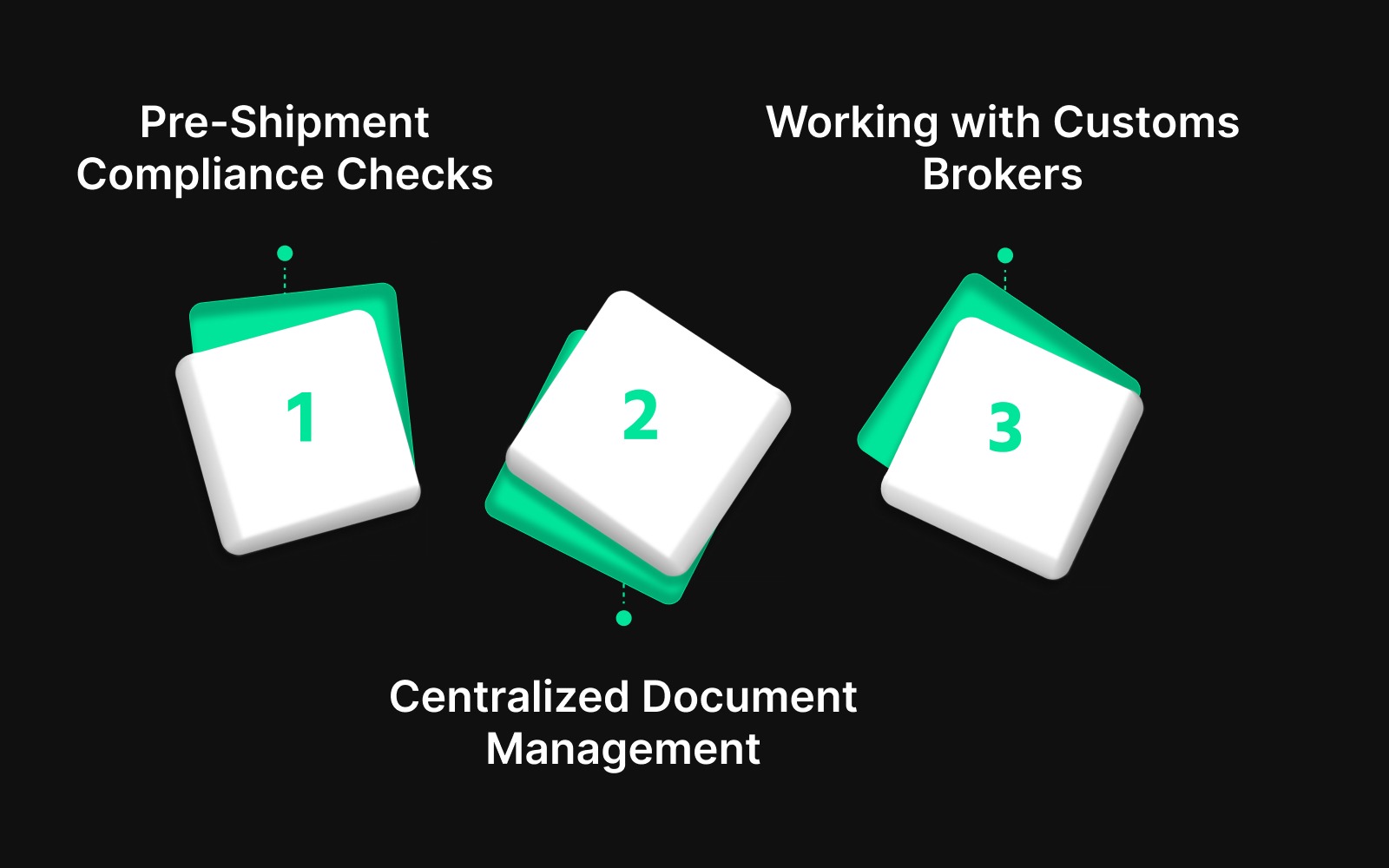
A disciplined and well-structured documentation process is essential for minimizing compliance risk and ensuring smooth export operations. The following best practices help exporters maintain accuracy, consistency, and regulatory readiness across all shipments.
1. Pre-Shipment Compliance Checks
Conducting compliance checks before goods are dispatched helps identify errors early and prevents costly delays. This includes:
- Verifying HS codes, valuation, and product descriptions
- Confirming license and permit requirements
- Ensuring consistency across all export documents
A pre-shipment review acts as a final safeguard against regulatory non-compliance.
2. Centralized Document Management
Maintaining export documents in a centralized system improves visibility, control, and audit readiness. Key benefits include:
- Easy access to historical records and shipment data
- Reduced risk of missing or outdated documents
- Faster response to customs inquiries and audits
Digital document management systems also support version control and secure storage.
3. Working with Customs Brokers and Trade Experts
Customs brokers and trade compliance specialists bring regulatory expertise that helps exporters navigate complex and changing trade rules. Their support can:
- Ensure accurate customs filings and declarations
- Advice on product- and destination-specific requirements
- Reduce the risk of penalties and shipment disruptions
Partnering with experienced professionals allows exporters to focus on growth while maintaining confidence in compliance.
How Pazago Supports Exporters with Logistics Execution
While managing mandatory export documentation is critical, strong logistics execution is equally important for reducing delays and ensuring compliance.
Pazago strengthens logistics execution, making it easier for exporters to maintain consistency from order creation to delivery. Here's how Pazago supports exporters with smooth logistics management:
- Confirmed container bookings and scheduled loading: Ensures exporters have confirmed container space and coordinated loading, eliminating booking delays and avoiding last-minute changes that can disrupt documentation timing.
- Stable freight rates across global routes: By offering competitive, stable rates, Pazago helps exporters plan ahead and secure consistent pricing, reducing cost fluctuations that can affect documentation alignment and lead to delays.
- Real-time shipment tracking and visibility: Pazago provides exporters with daily updates on container movements, vessel ETDs/ETAs, and transshipment changes, ensuring that shipments align with their documentation and timelines.
- Pre- and post-shipment support: With ongoing coordination from booking through delivery, Pazago ensures that all logistics steps are followed, preventing missed cut-offs and discrepancies that can cause compliance issues or delays in payment processing.
- Supporting exporters of all sizes: Whether managing a single LCL shipment or coordinating 100 containers, Pazago ensures each shipment receives the same attention to detail and streamlined logistics, ensuring timely delivery and alignment with export documentation.
By improving logistics execution from start to finish, Pazago helps exporters to reduce errors, maintain compliance, and move shipments efficiently through global supply chains.
Conclusion
Mandatory export documents are critical for smooth and compliant global trade. When exporters understand the purpose, format, and regulatory requirements of each document, they can avoid delays and reduce the risk of customs hold-ups.
As export regulations grow more complex, relying on manual processes increases operational friction and logistics inefficiency. This is where reliable logistics planning plays a key role in reducing errors, ensuring timely shipments, and maintaining alignment between documentation and freight execution.
Pazago supports exporters by offering consistent freight rates, guaranteed container availability, and live shipment tracking. By enhancing logistics execution, exporters can minimise delays, streamline customs processes, and ensure timely delivery, keeping their export operations running smoothly.
Ready to streamline logistics and reduce lead time in your export operations?
Contact us to discover how we help exporters move goods efficiently and meet regulatory requirements on time.
FAQs
1. Do export documentation requirements vary by country?
Yes. While core documents are similar worldwide, destination countries may require additional certificates, licenses, or inspections based on local import regulations.
2. How can exporters reduce documentation errors?
Exporters can reduce errors by using standardized templates, conducting pre-shipment compliance checks, and centralizing document management through digital platforms.
3. Which export documents are required for most shipments?
Most export shipments require a commercial invoice, packing list, export declaration or shipping bill, bill of lading or airway bill, and a certificate of origin. Additional documents may apply depending on the product or destination.
4. How do HS codes affect export compliance?
HS codes determine how goods are classified globally and directly impact duties, export controls, and trade agreement benefits. Incorrect HS classification is a common cause of compliance violations.
5. What happens if export documents contain errors?
Errors can result in customs holds, financial penalties, delayed payments, or loss of trade incentives. Repeated non-compliance may also trigger audits or export restrictions.