.png)


A Complete Guide to Export and Import Procedures for Businesses

Optimize your business: use unlimited savings with Pazago fulfilled now!
Get Started ->Global trade isn’t just a buzzword; it’s the engine that drives over $33 trillion in annual merchandise exports worldwide in 2024, linking producers to markets across continents and exploring opportunities no business can afford to ignore.
Whether you’re a startup eyeing overseas customers or a seasoned company handling customs protocols, mastering export–import operations isn’t optional; it’s essential for growth, legal compliance, and sustainable global expansion.
Understanding the procedures behind cross-border trade empowers you to reduce costs, avoid costly regulatory penalties, and seize new revenue streams in markets hungry for your products. From paperwork and tariffs to logistics and trade agreements, the export–import landscape can be complex, but it’s also where ambitious businesses secure their competitive edge.
Key Highlights
- Global trade processes directly influence cost, compliance, and profitability, making structured export–import operations essential for every growing business.
- The complete trade lifecycle involves multiple stakeholders, exporters, importers, customs, banks, and logistics partners, each playing a critical role in smooth cross-border movement.
- Success in international trade depends on accurate documentation, correct HS codes, regulatory compliance, and risk management, which together prevent delays and penalties.
- A clear step-by-step process for exports and imports, from inquiry and documentation to customs clearance and delivery, helps businesses build predictable, scalable global operations.
What do Export and Import Mean in a Business Context?

In business terms, exporting refers to selling domestically produced goods or services to customers in foreign markets, while importing involves purchasing goods or services from overseas suppliers for use or resale in the domestic market.
Beyond the basic definitions, both activities carry strategic implications. Exports open new revenue streams and diversify markets, while imports help businesses reduce costs, access better inputs, and stay competitive.
However, export and import transactions are not simple buy-and-sell deals. They require compliance with trade regulations, accurate documentation, currency exchange management, taxation, and coordination across multiple jurisdictions. A clear grasp of these responsibilities helps businesses operate smoothly and avoid costly legal or financial setbacks.
Key Stakeholders in Export–Import Operations
Successful international trade depends on the coordinated efforts of several key stakeholders, each playing a critical role:
- Exporters: Businesses or individuals that supply goods or services to foreign buyers. Exporters are responsible for product compliance, documentation, pricing, and ensuring goods meet destination-country regulations.
- Importers: Entities that purchase goods or services from abroad. Importers handle customs clearance, duty payments, regulatory approvals, and domestic distribution.
- Customs Authorities: Government agencies that regulate cross-border trade. They inspect shipments, verify documentation, assess duties and taxes, and ensure compliance with trade laws.
- Banks and Financial Institutions: Banks facilitate international payments, manage foreign exchange, and provide trade finance instruments such as letters of credit and bank guarantees, reducing payment risk for both parties.
- Logistics and Freight Service Providers: These include freight forwarders, shipping lines, airlines, and customs brokers who manage transportation, warehousing, and delivery while ensuring shipments move efficiently across borders.
When these stakeholders operate in sync, export–import transactions become predictable, compliant, and scalable, allowing businesses to focus on growth rather than firefighting operational issues.
Also Read: Top Shipping Software Platforms for Small Business Delivery
Pre-Requisites for Starting an Export and Import Business

Before the first shipment moves or a foreign invoice is issued, an export and import business must be built on a solid legal and regulatory foundation. These pre-requisites ensure your operations are legally compliant, financially secure, and scalable, helping you avoid delays, penalties, or shipment rejections later.
a. Business Registration and Legal Structure
The first step is establishing a legally recognised business entity. This defines how you operate, pay taxes, and enter contracts internationally. Common structures include sole proprietorships, partnerships, limited liability partnerships (LLPs), and private limited companies.
Your chosen structure affects:
- Liability and risk exposure
- Access to banking and trade finance
- Credibility with overseas buyers and suppliers
- Compliance and reporting requirements
Once registered, the business must obtain essential tax registrations and open a current bank account capable of handling foreign currency transactions.
b. Import Export Code (IEC) and Mandatory Registrations
An Import Export Code (IEC) is a foundational requirement for conducting cross-border trade in many countries. In India, the IEC is issued by the Directorate General of Foreign Trade and is mandatory for clearing customs, receiving foreign payments, and claiming export incentives.
In addition to the IEC, businesses may need:
- Tax registrations (such as GST or VAT, depending on jurisdiction)
- Registration with export promotion councils (for sector-specific benefits)
- Customs registration for electronic filing and clearance
Without these registrations, shipments can be held at ports, payments may be delayed, and regulatory benefits may be unavailable.
c. Required Licenses and Product-Specific Approvals
Not all products can be freely exported or imported. Certain goods are restricted, regulated, or prohibited due to safety, environmental, or national interest concerns. Depending on the product and destination market, additional licenses or certifications may be required.
Common examples include:
- Food, agricultural, and pharmaceutical product approvals
- Quality and safety certifications (such as ISO, CE, or phytosanitary certificates)
- Special licenses for chemicals, electronics, defence items, or dual-use goods
Understanding product classification and regulatory requirements upfront prevents costly shipment rejections and compliance violations.
Product Selection and Market Research

Product selection is where most export and import businesses either build momentum or quietly fail. Choosing the right product isn’t just about what sells; it’s about market demand, regulatory feasibility, and long-term profitability.
Strong market research ensures you invest in products that can legally enter target markets, meet customer expectations, and deliver sustainable margins.
a. Identifying Export-Ready or Import-Viable Products
An export-ready or import-viable product is one that meets three core criteria: demand, compliance, and competitiveness.
When evaluating products, businesses should assess:
- Consistent market demand rather than short-lived trends
- Ease of sourcing or manufacturing at scale
- Shelf life, durability, and transport suitability
- Price competitiveness after duties, logistics, and taxes
Exporters should prioritise products that offer differentiation through quality, customisation, origin advantage, or pricing, while importers should focus on cost efficiency, reliability of supply, and domestic resale potential.
b. Target Market Analysis and Trade Restrictions
Once a product is shortlisted, understanding the target market becomes critical. Market analysis goes beyond identifying buyers; it includes studying consumer preferences, pricing sensitivity, competition, and regulatory conditions.
Key factors to analyse include:
- Import regulations and local standards
- Customs duties, taxes, and landed cost structure
- Trade agreements or tariff benefits
- Restricted, prohibited, or quota-controlled goods
Some markets impose strict controls on items such as food, chemicals, electronics, pharmaceuticals, and textiles. Ignoring these restrictions can result in shipment seizures, penalties, or permanent blacklisting, making regulatory research as important as sales potential.
c. HS Codes and Product Classification Basics
Every product traded internationally is classified under a Harmonised System (HS) code, a globally standardised numerical system used by customs authorities. HS codes determine:
- Applicable customs duties and taxes
- Import–export eligibility
- Required licenses or certifications
- Trade statistics and reporting
Accurate product classification is essential. An incorrect HS code can lead to overpayment of duties, shipment delays, penalties, or compliance violations. Businesses should verify HS codes carefully and, when necessary, consult customs experts or official tariff schedules.
Export Procedure: Step-by-Step Process
Exporting is a structured process that follows a defined sequence from the first buyer interaction to the final shipment dispatch. Understanding each stage of the export lifecycle helps businesses avoid errors, meet compliance requirements, and deliver goods on time, while maintaining trust with international buyers.
1. Receiving Export Inquiry and Sending Quotation
The export process begins when a foreign buyer sends an inquiry requesting product details, pricing, quantity, and delivery terms. This stage sets the tone for the entire transaction.
An export quotation typically includes:
- Product specifications and quality standards
- Unit price and total value
- Incoterms (FOB, CIF, EXW, etc.)
- Payment terms and delivery timeline
- Validity period of the offer
Clear and accurate quotations reduce misunderstandings and improve conversion rates.
2. Order Confirmation and Contract Terms
Once the buyer accepts the quotation, the exporter issues a proforma invoice or enters into a formal export contract. This document confirms all commercial and legal terms agreed upon by both parties.
Key elements include:
- Buyer and seller details
- Product description and quantity
- Price and currency
- Payment method (advance, letter of credit, open account)
- Delivery terms and dispute resolution clauses
A well-defined contract protects both parties and minimises commercial risk.
3. Export Documentation and Compliance Checks
Documentation is the backbone of export operations. Incomplete or incorrect paperwork is one of the most common causes of shipment delays.
Common export documents include:
- Commercial invoice
- Packing list
- Bill of lading or airway bill
- Certificate of origin
- Export licenses or product-specific certificates
At this stage, exporters must also ensure compliance with export regulations, destination-country requirements, and trade controls.
4. Packaging, Labelling, and Pre-Shipment Inspection
Proper packaging and labelling protect goods during transit and ensure compliance with international standards. Export packaging must consider handling, stacking, climate conditions, and transport mode.
Labelling typically includes:
- Product details
- Country of origin
- Handling instructions
- Regulatory markings required by the destination market
Some shipments require pre-shipment inspection by authorised agencies to verify quantity, quality, or compliance before customs clearance.
5. Customs Clearance and Shipment Dispatch
The final stage involves filing export declarations with customs authorities and clearing the shipment for export. Once duties (if applicable) and documentation are approved, the cargo is handed over to the logistics provider for dispatch.
This step includes:
- Customs examination and clearance
- Loading goods onto the vessel, aircraft, or transport vehicle
- Issuance of transport documents
- Shipment tracking and buyer notification
Successful customs clearance marks the completion of the export process and the transition into post-shipment activities such as payment realisation and documentation follow-up.
Import Procedure: Step-by-Step Process

Importing goods is a regulated process designed to ensure product safety, legal compliance, and accurate revenue collection for the destination country.
A clear understanding of each step helps businesses control costs, avoid clearance delays, and ensure uninterrupted supply chains. Below is a step-by-step walkthrough of how goods legally enter a country.
1. Import Order Placement and Supplier Coordination
The import process begins with identifying a reliable overseas supplier and placing an import order based on agreed commercial terms. At this stage, importers finalise pricing, quantities, delivery timelines, and Incoterms that define responsibility for freight, insurance, and risk.
Effective supplier coordination includes:
- Confirming product specifications and quality standards
- Agreeing on packaging and labelling requirements
- Finalising payment terms and delivery schedules
- Ensuring supplier compliance with export regulations
Clear communication at this stage prevents costly misunderstandings later.
2. Import Documentation Requirements
Accurate documentation is critical for smooth import operations. Missing or incorrect documents can result in cargo holds, penalties, or demurrage charges.
Key import documents generally include:
- Commercial invoice
- Packing list
- Bill of lading or airway bill
- Certificate of origin
- Insurance documents (if applicable)
- Import licenses or product-specific certificates
Importers must ensure all documents align with customs declarations and local regulatory requirements.
3. Customs Filing and Duty Assessment
Once the shipment arrives at the port of entry, importers or their customs brokers file an import declaration with customs authorities. This declaration includes product details, value, HS codes, and origin information.
Customs authorities assess:
- Applicable customs duties and taxes
- Compliance with import regulations and standards
- Eligibility for exemptions or preferential tariffs under trade agreements
Any discrepancies can trigger inspections, reassessments, or fines, making accuracy at this stage essential.
4. Cargo Clearance and Delivery
After duties and taxes are paid and customs clearance is granted, the cargo is released. The goods are then transported from the port, airport, or inland container depot to the importer’s warehouse or final destination.
This final step involves:
- Customs out-of-charge approval
- Port handling and cargo release
- Inland transportation and delivery
- Post-clearance record-keeping and compliance checks.
A well-managed import process ensures the timely availability of goods, predictable costs, and regulatory compliance.
Also Read: How to Implement Inventory Tracking: Steps and Methods
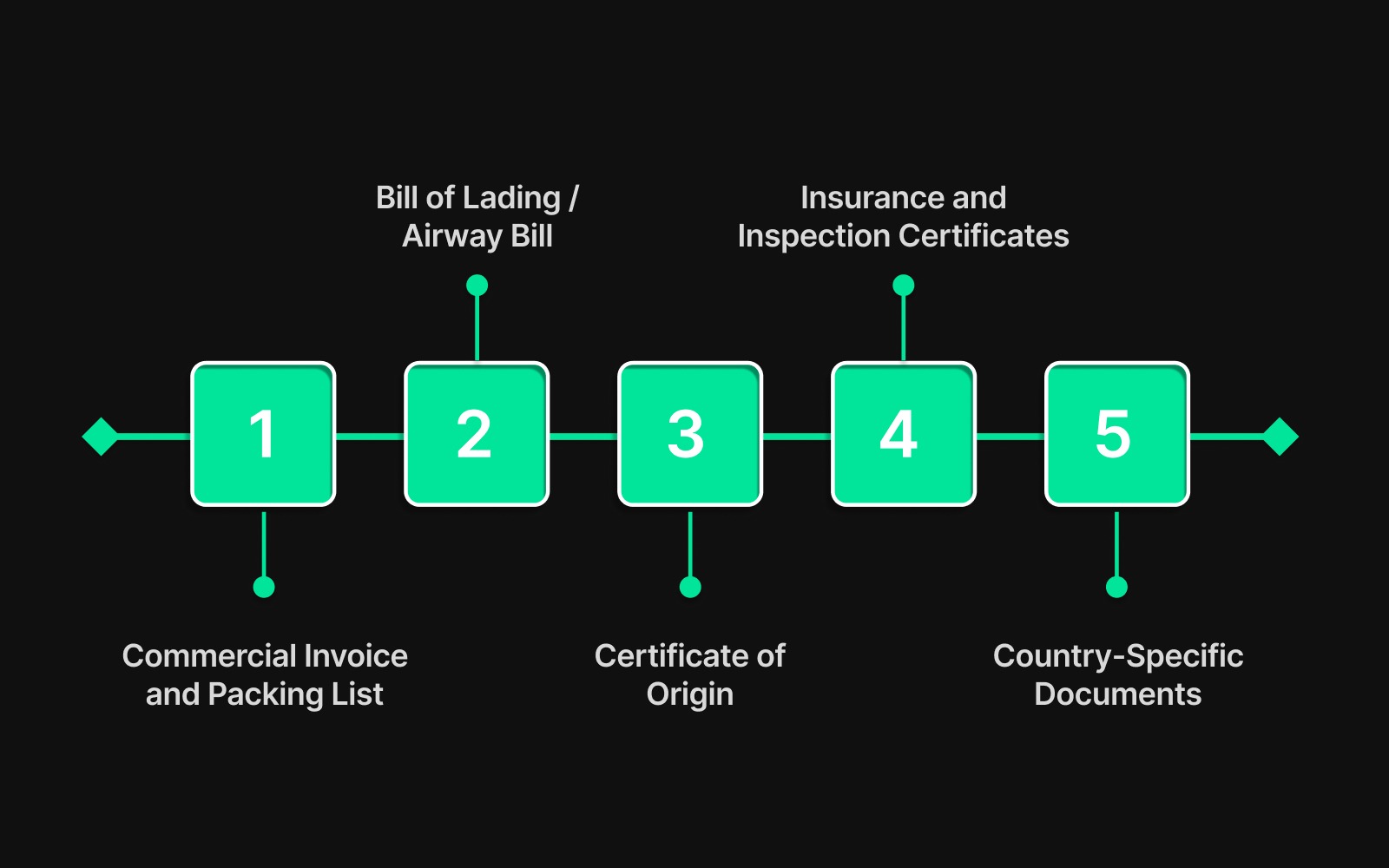
5 Essential Export–Import Documentation
Export–import documentation supports every stage of an international trade transaction, from customs clearance to payment realisation. Accurate and complete documents ensure legal compliance, smooth cargo movement, and reduced operational risk.
- Commercial Invoice and Packing List: The commercial invoice records the financial details of the transaction and is used by customs to assess duties and taxes. The packing list provides shipment-specific information such as package count, weight, and dimensions, helping authorities and logistics providers verify cargo.
- Bill of Lading / Airway Bill: The bill of lading (for sea freight) and airway bill (for air freight) act as proof of shipment and evidence of the transport contract. They are essential for cargo release, tracking, and customs clearance.
- Certificate of Origin: The certificate of origin confirms the country where the goods were produced or manufactured. It is used to determine duty rates, apply trade agreement benefits, and enforce import restrictions.
- Insurance and Inspection Certificates: Insurance certificates confirm that goods are covered against transit risks. Inspection certificates verify product quality, quantity, or compliance and may be mandatory for certain products or destination countries.
- Regulatory and Country-Specific Documents: Depending on the product and destination, additional documents such as licenses, health certificates, safety approvals, or conformity declarations may be required to meet regulatory standards.
Compliance, Risks, and Common Mistakes
Export–import operations involve multiple layers of regulation and risk. Understanding compliance requirements and common pitfalls helps businesses prevent penalties, shipment delays, financial losses, and reputational damage.
Companies that proactively manage compliance and risk operate more efficiently, face fewer disruptions, and build stronger credibility with customs authorities and international partners.
How Pazago Supports Exporters with Efficient Logistics Execution
Export trading is about ensuring that every shipment is executed flawlessly, on time, and in compliance with international standards.
Pazago plays a critical role in helping exporters manage logistics efficiently, offering a comprehensive platform that integrates all aspects of the logistics chain. Instead of relying on multiple systems or making decisions in isolation, exporters can manage their entire logistics workflow from a single platform.
- Assured Container Booking & Smooth Loading Coordination: Pazago ensures confirmed container bookings and handles seamless loading coordination at the factory or port. This helps exporters avoid equipment shortages and delays, making sure shipments are on time for their scheduled departures.
- Stable Freight Rates for Predictable Shipping Costs: Through long-term relationships with major shipping lines, Pazago offers competitive freight rates, reducing unpredictable costs.
- Real-Time Shipment Tracking & Visibility: Stay informed with real-time tracking updates, covering container movements, vessel ETD/ETA, and transshipment updates. By proactively tracking shipments, exporters can avoid unexpected delays and keep buyers updated throughout the shipping process.
- Integrated Export Document Management: Pazago automates key export documents, like invoices and packing lists, directly from the order data. This reduces documentation mismatches and ensures smoother customs clearance, making logistics execution more efficient.
- Full Visibility Across Teams & Stakeholders: By centralising all logistics communication, including shipment references, schedules, and customs details, Pazago ensures smoother coordination between exporters, logistics providers, and internal teams, minimising delays and confusion.
Pazago doesn’t just help exporters manage logistics; it integrates logistics management with the entire export process, ensuring greater control, visibility, and efficiency.
Conclusion
Efficient logistics execution is essential for successful export operations. For exporters, managing everything from freight rates and container bookings to shipment tracking and documentation is critical to ensuring timely deliveries and cost-effective operations.
Pazago helps exporters by centralising all logistics activities on a single platform, streamlining operations, reducing errors, and improving shipment visibility.
Ready to streamline your logistics and reduce delays?
Contact us to discover how Pazago can help you optimise your export logistics, reduce operational friction, and deliver on your commitments reliably.
Frequently Asked Questions (FAQs)
1. Why is HS code classification important?
HS codes determine customs duties, tax rates, licensing requirements, and eligibility under trade agreements. Incorrect classification can cause delays, penalties, or overpayment of duties.
2. How are customs duties calculated?
Customs duties are calculated based on product value, HS code, country of origin, and applicable tariff rates, along with additional taxes such as VAT or GST.
3. What are the biggest risks in international trade?
Key risks include regulatory non-compliance, currency fluctuations, shipment delays or damage, political instability, and documentation errors.
4. When should a business use customs brokers or trade consultants?
Professional support is helpful when entering new markets, dealing with regulated goods, managing high shipment volumes, or facing frequent customs or compliance challenges.
5. How does technology help in export and import operations?
Trade platforms centralise documentation, shipment tracking, compliance, and payments, reducing manual effort, errors, and operational risk.