.png)


FOB Incoterms Meaning: Responsibilities, Risks, and Use Cases
Optimize your business: use unlimited savings with Pazago fulfilled now!
Get Started ->FOB is one of the most commonly used Incoterms in international trade, yet it is also one of the most frequently misunderstood. Many exporters apply FOB as a pricing label without fully understanding where responsibility actually ends, when risk transfers, and how execution at the port of shipment affects payments, claims, and disputes.
This blog explains the FOB Incoterms meaning in practical terms. It breaks down exporter and buyer responsibilities, shows where FOB works well and where it creates risk, explains why FOB fails for containerised cargo, and highlights the operational mistakes that cause delays and losses.
Key Takeaways
- FOB (Free On Board) defines the point at which risk and cost transfer from exporter to buyer when goods are loaded on board the vessel at the named port of shipment.
- Under FOB, the exporter is responsible for the goods until vessel loading, after which the buyer bears freight, insurance, and transit risk.
- FOB is intended for sea shipments and is often misapplied to container cargo, where handover happens before vessel loading.
- FOB shifts freight control to the buyer, but exporters remain responsible for inland transport, export clearance, and loading at origin.
- FOB outcomes depend on execution at the port of shipment, including vessel nomination, loading coordination, and document accuracy.
What Does FOB Incoterm Mean in Shipping?
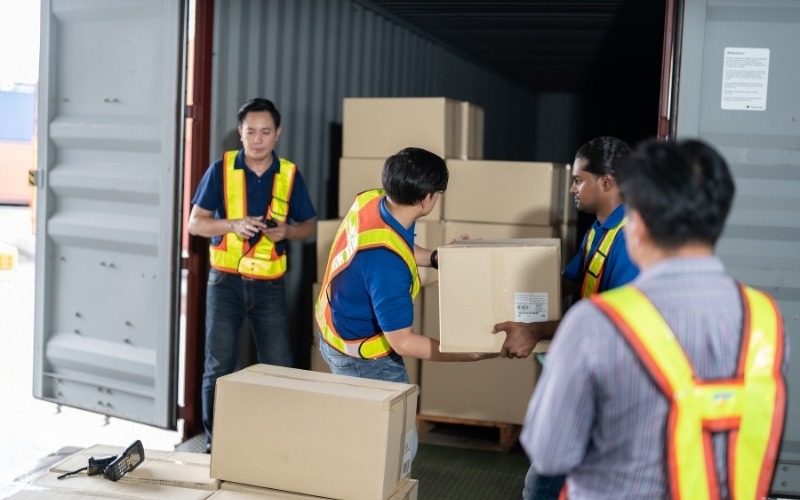
Incoterms are a set of 11 international trade rules created by the International Chamber of Commerce. These rules exist to clearly define who is responsible for costs, risks, and tasks at each stage of an international shipment. Without Incoterms, exporters and buyers often interpret delivery terms differently, which leads to disputes, delays, and payment issues.
FOB, or Free On Board, is one of these 11 Incoterms under Incoterms 2020. Under FOB, the exporter’s responsibility ends when the goods are loaded on board the vessel at the agreed port of shipment. From that moment onward, the buyer assumes the risk and any additional costs associated with the shipment.
How FOB Origin And FOB Destination Relate To FOB Incoterms
FOB Origin and FOB Destination are commonly used alongside FOB Incoterms because the terms sound similar. In practice, these terms are accounting and commercial labels, used to decide when ownership transfers in financial records. They do not define logistics responsibility, risk transfer, or customs obligations in international shipping, which is what FOB Incoterms are designed to do. Here is a table summarising the differences between the two terms.
Seller Obligations Under FOB (Exporter Perspective)

Under FOB, the exporter carries responsibility from the factory gate until the goods are physically loaded on board the vessel at the named port of shipment. Everything that occurs before vessel loading is the exporter's responsibility and must be planned, documented, and executed correctly.
Exporter responsibilities under FOB include:
- Supplying goods exactly as per the sales contract.
- Issuing the commercial invoice and supporting export documents.
- Arranging export-grade packaging suitable for international transport.
- Applying export markings, labels, and handling instructions.
- Completing any required pre-shipment inspection at the origin.
- Obtaining export licenses, permits, and regulatory approvals.
- Managing export customs formalities and shipping bill filing.
The exporter’s obligation under FOB ends only when the goods are on board the vessel, not when they enter the port or clear customs.
Buyer Obligations Under FOB

Once the goods are loaded on board the vessel, responsibility shifts to the buyer. From this point onward, the buyer controls the main carriage and bears all associated risks and costs until final delivery.
Buyer responsibilities under FOB include:
- Paying for the goods as per the agreed sales contract.
- Nominating the vessel and confirming the sailing schedule.
- Booking ocean freight with the carrier or forwarder.
- Paying the main carriage freight charges.
- Deciding whether to arrange marine insurance for the shipment.
- Bearing the risk of loss or damage after vessel loading.
Under FOB, buyer coordination directly affects shipment timelines and exporter payment cycles, especially when payments are linked to Bill of Lading issuance or shipment milestones.
FOB Advantages for Exporters and Buyers

FOB works best when both the exporter and the buyer have experience managing their respective parts of an international shipment.
The term creates a clear operational boundary at the port of shipment, reducing ambiguity around cost, risk, and control. When used correctly, FOB simplifies pricing for exporters and gives buyers flexibility over freight and delivery planning.
This split makes FOB attractive when both parties have experience in international trade and clearly understand their respective operational responsibilities.
Also read: Differences Between FOB and FCA in Shipping Terms.
FOB Disadvantages for Exporters and Buyers

FOB reduces responsibility after vessel loading, but it also limits the exporter’s control over critical parts of the shipment.
When coordination between the exporter and buyer is weak, FOB can introduce delays, cost disputes, and payment risks. These drawbacks become more pronounced in containerised, time-sensitive shipments.
These disadvantages highlight why FOB requires strong coordination and is often unsuitable for container-heavy or inexperienced trade relationships.
Related: Differences in EXW and FOB: A Simple Guide.
When To Use FOB

If you are planning an export shipment, choose FOB in the following situations:
- Buyer controls ocean freight: The buyer wants to select the carrier, negotiate freight rates, and manage the main carriage.
- Clear cutoff at port of shipment: You want responsibility to end once the goods are loaded on board the vessel.
- Bulk or breakbulk cargo: The shipment is not containerised and is delivered directly onto the vessel.
- Limited freight risk appetite: You want to avoid exposure to freight rate changes and insurance decisions.
- Experienced buyer relationship: The buyer understands vessel nomination, loading timelines, and document coordination.
Why FOB Is Not Suitable for Containerised Cargo

For container shipments, the exporter hands over the container at the terminal gate, often days before the vessel arrives. Under FOB, delivery technically happens only when the container is loaded on the vessel, which creates a risk gap.
During this gap, containers may be rolled over, damaged, or delayed. FOB does not clearly allocate responsibility during this period, which is why disputes are common. For container cargo, FCA usually aligns better with real operational handover.
Common FOB Mistakes Exporters Make And How To Solve Them
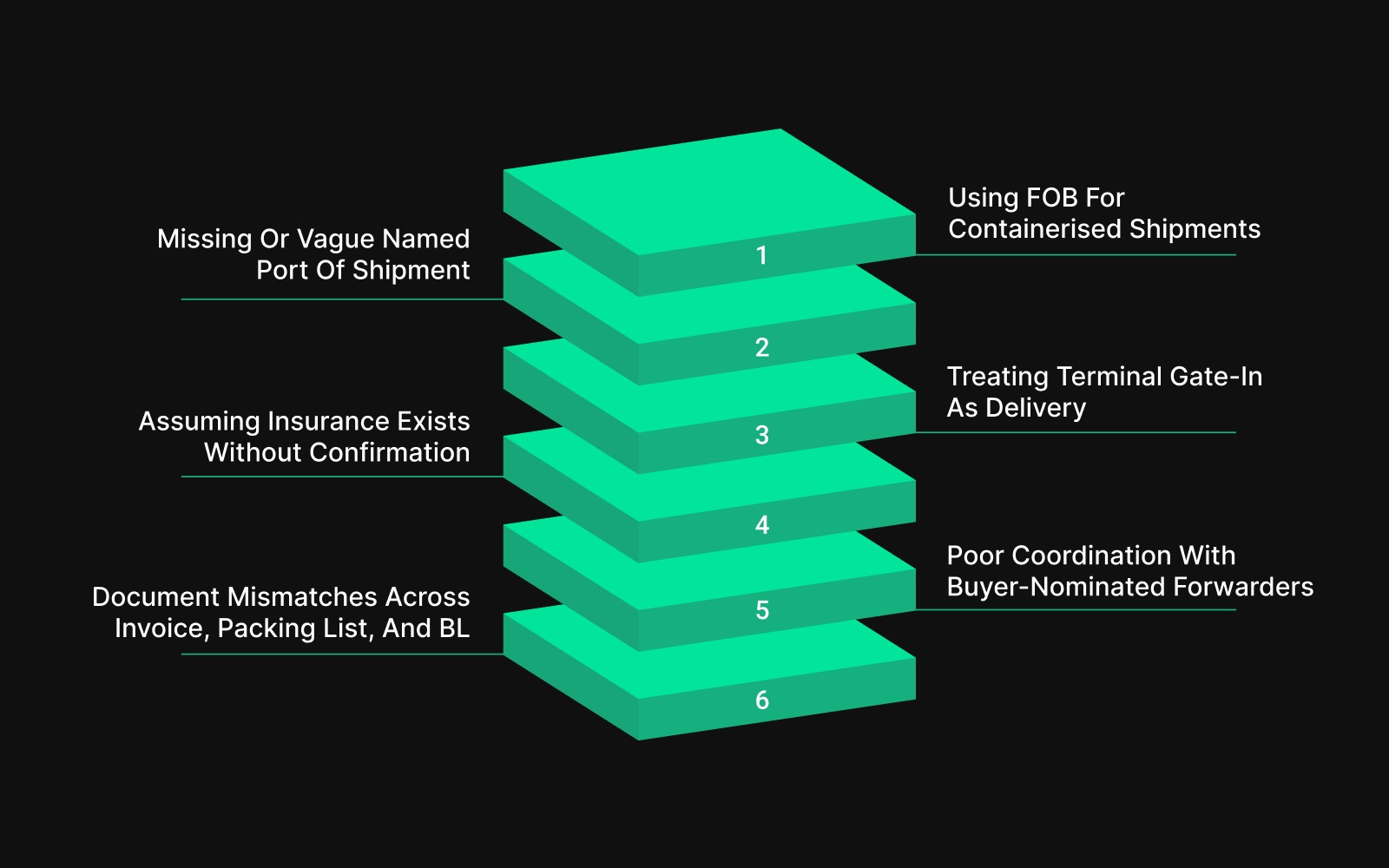
Even experienced exporters encounter issues with FOB when the term is applied mechanically rather than operationally. The problems below are the most frequent causes of disputes, delays, and payment friction under FOB, along with practical ways to avoid them.
1. Using FOB For Containerised Shipments
FOB is often applied to container cargo out of habit, even though the exporter hands over the container at the terminal well before vessel loading. This creates a risk gap where damage or delay occurs after handover but before loading.
How to solve it: Use FCA for container shipments so delivery aligns with terminal handover and carrier receipt.
2. Missing Or Vague Named Port Of Shipment
Using terms like “FOB India” or omitting the port entirely leaves the delivery point undefined. This weakens the exporter’s position during claims, document checks, and payment disputes.
How to solve it: Always specify the exact port of shipment in contracts, invoices, and shipping instructions.
3. Treating Terminal Gate-In As Delivery
Many exporters assume responsibility ends when cargo enters the port or clears customs. Under FOB, delivery is completed only when the goods are loaded on board the vessel.
How to solve it: Track vessel loading status and retain proof of on-board delivery as part of shipment records.
4. Assuming Insurance Exists Without Confirmation
Exporters often assume the buyer has arranged insurance immediately after handover. In practice, insurance may start later or be missing entirely.
How to solve it: Confirm insurance responsibility and coverage start point during contract negotiation.
5. Poor Coordination With Buyer-Nominated Forwarders
FOB requires close coordination with the buyer’s logistics partners. Delays in vessel nomination or document exchange can stall the shipment.
How to solve it: Establish clear communication channels and loading timelines before cargo reaches the port.
6. Document Mismatches Across Invoice, Packing List, And BL
Differences in quantity, weight, or port details often lead to customs queries and bank discrepancies, delaying payment.
How to solve it: Align all shipment data across documents and validate details before BL issuance.
How Pazago Supports Clean FOB Execution at the Port of Shipment
FOB often fails because execution at the port of shipment is fragmented. Vessel nomination, container readiness, gate cut-offs, document alignment, and loading confirmation are often tracked across emails, WhatsApp messages, and spreadsheets, creating gaps exactly where FOB responsibility ends.
Pazago helps exporters structure origin-side logistics activities around the export order until goods are loaded on board.
Container Planning and Coordination Before Vessel Loading
FOB shipments require tight coordination between factory readiness, container allocation, and vessel schedules. Pazago supports exporters by helping them align container booking decisions and loading plans with vessel timelines so cargo reaches the port in time for the correct sailing.
Container-Level Visibility Before Handover
For FOB shipments involving containers, exporters must manage the risk window between terminal gate-in and vessel loading. Pazago provides visibility into container movement, stuffing status, and loading updates so exporters know exactly when cargo has been handed over for shipment.
Documentation Alignment Before BL Issuance
FOB payments often depend on clean Bills of Lading. Pazago helps exporters stay aligned with documentation timelines and shipment details so discrepancies in quantity, weight, or port information do not delay BL issuance or buyer payments.
Conclusion
FOB is a logistics commitment that ends only when goods are loaded on board the vessel at the named port. Most FOB disputes arise not from misunderstanding risk transfer, but from poor execution at origin: missed cut-offs, vessel delays, document mismatches, and unclear handover points.
Exporters who succeed with FOB treat it as an operational process, not a contract line item. They maintain visibility over origin logistics, align documents with shipment milestones, and coordinate tightly with buyer-nominated carriers.
Pazago fits into this workflow by keeping FOB orders, shipment timelines, containers, and documents aligned until vessel loading is complete. This reduces execution gaps, payment delays, and avoidable disputes at the port of shipment.
If you want tighter control over FOB execution without chasing updates across tools, Book a Demo with Pazago and see how exporters manage origin-side logistics with clarity and confidence.
FAQs On FOB Incoterms
1. Does FOB affect who chooses the port terminal within the same port?
FOB defines the port of shipment, not the specific terminal. Terminal allocation is usually determined by the carrier and the port authority.
2. Can FOB be combined with inspection clauses in the sales contract?
Yes. Pre-shipment inspections can be added contractually, even though FOB itself does not mandate them.
3. Does FOB change how export incentives or rebates are claimed?
No. Export incentives depend on export documentation and regulatory compliance, not on the chosen Incoterm.
4. Is FOB suitable for shipments involving multiple loading ports?
FOB works best with a single, clearly named port. Multiple loading ports complicate delivery and clarity of risk transfer.
5. Can FOB shipments be amended after vessel nomination?
Changes are possible but risky. Any amendment after vessel nomination can affect loading schedules, documentation, and payment timelines.