.png)


Invoice Discounting: Meaning, Benefits, and Cash Flow for Exporters
Optimize your business: use unlimited savings with Pazago fulfilled now!
Get Started ->Invoice discounting helps you unlock cash tied up in unpaid invoices. For exporters, this matters because payment cycles are long and cash needs are constant. You ship goods today, but payments often arrive weeks or months later.
That gap can slow production, delay freight planning, and limit your ability to accept new orders. Invoice discounting offers a way to access a portion of your invoice value before the buyer pays, without changing the agreed payment terms.
This blog explains the invoice discounting meaning for exporters, how it works, and when it supports export cash flow planning.
Key Takeaways
- Invoice discounting improves timing, not sales. It helps you access cash earlier from invoices you have already raised, without changing buyer terms.
- Exporters feel the benefit more clearly. Long production cycles, freight costs, and 60–90 day payments make early cash access more valuable in exports.
- Clean data decides success. Accurate invoices, aligned shipment details, and clear payment tracking reduce delays and disputes.
- Structure matters as much as financing. Invoice discounting works best when orders, documents, and payment stages are connected and visible.
Invoice Discounting Meaning (Simple Definition for Exporters)

Invoice discounting is a financing method where you receive early funds against an unpaid invoice.
Instead of waiting for your buyer to pay on the due date, you access a portion of the invoice value earlier. When the buyer pays later, the amount is settled after deducting a fee.
In simple terms, you convert future receivables into present cash.
For exporters, this usually works like this:
- You ship goods and raise an invoice with agreed credit terms
- A financier advances part of the invoice value to you
- Your buyer pays on the original due date
- The advance is adjusted after payment, along with fees
What does not change is your buyer relationship. Your buyer still pays you as per the contract. Your pricing and shipment terms remain the same.
Invoice discounting is useful when your business is profitable, but cash is locked in receivables. It supports smoother operations without waiting for long export payment cycles.
It often helps exporters when:
- Payment terms are 30 to 90 days
- Orders are regular, but cash inflow is uneven
- Production and logistics costs must be paid upfront
If this sounds familiar, invoice discounting can support better cash flow control.
Also Read: Understanding the Format and Importance of a Commercial Invoice
How Does Invoice Discounting Work Step by Step?

Invoice discounting follows a structured process. Once set up, it runs alongside your regular export workflow.
Here is how it typically works:
- You raise an invoice: You ship goods and issue an invoice with agreed payment terms, such as 60 or 90 days.
- You submit the invoice for discounting: The invoice details are shared with the financier or platform you are using.
- Invoice and buyer checks happen: They review invoice accuracy, buyer credibility, and payment history. Clean data speeds this step.
- You receive an advance: A percentage of the invoice value is released to you. This is usually less than the full amount.
- You continue business as usual: You manage buyer communication and collections. Your buyer follows the original payment timeline.
- Buyer pays on the due date: Payment is made as per the contract. There is no change for the buyer.
- Final settlement is completed: The advance is adjusted against the payment, and fees are deducted.
This structure gives you early access to funds while keeping control of customer relationships and day-to-day operations.
A Simple Example to Understand Invoice Discounting

Assume you export goods worth ₹50 lakh with a 60-day payment term.
Here is how invoice discounting may work in practice:
- Invoice value: ₹50,00,000
- Credit period: 60 days
- Advance received: ₹40,00,000 (example amount)
- Fee: Deducted during final settlementt
Instead of waiting two months, you receive most of the cash soon after invoicing. You use this money to fund raw materials, pay freight charges, or start the next production cycle.
When your buyer pays after 60 days, the financier adjusts the advance and deducts the agreed fee. You receive the balance.
The key benefit is timing. You unlock cash earlier without changing shipment terms or buyer agreements. This improves planning and reduces pressure on working capital during long export cycles.
Now that you understand the process and the numbers, the next section explains why this matters specifically for exporters and the business impact you can measure.
Why Invoice Discounting Matters for Exporters and the Business Impact You Can Measure

Exporting creates longer gaps between spending money and receiving it. Even when orders are confirmed, cash moves slowly.
Common reasons include:
- Production starts weeks before shipment
- Freight, insurance, and port charges are paid upfront
- Buyers usually pay 30, 60, or 90 days after shipment
This means your cash is tied up long before revenue comes in.
How Invoice Discounting Helps Manage This Gap
Invoice discounting helps you access cash earlier, using invoices you have already raised. Instead of waiting for the buyer’s payment date, you receive funds during the waiting period.
This does not change:
- Your shipment terms
- Your buyer agreement
- Your invoicing process
It only changes when you receive usable cash.
Business Impact You Can Actually Measure
For exporters, the value shows up in day-to-day decisions, not abstract benefits.
Invoice discounting can help you:
- Shorten the cash conversion cycle by unlocking receivables earlier
- Plan production with more confidence because cash timing is clearer
- Reduce reliance on short-term borrowing for freight or raw materials
- Accept repeat or larger orders without stretching internal funds
Instead of reacting to cash shortages, you gain more control over how money flows through your export operations.
Now that the exporter impact is clear, the next section explains how invoice discounting compares with export-specific financing methods.
Export Bill Discounting Vs Invoice Discounting: What Exporters Should Know

Many exporters hear both terms used interchangeably. In practice, they serve different operational needs.
What Invoice Discounting Focuses on
Invoice discounting is centred on receivables.
Key characteristics:
- Based on your commercial invoice
- You access funds before the buyer pays
- Buyer pays you on the original due date
- You retain control of buyer communication
It works well when you have repeat buyers and consistent invoicing.
What Export Bill Discounting Focuses on
Export bill discounting is more common in traditional trade finance, especially with banks.
It is linked to:
- Export bills and shipment documents
- Banking processes tied to specific shipments
- Structured trade arrangements
It usually comes into play after shipment, once export documents are submitted.
Practical Difference That Matters to Exporters
Which Option Fits Your Export Operations
Invoice discounting often fits exporters who:
- Ship regularly to known buyers
- Want predictable cash flow across multiple orders
- Prefer simpler, repeatable processes
Export bill discounting may fit exporters who:
- Rely heavily on bank-managed trade instruments
- Finance shipments individually
- Operate under structured trade arrangements
Choosing the right option depends on how your exports run in practice, not just on terminology.
Also Read: Differences Between Original and Express Bill of Lading
Invoice Discounting Vs Factoring: Quick Clarity for Exporters
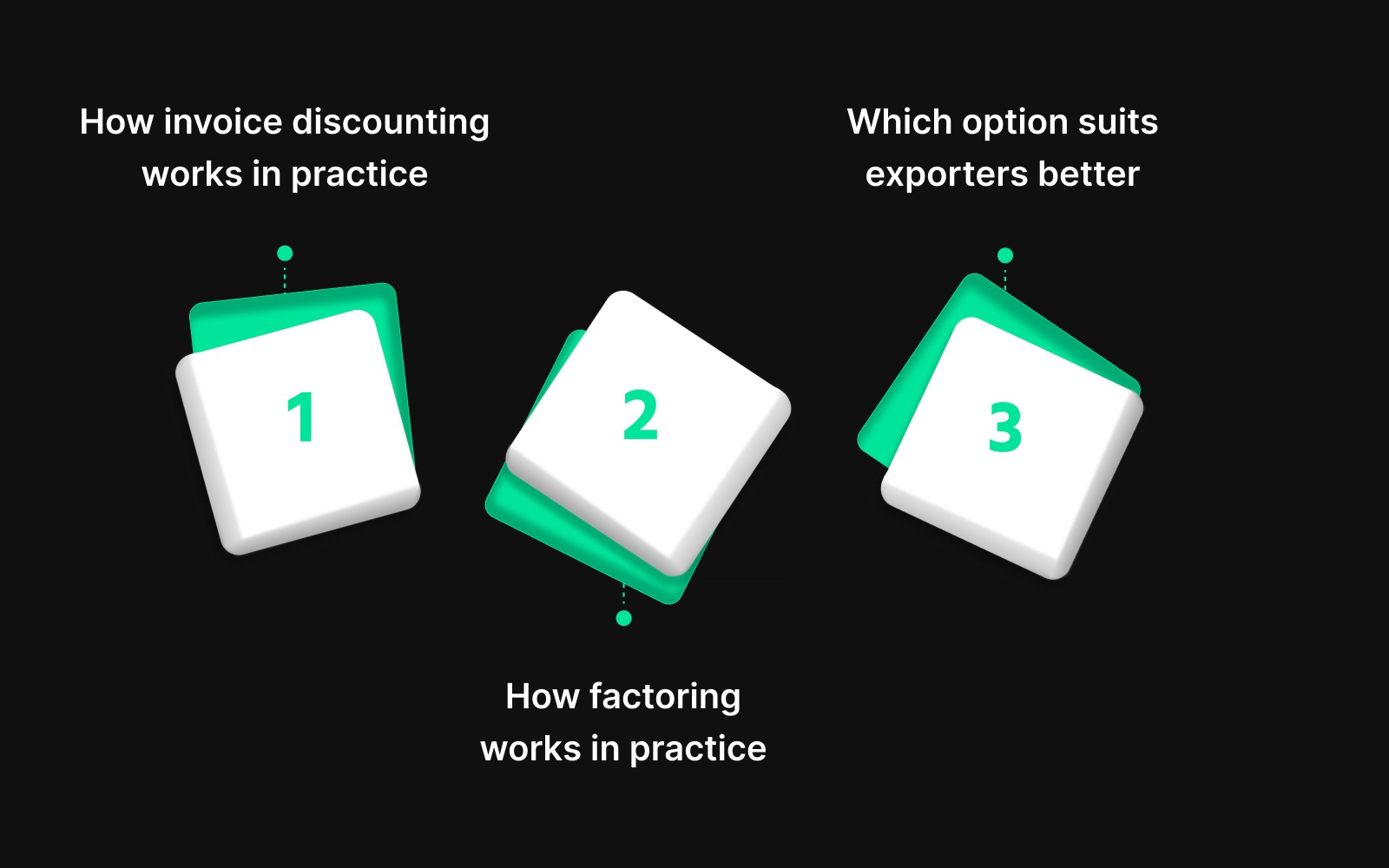
Invoice discounting and factoring are often compared because both unlock cash from receivables. The difference lies in control and visibility.
How Invoice Discounting Works in Practice
With invoice discounting, you stay in charge of your customer relationship.
Key points:
- You raise the invoice and manage collections
- Your buyer usually does not deal with the financier
- Payments follow the original agreed timeline
- You decide how communication with buyers is handled
This suits exporters who want to keep full control over buyers and pricing discussions.
How Factoring Works in Practice
Factoring changes who manages collections.
Key points:
- The financier purchases your invoices
- They may contact your buyer directly for payment
- Buyer visibility is usually higher
- Collections and follow-ups are often outsourced
This can reduce internal effort but may affect how buyers perceive your business.
Side-by-Side Comparison for Decision-Makers
Which Option Suits Exporters Better
Invoice discounting often fits exporters who:
- Have established buyers
- Want to protect long-term customer relationships
- Prefer predictable, repeatable cash flow processes
Factoring may suit exporters who:
- Want to reduce collection effort
- Are you comfortable with third-party buyer interaction
Understanding this difference helps you choose a solution that supports growth without disrupting buyer trust.
Common Exporter Use Cases for Invoice Discounting
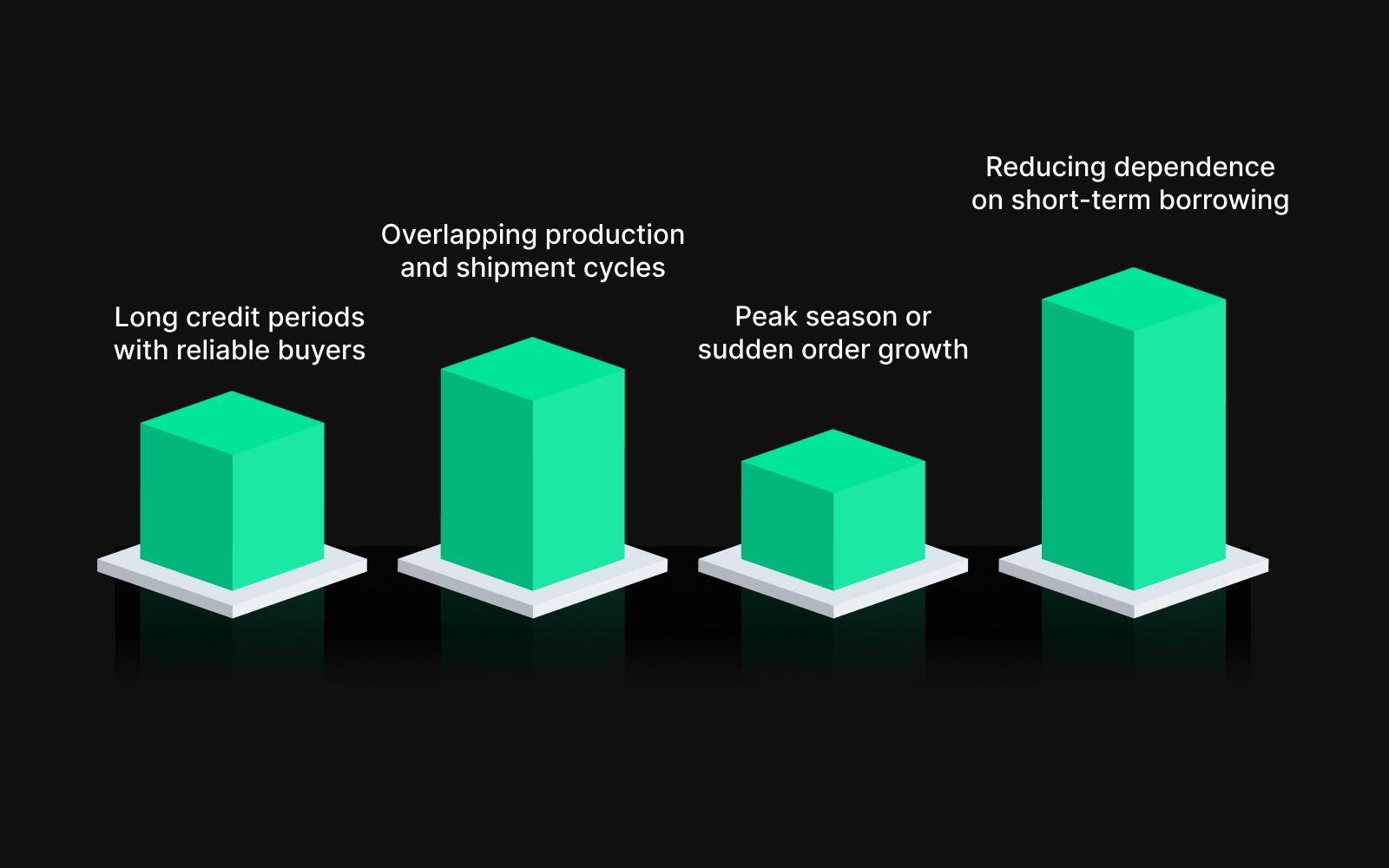
Invoice discounting is not for every situation. It is most effective when it matches how your export business operates.
1. Long Credit Periods With Reliable Buyers
Many exporters work on 60 to 90-day payment terms. Even when buyers pay on time, the waiting period can strain cash flow.
Invoice discounting helps you:
- Access funds during the waiting period
- Keep operations running without pauses
2. Overlapping Production and Shipment Cycles
Exporters often start the next order before payment from the previous one arrives.
This creates overlap in:
- Raw material purchases
- Production costs
- Freight and logistics payments
Early access to invoice value supports smoother cycle management.
3. Peak Season or Sudden Order Growth
During peak export seasons, order volume rises faster than cash inflows.
Invoice discounting can help you:
- Accept larger orders
- Manage higher freight and container costs
- Avoid rejecting orders due to short-term cash gaps
4. Reducing Dependence on Short-Term Borrowing
Some exporters rely on temporary borrowing to cover working capital gaps. This adds complexity and frequent follow-ups.
Invoice discounting offers an alternative by using:
- Existing receivables
- Confirmed export orders
This aligns funding more closely with actual business activity.
Also Read: Tracking and Measuring Supply Chain Performance Metrics
Costs and Trade-Offs You Should Evaluate

Invoice discounting improves cash timing, but it is not free. Understanding the cost structure helps you decide if it fits your margins and operating model.
What Typically Influences the Cost
Pricing varies across providers, but it usually depends on:
- Length of the credit period on your invoice
- Buyer credit profile and payment history
- Invoice value and frequency
- Currency involved in the transaction
Longer payment terms and higher risk generally increase costs.
How Costs Affect Your Export Margins
The fee reduces the net amount you finally receive. This means:
- Your gross margin stays the same
- Your net realised margin may reduce slightly
For many exporters, this trade-off is acceptable because early cash supports smoother operations and order continuity.
Operational Trade-Offs to Be Aware of
Invoice discounting also requires process discipline.
You need to:
- Raise accurate invoices
- Maintain consistency across shipment and invoice data
- Track due dates and settlements carefully
If internal records are weak, approvals can slow down or disputes can arise.
Questions Worth Asking Before Choosing a Provider
Before committing, it helps to clarify:
- How fees are calculated and when they apply
- What happens in the case of delayed buyer payments
- How disputes or short payments are handled
- What documentation is mandatory for approval
Clear answers reduce surprises later.
Also Read: Understanding Differences and Costs in Shipping and Handling
Risks Exporters Should Plan for and How to Reduce Them

Invoice discounting works best when risks are identified early and managed through simple controls.
Risk 1: Invoice Disputes and Short Payments
If your buyer raises a dispute or pays less than expected, settlement can be delayed.
You can reduce this risk by:
- Ensuring invoice quantities and values match shipment records
- Keeping buyer-specific terms clearly documented
- Sharing invoice details promptly after shipment
Risk 2: Document Mismatches
Differences between invoices, packing lists, and shipment details can slow approvals or settlements.
Common causes include:
- Manual data entry across multiple systems
- Late updates to shipment changes
Using a single source of order data helps reduce these gaps. Some exporters rely on export operations platforms such as Pazago to keep order, shipment, and invoice details aligned, which can reduce avoidable delays.
Risk 3: Poor Visibility on Payment Timelines
When multiple invoices and buyers are active, it becomes harder to track what is due and when.
Simple controls help:
- Maintain clear due dates for each invoice
- Set reminders for expected payments
- Reconcile receipts regularly
Risk 4: Dependency Without Planning
Invoice discounting works best as part of a planned cash flow strategy, not as a last-minute fix.
You reduce risk when you:
- Use it selectively for predictable buyers
- Align it with your export cycle, not every transaction
- Review its impact on margins periodically
Managing these risks keeps invoice discounting supportive, not disruptive, to your export business.
What You Need Before Applying for Invoice Discounting (Exporter Readiness Checklist)

Invoice discounting works smoothly when basic inputs are ready. Preparing these in advance reduces delays and follow-ups.
Invoice Readiness
Before applying, ensure that:
- Invoice values, quantities, and payment terms are clearly stated
- Buyer name and address match contractual records
- The credit period is clearly mentioned
Clean invoices are easier to assess and approve.
Buyer Clarity
Providers usually look at buyer reliability. You should be able to share:
- Buyer details and country
- Agreed payment terms
- Past payment behaviour, if available
This helps reduce approval time and unexpected queries.
Shipment Status Visibility
Your invoice should align with the shipment reality. Keep clarity on:
- Shipment date
- Mode of transport
- Container or shipment reference, where applicable
A mismatch between invoice and shipment details often causes delays.
Internal Ownership
Decide who manages:
- Invoice submission
- Follow-ups and reconciliations
- Communication across finance and operations
Clear ownership avoids confusion when multiple invoices are active.
Record-Keeping Discipline
Consistent records make a difference over time.
Many exporters use a central system to store order data, shipment milestones, and invoices together.
Also Read: 10 Required Pre-Shipment Documents for Export Procedure and Shipping Process
Practical Workflow: How to Run Invoice Discounting Inside Your Export Process
Invoice discounting delivers the most value when it fits naturally into how your export operations already work.
Where it Fits in the Export Timeline
A simple way to place it in your workflow:
- Order confirmation and production planning
- Shipment execution and logistics coordination
- Invoice generation after shipment
- Invoice discounting submission
- Buyer payment and settlement
This keeps financing aligned with actual business activity.
Who Owns What Internally
A clear role definition helps avoid delays. Typical ownership looks like:
- Operations: Shipment status and logistics updates
- Documentation: Invoice and export documents
- Finance: Discounting, settlements, and reconciliation
- Management: Oversight of cash flow and limits
When teams share the same data, coordination improves.
Why Visibility Matters for Consistency
Problems often arise when information is scattered across emails and spreadsheets.
A single operational view helps you:
- Track invoice due dates
- Monitor shipment progress
- Plan cash inflows more accurately
Some exporters use platforms like Pazago to connect orders, logistics dates, invoices, and payment stages. This supports smoother coordination and can help reduce turnaround time across export cycles.
Using Invoice Discounting as a Planned Tool
Invoice discounting works best when used intentionally.
You get better results when you:
- Apply it to predictable buyers
- Review its impact on margins periodically
- Integrate it into regular cash planning
This turns invoice discounting into a support mechanism, not a short-term fix.
To ensure this process runs smoothly, the physical movement of your goods must be as reliable as your financial planning. Even with early access to cash, operational delays or unmanaged shipping costs can quickly derail your export cycle. This is why pairing a smart cash flow strategy with expert logistics management is essential for long-term growth.
Pazago: Helping Exporters Run Smooth International Operations
Pazago supports exporters with competitive freight rates, confirmed container bookings, and coordinated loading to reduce delays.
- Competitive Freight Rates: Access stable, competitive rates through deep shipping line relationships. This helps protect margins and allows for predictable buyer pricing even during market fluctuations.
- Assured Container Bookings: Confirmed bookings and seamless loading coordination at the factory or port minimize the risk of rollovers and scheduling hassles.
- Daily DSRs for Total Visibility: Daily Status Reports (DSRs) provide updates on vessel ETD/ETA and transit movements, ensuring buyers stay informed and operations remain transparent.
- Support for All Exporter Sizes: From first-time LCL shipments to large-scale enterprise logistics, every exporter receives transparent pricing and focused service.
Conclusion
Invoice discounting improves cash timing for exporters working on credit terms. It helps align working capital with production and shipment cycles without changing buyer agreements.
Pazago supports exporters by aligning freight execution, container movement, and shipment visibility with financial planning, helping reduce operational delays that affect cash flow.
Contact Pazago to discuss how structured freight coordination can support your export shipments.
FAQs
1. What is invoice discounting in simple words?
Invoice discounting lets you receive part of your invoice value early instead of waiting for the buyer’s payment date.
2. Is invoice discounting a loan?
No. It is linked to your receivables. You are accessing funds against invoices you have already raised.
3. Do buyers know about invoice discounting?
In most invoice discounting arrangements, buyers continue to pay you as usual and are not directly involved.
4. Is invoice discounting suitable for exporters with 60–90 day terms?
Yes. It is commonly used when payment cycles are long, but buyers are reliable.
5. What is the difference between invoice discounting and export bill discounting?
Invoice discounting is based on invoices and receivables. Export bill discounting is tied more closely to shipment documents and bank-led trade processes.
6. How is invoice discounting different from factoring?
With invoice discounting, you manage buyer communication. In factoring, collections are often handled by the financier.
7. What causes delays in invoice discounting approvals?
Common reasons include invoice errors, document mismatches, and unclear shipment or payment details.