.png)


10 Top Export Logistics Partners in Navi Mumbai

Optimize your business: use unlimited savings with Pazago fulfilled now!
Get Started ->For an Indian exporter, getting goods to international buyers on time is a matter of business survival. As any seasoned exporter knows, the road to timely, cost-effective deliveries is full of potholes: Volatile freight rates, documentation errors, and delays at ports like Navi Mumbai’s Nhava Sheva.
It might happen that you already promised your buyer delivery by a specific date. Yet, just days before the goods are due to leave, you’re told there’s a paperwork issue that risks a customs hold. Suddenly, your timeline is at risk, and with it, your reputation.
This is where the right export logistics partner can make all the difference. In a busy export hub like Navi Mumbai, it’s crucial to know who to rely on, how to manage risks, and what to do to prevent delays that could cost you more than just money.
Key Takeaways
- Exporters should prioritise predictability and coordination, not just freight price.
- Documentation support prevents more delays than faster shipping routes.
- Visibility during transit matters for buyer communication and dispute prevention.
- Peak season readiness is a strong indicator of a dependable logistics partner.
- A good partner helps exporters act early, not react late.
Why Navi Mumbai Exporters Need Specialised Export Logistics Support
Navi Mumbai, with its bustling port at Nhava Sheva, is one of the busiest gateways for Indian exports. But with this hub of activity comes a series of unique challenges that every exporter must understand.
From textiles to engineering goods and perishables, the logistics decisions you make in Navi Mumbai directly impact buyer relationships and long-term success.
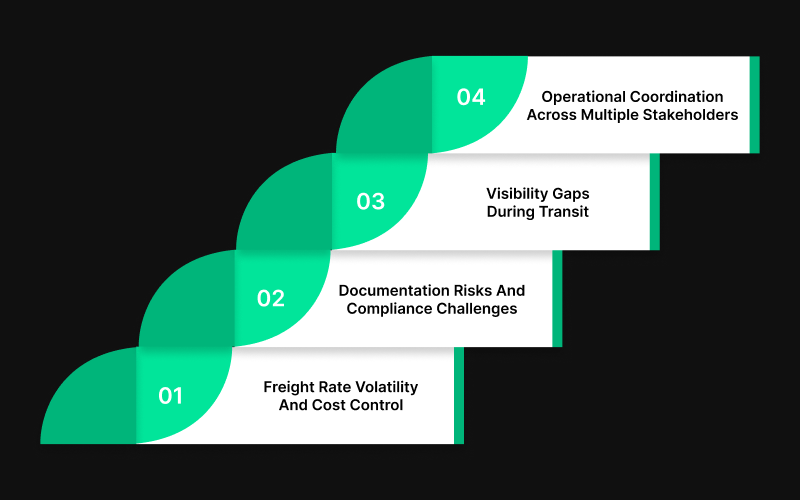
1. Freight Rate Volatility and Cost Control
Exporting textiles, engineering goods, or perishables from Navi Mumbai requires careful logistics planning. The decisions you make directly affect your bottom line, buyer relationships, and long-term success. This unpredictability can impact profit margins, making it difficult for exporters to offer competitive pricing while ensuring timely delivery.
2. Documentation Risks and Compliance Challenges
A missing signature or incorrect HS code could result in shipment holds, delays at customs, or even fines. Many exporters underestimate the complexity of compliance, leaving themselves vulnerable to errors that disrupt their entire shipment process.
Given the complexities of Indian export regulations and destination country requirements, it's crucial to have a logistics partner who can guide you through the paperwork maze.
3. Visibility Gaps During Transit
Once your goods are in transit, you often have little visibility into their exact location or the status of the journey. In an ideal world, you’d always know where your cargo is and if any delays are expected.
But in reality, exporters are often left in the dark, unable to provide their buyers with updates, which can lead to frustration and damaged relationships. Without reliable visibility tools, you can’t accurately take proactive steps to address any disruptions.
4. Operational Coordination Across Multiple Stakeholders
Managing a shipment is rarely a simple, single-phase process. It involves coordination across multiple parties, factories, Container Freight Stations (CFSs), ports, and shipping lines. The lack of an integrated operational strategy can lead to inefficiencies, missed timelines, and an overall lack of control.
With numerous logistics companies available, it's essential to identify partners who specialise in solving specific problems for exporters.
Also Read: LCL Shipping: Definition, Usage, and Cost
Top 10 Logistics Companies in Navi Mumbai for Exporters
With high stakes such as cost control, meeting buyer timelines, and ensuring smooth transit, exporters need a strategic ally. Below are the top 10 logistics companies in Navi Mumbai that specialise in addressing the unique challenges faced by Indian exporters. These companies are selected based on operational capabilities, export expertise, port proximity, and industry presence:
1. Pazago
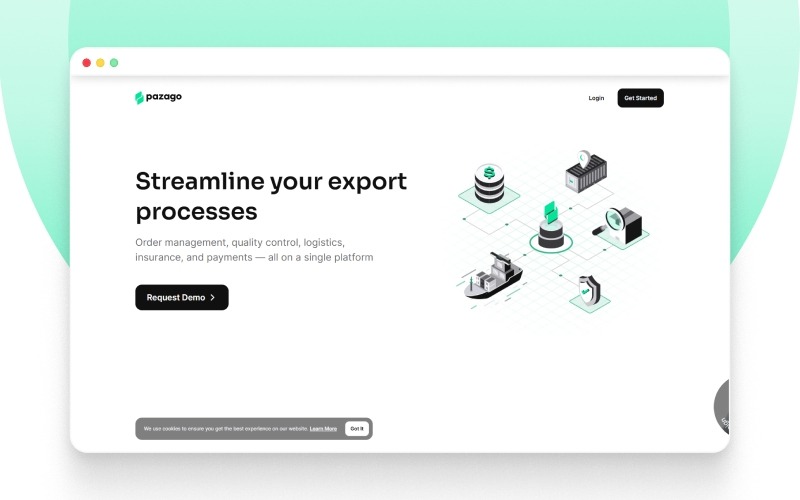
Pazago addresses the most pressing challenges for exporters, such as freight rate volatility, documentation errors, and shipment delays. By offering stable pricing and detailed shipment tracking, Pazago ensures that Indian exporters can meet delivery timelines.
Key Strengths:
- Pazago uses long-term relationships with major shipping lines to offer stable and predictable rates, which are critical in reducing margin pressure.
- It ensures accurate export documentation, from HS codes to bill of lading (BL) processes, avoiding delays or penalties at customs.
- Pazago provides exporters with real-time shipment updates via Daily Status Reports (DSRs), giving exporters complete visibility throughout the shipment journey.
2. Allcargo Logistics
Exporters with inconsistent order quantities often end up booking full containers just to meet dispatch timelines. This silently reduces margins across shipments. Consolidation specialists help exporters ship smaller volumes without paying the unused container cost.
Key strengths
- Scheduled Less than Container Load (LCL) consolidation departures
- Cost sharing across consolidated cargo
- Direct CFS handling aligned to consolidation cut-offs
3. Jeena & Company
Best Logistics Company in Mumbai, India - Jeena & Company
When cargo categories require specific classification or paperwork, even small documentation mistakes trigger customs queries. Exporters usually discover this only after cargo reaches port, risking missed sailings. Compliance-focused partners reduce this risk before dispatch.
Key strengths
- Commodity-specific classification support
- Regulatory documentation verification
- Destination requirement guidance
4. J M Baxi & Co
Exporters often assume that a confirmed booking guarantees loading, but port cut-offs and terminal coordination frequently disrupt plans. Delays happen at the terminal stage, not during transit. Strong port-side coordination reduces rollover risk.
Key strengths
- Terminal coordination within port operations
- Faster resolution of port exceptions
- Alignment with vessel loading schedules
5. Seaways Shipping & Logistics Ltd
Shipping logistics | Sea ship logistics | Seaways group
Exporters often discover vessel delays only after cargo reaches port because they depend entirely on forwarder updates. Companies closely connected to port and vessel operations help exporters anticipate schedule shifts earlier and adjust dispatch timing.
Key strengths
- Strong operational presence around the JNPT port movement
- Vessel schedule monitoring and coordination
- Support for bulk and break-bulk export cargo
6. Goodrich Maritime Pvt Ltd
Goodrich Maritime | Leading Global Logistics and Shipping Services
Many exporters depend on whichever carrier their forwarder suggests, without knowing alternate routing options. During congestion or skipped sailings, shipments get pushed to the next week. Liner agencies and Non-Vessel Operating Common Carrier (NVOCC) operators expand routing options and reduce dependence on a single carrier schedule.
Key strengths
- Liner agency representation and carrier access
- Alternate routing options across trade lanes
- Space allocation support during tight capacity
7. DHL Global Forwarding India
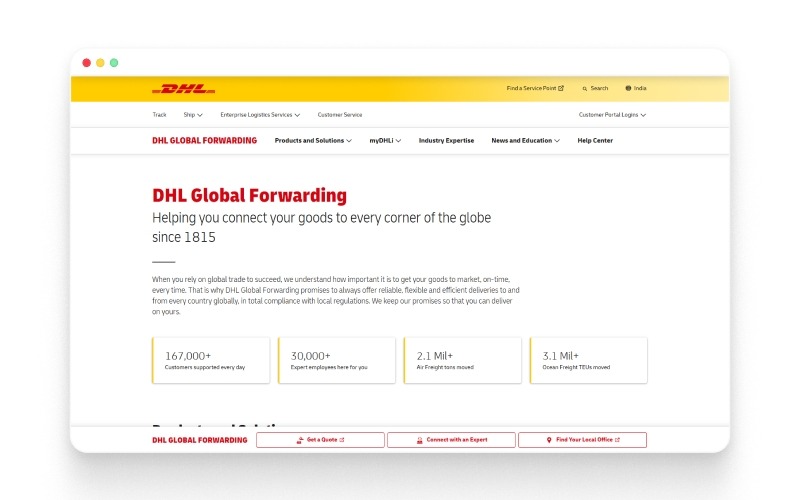
DHL Global Forwarding - Global Air, Ocean, Road and Rail Freight Forwarder - India
Large or regulated shipments often face destination documentation queries after cargo reaches port. Exporters discover requirements late and miss sailings. Forwarders experienced in international compliance preparation reduce this pre-departure risk.
Key strengths
- Destination documentation coordination
- Handling of specialised and regulated cargo
- Structured shipment planning workflows
8. Safexpress
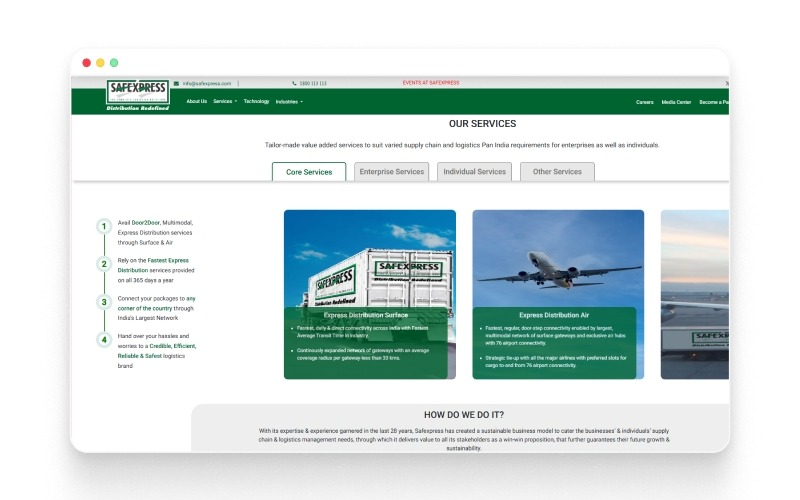
Safexpress - The Best Logistics Company in India
Many exporters plan dispatch based on production completion instead of the port cut-off time. The cargo leaves the factory on schedule but reaches the terminal after the gate closes, so the container rolls to the next vessel.
Even a one-day delay at this stage can shift delivery by a week and force exporters to renegotiate buyer timelines. Reliable inland transport aligned with vessel schedules helps exporters dispatch cargo according to the port timeline rather than factory readiness.
Key strengths
- Time-defined inland transport
- Pickup aligned to vessel schedules
- Nationwide cargo collection network
9. Transworld Shipping Lines Limited
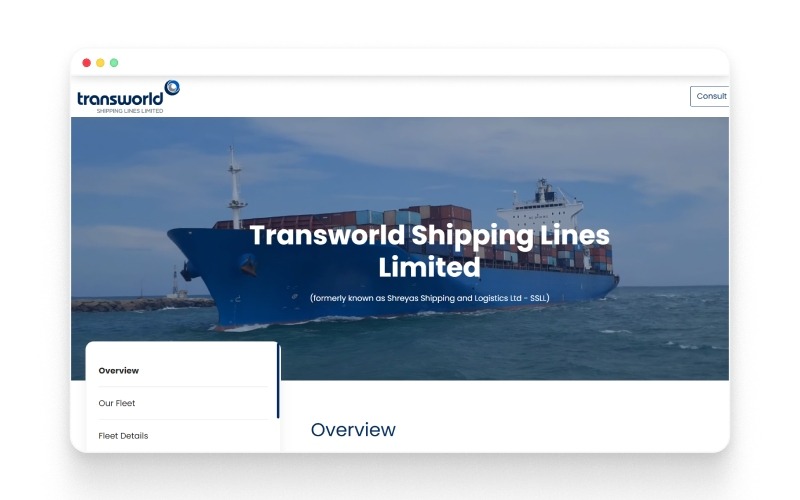
Transworld Shipping Lines Limited - Leading Ship Owner in India
Exporters planning delivery dates often consider only the main vessel but not the feeder leg. Missing the feeder connection delays the shipment before it even leaves India. Reliable feeder operators improve schedule predictability.
Key strengths
- Coastal feeder connectivity to mainline vessels
- Predictable port connection schedules
- Multi-port linkage within India
10. TCI Supply Chain Solutions
Supply Chain Solutions and Logistics Services India - TCISCS
Cargo frequently reaches port too early or too late due to production variation. Without staging and dispatch planning, exporters either pay storage or miss cut-offs. Pre-export warehousing allows timing control.
Key strengths
- Export staging warehousing
- Batch dispatch planning
- Vendor coordination before stuffing
However, a long list of potential partners presents its own challenge: How do you choose the right one? For exporters, developing a clear framework to assess logistics providers is essential.
Also Read: How Logistics Operations and Supply Chain Work
How Exporters Should Evaluate Navi Mumbai Logistics Partners
Finding the cheapest logistics provider is easy. Finding one that actually solves your problems as an exporter? That takes insight. In a hub like Navi Mumbai, the right partner protects your reputation.
Here's what to ask during the onboarding of companies to ensure they deliver on those fronts:
1. Freight Rate Predictability
- Do you offer fixed rates or are the charges variable based on market conditions?
- Can you provide long-term pricing agreements or quarterly rate locks?
2. Documentation Accuracy Support
- How do you ensure accuracy in the documentation process?
- Do you provide support with customs forms, HS codes, and other export paperwork?
3. Visibility & Reporting
- Do you offer real-time tracking of shipments?
- Can you provide regular status reports (e.g., Daily Status Reports or DSRs) throughout the shipment process?
4. Customs Clearance Expertise
- What experience do you have with customs clearance at JNPT and other major ports?
- Can you assist with pre-clearance documentation and regulatory compliance?
5. Handling Peak/Seasonal Container Availability
- How do you handle container availability during peak seasons?
- Do you offer any assurances or agreements for guaranteed container bookings during busy periods?
Also Read: Understanding How A Logistic System Works And Its Main Components
Conclusion
Export logistics is less about who can move cargo and more about who helps you avoid surprises. When evaluating companies, focus on operational clarity instead of brand size. The right partner is the one who helps you commit to timelines with confidence and respond quickly when plans change.
A reliable logistics partner, such as Pazago, helps you predict costs before quoting buyers and stay informed after the vessel sails. We help Indian exporters make shipping predictable with clear cost visibility, coordinated loading, and continuous shipment updates.
To ensure smooth and timely deliveries, talk to the expert team at Pazago for expert support in choosing the right logistics partner.
FAQs
1. Should exporters choose a logistics company near the port for faster shipment handling?
Proximity helps only for the physical movement of containers. Most delays happen due to documentation errors, missed cut-offs, or booking rollovers. A partner with process control and communication discipline matters more than office location.
2. Is it better to work with multiple logistics partners or one dedicated partner?
Many exporters try multiple partners to compare rates, but this often creates coordination confusion. A primary partner who understands your cargo cycles and buyer timelines usually reduces operational friction and prevents repeated onboarding errors.
3. How early should exporters start planning shipments before ETD?
Planning ideally starts at purchase order confirmation, not cargo readiness. Container booking, compliance checks, and schedule buffers should be aligned before production completion to avoid last-minute rollovers.
4. What causes shipments to miss vessels even after confirmed booking?
Common reasons include late stuffing, documentation mismatch, or revised port cut-off timings. Many exporters assume booking confirmation equals loading confirmation, which is not always true.
5. How can exporters reduce buyer disputes related to shipment delays?
Regular status communication with accurate updates helps more than faster transit time. Buyers usually accept delays if informed early. Problems escalate when exporters themselves receive late updates from their logistics partners.